BIS Certification for Toasters, Grills, Roasters, and Similar Appliances IS 302 Part-2
Category: BIS Certification
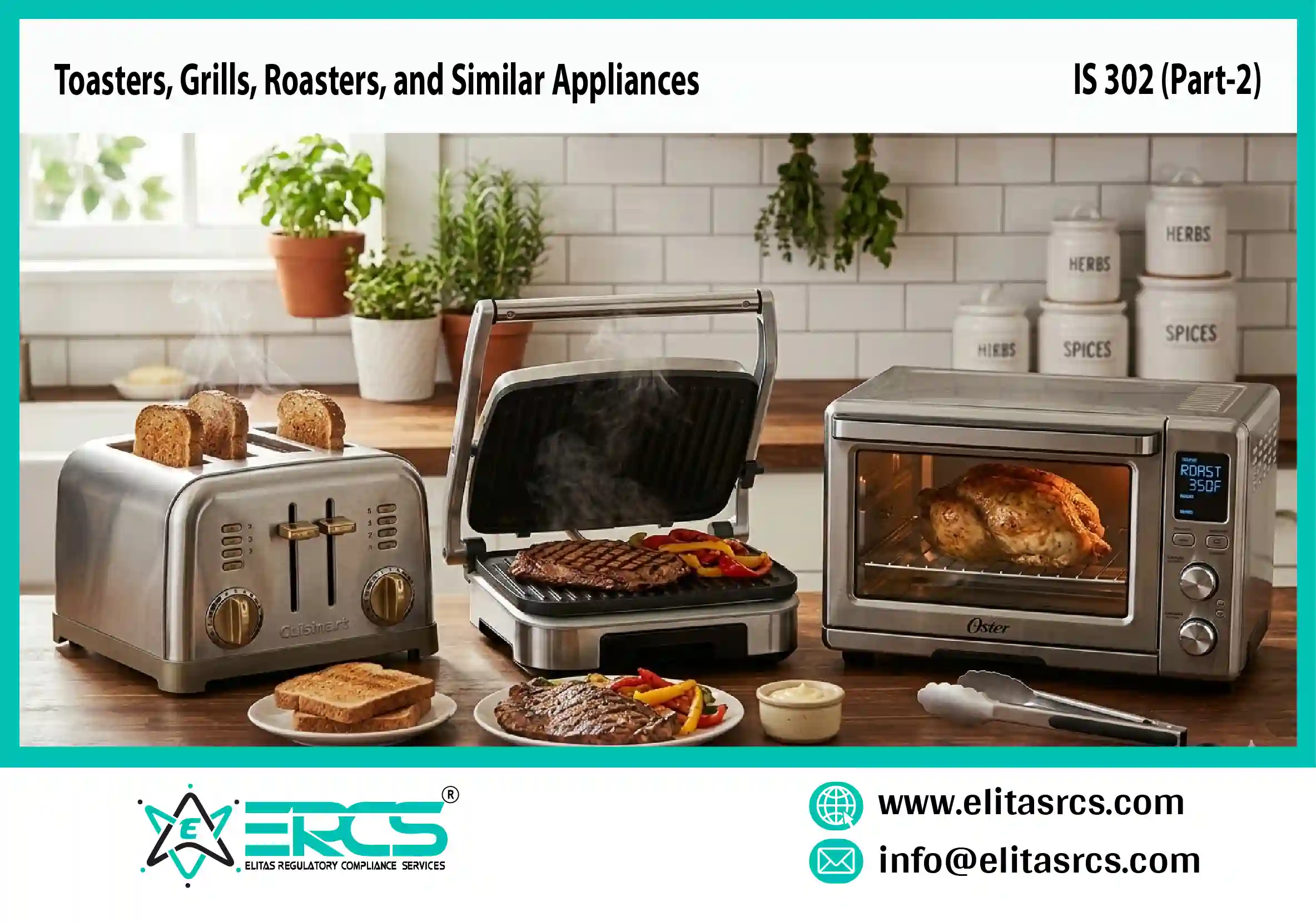
Electric kitchen appliances, such as toasters and grills, are portable devices that use electricity to cook food through electric heat sources or elements. Each of these devices typically operates at a voltage of 220V-240V (forced into a range), and has features like thermostats, timers, or other automatic features (e.g., shut-off), and indicator lights for ease of use and safety. This product must comply with IS 302 (Part 2/Section 9), which establishes safety standards.
The Bureau of Indian Standards (BIS) requires BIS Certification to evaluate the safety and quality standards of Toaster Grills and Roasters, which must comply with Indian standards. This certification allows manufacturers to use the ISI Mark. For businesses, it is more than just complying with the rules. It is about building trust and increasing brand acceptability in the market.
Overview of Toasters, Grills, Roasters, and Similar Appliances Certification under BIS
Toasters, grills, and roasters (including OTGs) must obtain mandatory BIS certification as per the BIS Guideline. According to IS 302 Part 2, the regulation protects users from electric shock, fire hazards, and overheating threats, which apply to both residential and industrial equipment. All testing for structural, thermal, and electrical safety needs to be completed before companies can apply for the required ISI Mark.
Key Highlights for IS 302 (Part 2/Sec 9)
The primary requirement for ISI Mark certification of toasters, grills, roasters, and similar appliances under the Indian Standard specifies their main requirements.
- Scope & Applicability: Electric toasters, grills (including sandwich makers/grillers), roasters, and similar cooking/heating devices intended for household or commercial use.
- Safety Requirements: Protects against electric shock, excessive temperature, fire, and mechanical dangers.
- Construction: Requires builders to use permanent protective materials that stop people from touching live electrical components.
- Moisture Resistance: Requires new testing standards, including additional humidity testing and new rinsing agents for evaluation.
- Components: The system enforces strict regulations that control the performance of UV lamps, high-voltage grids, and electrical insulation materials.
- Abnormal Operation: The system restricts the accessible safety extra-low-voltage output voltage to specific limits, protecting against abnormal operational conditions.
Benefits of BIS Certification for Toasters, Grills, Roasters, and Similar Appliances
BIS certification under IS 302-2-9 is mandatory and guarantees that products meet Indian safety standards and the quality requirements. The main advantages of this Certification include legal authorization to sell products, increased customer confidence, reduced risk of electrical and fire hazards, and a competitive edge through ISI mark certification.
- Enhanced Consumer Safety: The certification process requires multiple tests, which assess their ability to prevent electric shock and fire hazards, thereby establishing their safety for home, office, and restaurant use.
- Boosts Credibility and Trust: The ISI mark serves as a stamp of quality and reliability, which increases customer confidence and brand reputation.
- Improved Market Access and Competitiveness: Manufacturers with BIS certification can legally sell their products in the Indian market, giving them a competitive advantage over non-certified products.
- Quality Assurance: The Scheme verifies that products undergo design and testing in accordance with Indian Standard Specifications (ISS), ensuring their performance remains consistent.
- Reduced Risk of Penalties: Compliance prevents product seizures, which can lead to heavy fines and bans imposed by regulatory authorities.
Documents required for Obtaining ISI Mark on IS 302 (Part 2/Sec 9)
The list of important documents required for obtaining the BIS Certification on Toasters, Grills, Roasters, and Similar appliances is as follows:
- Duly Filled BIS Application Form
- Company Registration Certificate
- Factory Address Proof
- Product Technical Specification Sheet
- Manufacturing Process Flow Chart
- Factory Layout Plan
- List of Manufacturing Machinery and Equipment
- Details of In-House Testing Equipment
- Quality Control and Inspection Plan
- Product Test Report from a BIS-Recognized Laboratory
- Raw Material and Component Details
- Trademark Registration Certificate
- Authorization Letter and ID Proof
- Product Label and Packaging Artwork
Applicable Test Parameters for Toasters, Grills, Roasters, and Similar Appliances
The Key testing parameters for obtaining BIS Certification on IS 302 (Part 2/Sec 9):
- Protection against electric shock: Assessing accessibility of live parts and insulation resistance.
- Input power and current: Ensuring the appliance operates within specified wattage (e.g., 750W for some toasters).
- Heating element efficiency: Verifying the consistency of browning and heating performance.
- Temperature control: Testing thermal cut-off for overheating protection and fire hazards.
- Browning control setting: Testing bread toast quality at various settings (medium, maximum).
- Operational consistency: Ensuring uniform heating and browning across the heating element.
Process of BIS Certification of IS 302 (Part 2/Sec 9)
The following are the steps for obtaining the BIS certification for your product:
- Application for Registration: To apply for a license to manufacture your product, the manufacturer must first register on the BIS Portal. The application will require submitting additional documentation after registration.
- Prepare Required Documentation: The required documentation to be submitted includes, but is not limited to, Factory Licensing and Quality Control Certificates.
- Conduct Laboratory Testing: The manufacturer must provide product samples to an accredited BIS laboratory for chemical testing of the product's components.
- Conduct a Factory Inspection: BIS Officers will conduct a comprehensive inspection of all aspects of manufacturing processes, quality control procedures, and the factory's general layout.
- Granting of License: Upon completion of inspections and laboratory testing, BIS will grant the manufacturer a license to apply the "Standard Mark" to the product.
Both Foreign and Indian Manufacturers must follow these procedures to obtain BIS Certification:
- BIS Certification India - Indian Manufacturers
- BIS FMCS Certification - Foreign Manufacturers
BIS Certification Fees in India for Toasters, Grills, Roasters, and Similar Appliances
Go through the table to know the cost of BIS Certification India for IS 302 (Part 2/Sec 9):
|
S No. |
Particular |
Amount (INR) |
Remarks |
|
1. |
Application Fee |
1000 |
To be paid directly to BIS |
|
2. |
Audit Fee |
7000 |
To be paid directly to BIS |
|
3. |
License Fee |
1000 |
To be paid directly to BIS |
|
4. |
Sample Testing Fee |
As Applicable |
To be paid directly to BIS (Testing charges vary from product to product and lab to lab.) |
|
5. |
Minimum Advance Marking Fee |
As per the actual |
To be paid directly to BIS (Marking fee varies as per Indian Standard) |
|
6. |
Renewal Fee |
1000 |
To be paid directly to BIS |
|
7. |
Inclusion Fee |
5000 |
To be paid directly to BIS |
|
8. |
ERCS Pvt Ltd Service Fee |
Please contact info@elitasrcs.com |
|
|
Remarks |
Including all the taxes |
||
Why Choose ERCS Private Limited for BIS Certification of IS 302 (Part 2/Sec 9)?
ERCS Private Limited is a top choice for BIS Certification of IS 302 (Part 2/Sec 9) because they offer expert, end-to-end guidance to navigate complex safety regulations for products like toasters, grills, and roasters. They provide fast processing, in-depth knowledge of BIS standards, and ongoing support to ensure compliance.
- In-Depth Knowledge: ERCS provides expert guidance on specific Indian Standard Specifications (ISS) for household electrical appliances.
- Fast & Efficient Processing: They expedite the certification process, reducing delays and ensuring timely approval.
- End-to-End Support: ERCS assists through every step, including documentation, testing, and interaction with the Bureau of Indian Standards (BIS).
- Compliance Assurance: They ensure that products meet all necessary safety and quality standards (IS 302 Part 2/Sec 9), which helps with market access and regulatory compliance.
- Ongoing Assistance: After certification, they help maintain compliance through updates and audits.