BIS (ISI) Certification for Foreign Manufacturers
Broaden your reach internationally with FMCS Certification, your path into the Indian market; Conform to Indian Standards with accuracy; let the ISI Mark be your mark of excellence; Build trust between nations, letting compliance be your key to success; Enter the Indian market with your products, guided by ERCS into certification.
Every country has its own import laws and guidelines. This helps in maintaining market assurance and confidence. Similarly, the Indian government offers several certifications to ensure imported products are safe and reliable. Foreign manufacturers seeking to export products to India must obtain BIS (ISI) certification under the Foreign Manufacturers Certification Scheme (FMCS). The Bureau of Indian Standards (BIS) issues this licence to foreign manufacturing units whose products meet the relevant Indian standards.
Through FMCS, foreign manufacturers can obtain a licence to use the ISI Standard Mark on their products. For products requiring mandatory BIS certification, manufacturers must obtain a licence before importing, distributing, or selling in India.
What is BIS FMCS certification?
The Foreign Manufacturers Certification Scheme, or FMCS, was developed by the Bureau of Indian Standards and has been in effect since 2000, in accordance with Scheme-I of Schedule-II of the BIS Act, 2016, and the BIS (Conformity Assessment) Regulations, 2018. Under this scheme, the Bureau of Indian Standards issues a licence to foreign manufacturers to use the ISI mark on products that conform to the Indian Standard.
FMCS certification helps foreign manufacturers demonstrate that their products meet Indian quality and safety requirements. It is mandatory for products covered by QCOs, and foreign manufacturers must hold an FMCS licence to continue exporting and selling the product in the Indian market.
BIS Standard Mark / ISI Mark for FMCD
The Bureau of Indian Standards developed the Foreign Manufacturers Certification Scheme (FMCS), which has been in effect since 2000 under Scheme-I of Schedule-II of the BIS Act, 2016, and the BIS (Conformity Assessment) Regulations, 2018. Under this scheme, BIS issues a licence to foreign manufacturers to use the ISI Mark on products that conform to the Indian Standard.
- QCO-covered products require this, and foreign manufacturers must hold an FMCS licence to continue exporting and selling the product in the Indian market.
- The MTC (Mill Test Certificate) should include three key details: the ISI Mark (BIS Standard Mark) logo, the CM/L licence number (e.g., CM/L-XXXXXXXXXX), and the applicable Indian Standard (IS) number No specific MTC format is prescribed by BIS..
Who needs FMCS certification?
Foreign companies planning to export products to India must obtain the required certification from the Bureau of Indian Standards (BIS) and meet the applicable requirements. ERCS Private Limited helps manufacturers worldwide obtain BIS FMCS certification.
Eligibility and requirements:
| Requirement | Details |
|---|---|
| Manufacturing Location | The manufacturing unit must be located outside India. |
| Standard Compliance | All products must conform to the requirements of the applicable Indian Standard specification. |
| Factory Inspection and Logistics | The applicants must confirm readiness for the BIS factory inspection and complete the necessary formalities, including arranging an English interpreter and local transport in the foreign country for the BIS officer. |
| Premises and Infrastructure | All manufacturing machinery and testing facilities required under the applicable Indian Standard must be available at the factory premises. |
| Scheme of Testing and Inspection (STI) | The applicant must accept the STI and pay the annual marking fee. |
| Quality Control | QC personnel must be technically qualified and capable of performing the tests required by the applicable Indian Standard. |
| Sample Handling | Applicants are responsible for the timely, safe delivery of the sample sealed by the BIS officer to the designated laboratory, and for paying the applicable testing charges. |
| Currency of Payments | BIS payments must be made in the equivalent amount in US dollars. Applicants from SAARC countries (Afghanistan, Bangladesh, Bhutan, Nepal, the Maldives, Pakistan and Sri Lanka) may pay either in Indian rupees, including GST where applicable, or in US dollars. |
| Authorised Indian Representative (AIR) | Foreign applicants or manufacturers must nominate an AIR in Form VI. |
| Performance Bank Guarantee (PBG) | A PBG of USD 10,000 is required immediately after the licence is granted. An RBI-approved bank with a branch in India must issue it. |
| Application Rule | A separate application must be submitted for each product, Indian Standard and factory address. |
| Submission Mode | New FMCS applications are filed through the Manakonline portal from 1st June 2026. |
Documents required for FMCS certification
The following is the list of required documents for FMCS:
Company and factory documents
- Factory or company registration and address proof
- Authorisation letter for the application signatory
- Factory layout, installed production capacity, and manufacturing capability details
- Details of in-house testing facilities and equipment
- Details of existing or previously cancelled BIS licences, if any
Product and technical documents
- Product description, models, grades and photographs
- Product drawings and technical specifications
- Raw material and component details with test certificates
- Brand or trademark proof and undertaking
- Manufacturing process flow chart and machinery list
- Quality control parameters, in-process quality control details and their records
- Product marking details and user manual
Testing and quality documents
- Details of testing facilities and a list of testing equipment, including any external testing arrangements
- Valid equipment calibration certificates
- Quality Control In-charge (QCI) documents (Appointment letter, qualification certificate, identification proof, and photograph)
- Product test reports as per the applicable Indian Standard
- Signed acceptance of the Scheme of Testing and Inspection (STI), the annual marking fee and the licence terms and conditions
Authorised Indian Representative (AIR) documents
- Signed AIR nomination form (Form VI) and agreement
- AIR qualification, identity and address proof
- Contact details of the AIR
- Company registration and authorisation documents (if applicable)
- RBI clearance or proof of an Indian branch (where required)
Note: The exact document requirements may vary by product and the latest BIS FMCS guidelines.
FMCS Certification Process: Step by Step
These are the requirements one needs to fulfil while applying for FMCS:
- Application Submission: The application is submitted along with the documentation and other fees to BIS by the manufacturer.
- Application Review: BIS processes the application for further approval. In case there is some missing information in the application, the applicant will have to furnish the necessary data.
- Nomination of BIS Officer: After reviewing the application and resolving any queries, BIS nominates an officer to conduct the preliminary inspection. The manufacturer must issue an invitation letter to the nominated officer for a mutually agreed inspection period.
- Factory Inspection: BIS inspects the manufacturing facilities overseas and verifies the manufacturing process, quality control system, and testing facilities.
- Product Testing: BIS sends product samples to a BIS-recognised laboratory for testing to confirm compliance with the Indian Standard (IS). The applicant is liable for payment of testing fees.
- Granting of License: BIS examines the factory inspection report and the testing report. If both are satisfactory, the applicant pays the applicable license fee, the advance minimum marking fee, and any other dues. After meeting the above criteria, BIS issues a license to the manufacturer to use the BIS Standard Mark under the license conditions.
Advantages of the Foreign Manufacturers Certification Scheme
There are some evident advantages of BIS certification for foreign manufacturers; those are:
FMCS Certification Timeline, Licence Validity, Renewal and Surveillance
The timing for FMCS certification by BIS depends on completing the application, factory inspection, product testing, and paying the applicable charges. After the licence is issued, it must be renewed as required and maintained in compliance with BIS.
FMCS Certification Timetable: How long will it take?
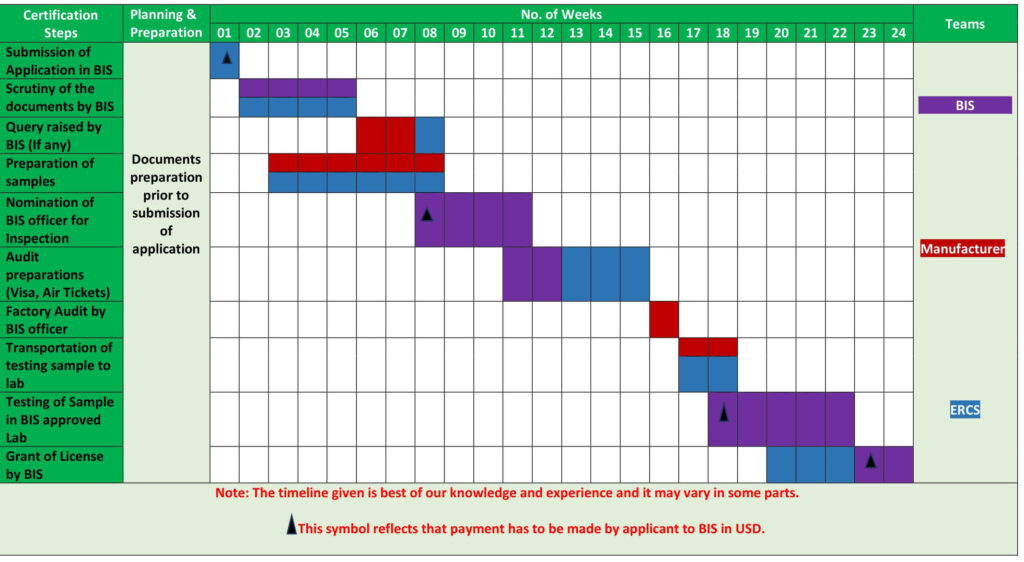
According to BIS, the FMCS certification timeline starts on the day BIS records the complete application. The process normally takes 4 to 6 months (roughly 16 to 26 weeks), but it can vary depending on the inspection schedule, laboratory tests, responses to questions raised by BIS, sample transport, and payment of applicable dues.
Validity and renewal of FMCS licence
- Initial Validity: 1–2 years, as selected by the applicant.
- Renewal: 1–5 years, based on applicable fees.
FMCS Surveillance and Continued Compliance
BIS surveillance involves monitoring the manufacturer’s ongoing compliance through factory inspections, product sample testing, and verification of quality control practices. These measures help ensure certified products comply with relevant Indian standards. Foreign manufacturers must keep records of their production and testing processes and comply with all conditions set by the BIS Licence.
Role of the Authorised Indian Representative (AIR) in FMCS
To obtain FMCS BIS Certification, foreign applicants must nominate an Authorised Indian Representative (AIR), who is legally responsible for compliance with the BIS Act, Rules, Regulations, and the terms of the BIS licence on the manufacturer's behalf. If the manufacturer has a branch or office in India, it should preferably nominate an employee there.
Key Responsibilities & Requirements for an AIR:
- Must be a resident Indian.
- Can represent only one manufacturing firm under BIS schemes.
- Must have no conflict of interest regarding third-party lab testing.
- Must be technically qualified (graduate) to understand the BIS Act, 2016.
- Must declare consent to be legally responsible for compliance via an indemnity bond.
- BIS must be informed in advance of any change in the AIR or address.
As an established compliance consultant, ERCS Private Limited helps obtain FMCS certifications, serving as your guide or designated AIR to ensure a seamless process with minimal delays.
Conclusion
FMCS certification requires more than just submitting an application. The foreign manufacturer will have to prepare a complete technical dossier, appoint an Authorised Indian Representative, undergo a BIS factory audit, and fulfil all licence conditions on an ongoing basis. Leaving even a single document or auditing point unchecked could delay the process by several months.
ERCS Private Limited has been assisting foreign manufacturers in FMCS Service India to acquire their BIS FMCS certification since 2019. Our team has completed more than 1,500 compliance projects in the last 7 years for over 700 clients. This has included FMCS factory audits in Germany, Malaysia, Indonesia, Saudi Arabia and BIS licensing for IS 19111 and IS 19112 in India. We are located in Noida, Frankfurt, Selangor and Dubai and offer AIR services in India. Our FMCS Consultant will handle your FMCS licence process from dossier preparation through licence award and renewal.
Planning to export your products to India? Schedule a free FMCS eligibility assessment with us now.