BIS Registration (CRS) for
Sealed Secondary Cells/Batteries containing Alkaline or other non-acid Electrolytes for use in portable applications
IS 16046 (Part 1)
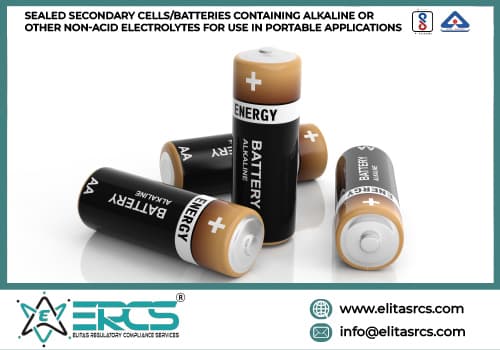
The Bureau of Indian Standards has implemented the Compulsory Registration Scheme for Sealed Secondary Cells/Batteries having Alkaline or Other Non-Acid Electrolytes under IS 16046 since 1 June 2016. This requirement ensures that sealed secondary cells, both manufactured in India and imported into India, comply with applicable technical and safety-based quality criteria before installation, distribution, or sale in India's commercial marketplace. This will help to provide consumers with safe, reliable products.
The safety and performance parameters associated with rechargeable batteries that contain alkaline or other non-acid electrolytes are defined by IS 16046, which is harmonised with IEC 62133. Alkaline and other non-acid electrolyte sealed secondary cells/batteries are the latest development in portable power storage technology. The focus of this standard is to prevent consumers from incurring injury as a result of short-circuiting, leaking, fire, or explosion due to electrical or mechanical shocks by requiring that these batteries must meet the same safety standards.
Specification for Sealed Secondary Cells/Batteries Certification under BIS Scheme-II
Under the Electronics & Information Technology Goods-(Requirements for Compulsory Registration) Order, 2021, BIS CRS Certification has been prescribed by the Bureau of Indian Standards for Sealed Secondary Cells/Batteries according to two Indian Standards as follows:
1. IS 16046 Part 1 – Secondary Cells and Batteries Containing Alkaline or Other Non-Acid Electrolytes – Safety Requirements for Portable Sealed Secondary Cells and Batteries Manufactured Thereof Used in Portable Applications IS 16046 Part 1 – Nickel Systems.
2. IS 16046 Part 2 – Secondary Cells and Batteries Containing Alkaline or Other Non-Acid Electrolytes – Safety Requirements for Portable Sealed Secondary Cells and Batteries Manufactured Thereof Used in Portable Applications IS 16046 Part 2 – Lithium Systems.
Key aspects of IS 16046 (Part 1)
Let’s go through the key aspects of Sealed Secondary Cells/Batteries, Indian Standard 16046 Under CRS Registration Scheme II:
- Scope: Included in the standard are the cells and batteries of nickel-cadmium and nickel-metal hydride, which are to be used in portable electronic devices like mobile phones, laptops, and power banks.
- Harmonization: The standard has been completely unified with the global standard IEC 62133-1.
- Separation of Systems: One of the major changes of the updated 2015 standard was the separation of the requirements: Part 1 deals solely with nickel systems, while Part 2 (IS 16046 (Part 2)) deals with lithium systems.
- Safety and Performance Requirements: It sets forth the indispensable criteria to prevent different types of hazards, such as electrical shock, fire, and explosion.
- Inclusion of Button Cells: The updated standard now also has specialized requirements and packaging rules for button cells to ward off the risk of ingestion.
Essential Requirements for BIS CRS Registration of IS 16046 (Part 1)
- Manufacturers - A BIS license is issued to the manufacturer. An importer or Trader are not eligible to get a BIS license. An importer can be an Authorized Indian Representative (AIR) of a foreign manufacturer license will be issued to the Manufacturer.
- Manufacturing Address – The manufacturer has to mention the same address in the application as mentioned in the Business License. If a manufacturer has more than one manufacturing location, then a separate BIS license/Registration is required for each location.
- Products - Each product Category/ Indian Standard require BIS Registration number. But if the same product category includes several models or series models, one License / Registration Number can cover all Series models of the same product category or lead model.
- Brands / Trademarks – For Every/Each Brand or Trademark require separate BIS Registration Number.
Complete Process for Obtaining BIS CRS Registration of Sealed Secondary Cells/Batteries
BIS-CRS registration procedures vary significantly for Foreign and Indian manufacturers. A list of steps associated with the processes is provided below.
1. Foreign manufacturers Registration Process:
- An Indian Representative must be appointed for the Foreign manufacturers.
- Create an account on the BIS Portal.
- Complete the Online Application Form.
- Submit test samples for testing to a BIS Certified Laboratory, and upload the laboratory report on the BIS Portal.
- Pay the required fees and submit your Application.
- The BIS will review your Application.
- If there are no additional questions from the BIS, the Application will be approved.
2. Domestic Manufacturers:
- Create an account on the BIS Portal.
- Complete the Online Application Form.
- Submit Test Samples to a BIS Certified Laboratory and upload the Laboratory Report on the BIS Portal.
- Pay the required fee(s) and submit your Application.
- The BIS will review your Application.
- If there are no additional questions from the BIS, the Application will be approved.
Document Checklist for Sealed Secondary Cells IS 16046
The list of documents that BIS requires is as follows:
- The BIS application form was filled out proper procedure.
- Name and address documentation for the factory and the applicant.
- Third-party lab test report in accordance with Indian Standards
- If the Application is signed by an authorised signatory, an authorization letter from the CEO in that person's name is necessary.
- The Indian Agent and Nomination Form information applies to overseas or international manufacturers.
- Technical information on the items, including the PCB layout, the schematic diagrams, the user guide, and the critical component list
- Recognition receipt
- Undertaking and Affidavit certified with ID Proof and authorised Native Representative's signature" (in case of the foreign or overseas manufacturer)
- Official Test Results from the BIS Laboratory
BIS CRS Registration Cost in India for Sealed Secondary Cells/Batteries
The fee for BIS registration is provided in the table below:
|
COST FOR BIS REGISTRATION / ELECTRONICS PRODUCTS (Government Costs) |
|||
|
Type of Fee |
New Application |
Renewal |
Inclusion |
|
Application Fee |
1000 |
1000 |
1000 |
|
Processing Fee* |
25,000x2 = 50,000 |
25,000x2 = 50,000 |
15,000x2= 30,000 |
|
Registration Fee* |
1000 x 2 = 2000 |
1000 x 2 = 2000 |
1000 x 2 = 2000 |
|
Total |
53,000 |
53,000 |
30,000 |
|
Note* 1. The processing fee and registration fee need to be paid within 2 years, as registration numbers will be granted initially for two years. 2. The cost of BIS registration will depend on the following factors: · Location and Name of the Manufacturing Process (Overseas/ Domestic) · Types of Products and model quantity · Testing fee for the products · Govt. Fee (BIS) and ERCS Service fee |
|||
Why Choose ERCS for BIS Registration of IS 16046 (Part 1)?
For BIS registration and producing a standard quality product, the manufacturer must ensure that their product follows the specified Indian Standard Specifications (ISS), which we directly interpret to you from the BIS officials as per the Indian Standards. ERCS Private Limited will be your friend, philosopher, and guide in the whole process of getting your product certified by the concerned authorities/ departments.
ERCS Pvt. Ltd. has developed a vast network within the Electronic Industry & various BIS departments to assist in ensuring conformity of the product Sealed Secondary Cells/Batteries containing Alkaline or other non-acid Electrolytes for use in portable applications according to IS 16046.