BIS Certification for
Petroleum and Natural Gas Industries -Steel Pipes for Use as Casing or Tubing for Wells
IS 19111
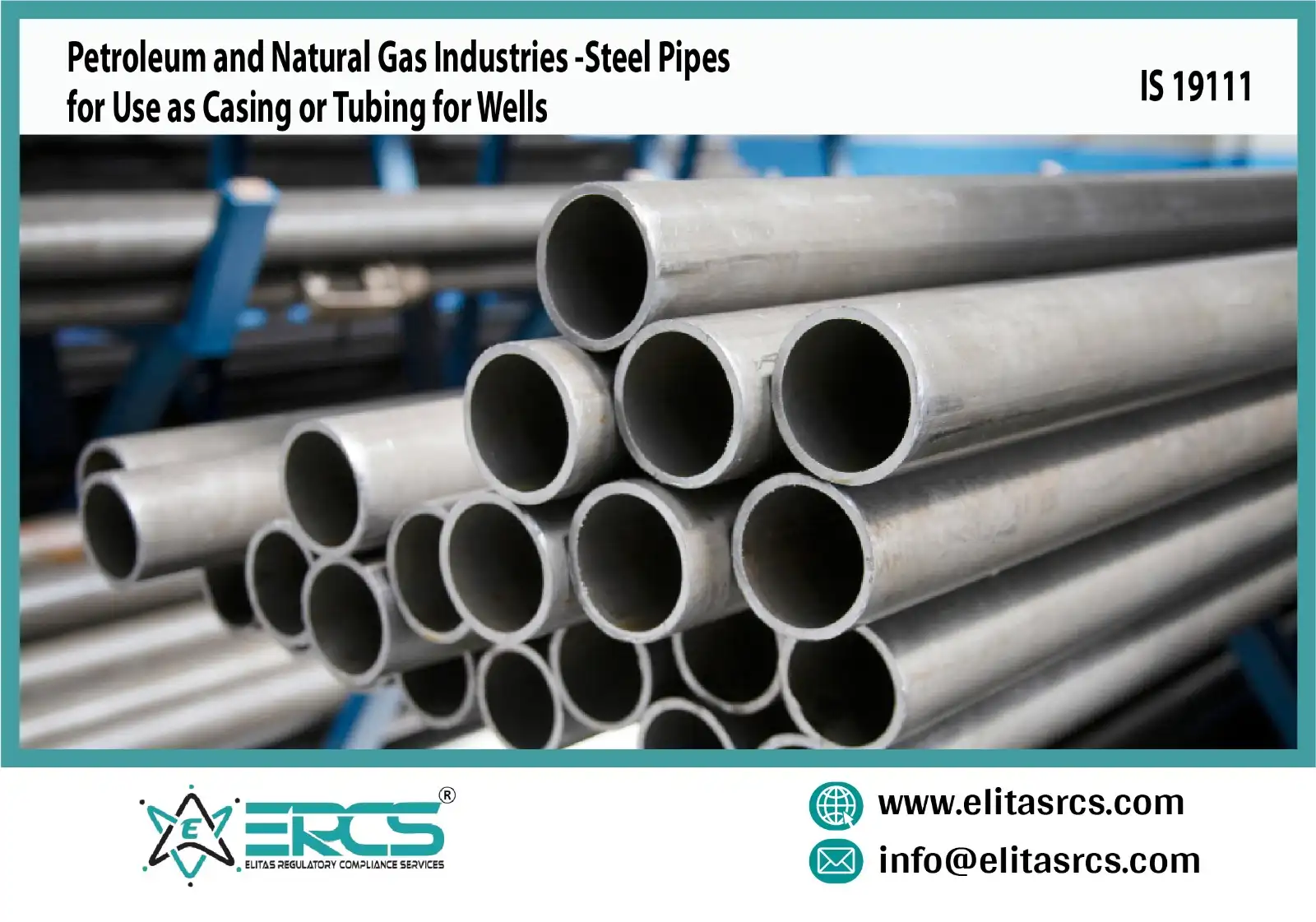
The Bureau of Indian Standards (BIS) Certification for Petroleum and Natural Gas Industries - Steel Pipes for Use as Casing or Tubing for Wells assures the quality, strength, and safety of steel pipes used in oil and gas drilling operations. This Indian Standard lays down technical, non-mandatory requirements for seamless and welded steel pipes used as casing and tubing in petroleum and natural gas wells. The certification confirms that manufacturers comply strictly with the Bureau of Indian Standards' (BIS) requirements for materials, testing, and marking, which assures reliability and safety in deep-well applications. The IS 19111 standard is presently in draft format and will soon be published on the BIS website. Now let’s delve deeper to know more about its process, cost, timeline, and more.
Overview of Steel Pipes for Use as Casing or Tubing for Wells under CRS
For steel pipes used as casing or tubing for wells (IS 19111), a BIS license is a compulsory certification that makers and importers in India must obtain to ensure their products conform to the rigorous national standards of quality and safety. A BIS license is issued by the Bureau of Indian Standards (BIS) and allows the ISI mark to be shown on such products.
The Indian Standard (IS) 19111 provides a specification for steel pipes that are intended for casing and tubing in oil and natural gas wells. This is an important certification because these steel pipes are subjected to severe pressure, stress, and corrosive conditions deep underground.
Key Specification of IS 19111
- Product type: This standard defines specifications for steel pipes intended for use as casing or tubing for wells, also commonly referred to as Oil Country Tubular Goods (OCTG).
- Adoption: The Indian Standard IS 19111 is an identical adoption of the International Standard ISO 11960.
- Technical Committee: The work on the standard was undertaken by the Indian technical committee MTD 19.
- Coverage: It specifies the technical delivery conditions applicable to casing and tubing with regard to Steel grades, Testing methods, Chemical composition, and Mechanical properties.
- Purpose: The standard is useful for ensuring the quality, safety, and reliability of steel pipes in the complex environment of petroleum and natural gas extraction.
Quality Control Order (QCO) of Steel Pipes for Use as Casing or Tubing for Wells
In India, several standards are typically tied to a Quality Control Order (QCO), which requires certification or making the standard mandatory for manufactured products. For example, there is a draft QCO for the "Iron and Steel Pipes, Tubes & Fittings" among these QCOs, including IS 19111. The standard IS 19111 would fall under the draft Iron and Steel Pipes, Tubes & Fittings QCO (2025) as one of the notified standards.
BIS Requirement for Wells Certification in India
If you are a manufacturer looking to obtain a Bureau of Indian Standards (BIS) license for steel pipes used as casing or tubing for wells under IS 19111, here are the key requirements you must fulfil.
- Product Scope – Confirm that the pipes (casing/tubing) fall under IS 19111:2025.
- Manufacturing Facility – Must be equipped and have a process flow and capacity for production.
- Quality Control System – Must have documented QA/QC systems and maintain traceability (heat/batch number) in production.
- In-house Testing Laboratory – Must be equipped to conduct chemical, mechanical, dimensional, pressure, and NDT tests in accordance with IS 19111.
- Test Reports – Must provide valid product test reports (test reports could be in-house laboratory or NABL/BIS approved laboratory).
- Raw Material Certificates – Must have certificates from suppliers for raw material tests and traceability of input.
- Application Submission – Must apply online (Manak Online) with all documents, test reports, and fees.
- Factory Inspection – BIS to inspect plant, processes, laboratory & marking before approving license.
- Product Marking – Mark pipes with ISI mark, IS 19111, license number, size/grade, heat number, mfg. date.
- QCO Compliance – If the product is a mandatory QCO product, then it must have certification to sell/import.
ISI Certification Process for IS 19111
To obtain a Bureau of Indian Standards Certificate for your product, please use the steps below:
- Application Process: First, manufacturers will register on the BIS portal, then register for a license or certificate by completing an application.
- Documentation Process: This includes gathering all relevant documents, such as factory license, quality control plan, specifications of the raw materials, etc.
- Testing Process: The samples will then be sent to a BIS-registered laboratory for chemical composition testing.
- Factory Inspection: The BIS officers will conduct a factory inspection of quality control documentation and layout.
- License Approval: If a satisfactory factory inspection is concluded, BIS will issue a license to the manufacturer to use the Standard mark, which signifies the tin ingots were manufactured according to the appropriate Indian Standards.
Timeline for BIS License of Steel Pipes for Use as Casing or Tubing for Wells
For Indian manufacturers, the likely timeline for a Bureau of Indian Standards (BIS) license for casing or tubing as a steel pipe for use in wells is estimated at around 30 to 45 days; for foreign manufacturers, it is expected to take around 120 to 180 days. This is only an estimate, and the timeline could be anywhere from less time to longer, depending on response times to questions and inspections. The related standard for these applications would most likely be IS 1239 (Part 1) for steel tubes.
Documents Required for BIS Certification of IS 19111
Below, you can go through the list of documents required for BIS Certification of Steel Pipes:
- Application Form
- Manufacturing Unit Details
- Quality Control Manual (QCM)
- List of Quality Personnel
- In-House Testing Facilities
- Raw Material Certificates
- Product Test Reports
- Marking Scheme
- Copy of the Indian Standard (IS 19111:2025)
- Company Registration Documents
- Authorised Signatory Letter
- Undertaking / Declaration
- Fee Payment Proof
BIS Certification Cost for Steel Pipes for Use as Casing or Tubing for Wells
Go through the table to know the cost of BIS Certification India for IS 19111:
|
S No. |
Particular |
Amount (INR) |
Remarks |
|
1. |
Application Fee |
1000 |
To be paid directly to BIS |
|
2. |
Audit Fee |
7000 |
To be paid directly to BIS |
|
3. |
License Fee |
1000 |
To be paid directly to BIS |
|
4. |
Sample Testing Fee |
As Applicable |
To be paid directly to BIS (Testing charges vary from product to product and lab to lab.) |
|
5. |
Minimum Advance Marking Fee |
As per actual |
To be paid directly to BIS (Marking fee varies as per Indian Standard) |
|
6. |
Renewal Fee |
1000 |
To be paid directly to BIS |
|
7. |
Inclusion Fee |
5000 |
To be paid directly to BIS |
|
8. |
ERCS Pvt Ltd Service Fee |
Please contact info@elitasrcs.com |
|
|
Remarks |
Including all the taxes |
||
Why ERCS Private Limited is the Top BIS Consultant for IS 19111?
ERCS Private Limited is the leading BIS Consultant for IS 19111 due to their depth of knowledge in BIS regulations and strong global experience, and a full service that includes advisory and end-to-end support. They have significant experience working with 1000+ manufacturers, particularly in the steel products, and are positioned as a knowledgeable partner, not just in processing paperwork. Included in their value proposition is the provision of cost-effective solutions for compliance, a global network and integrated services, and the commitment to keep clients informed of regulatory changes.