BIS Certification for
Low Speed Food Grinding Machines
IS 302 (Part 1)
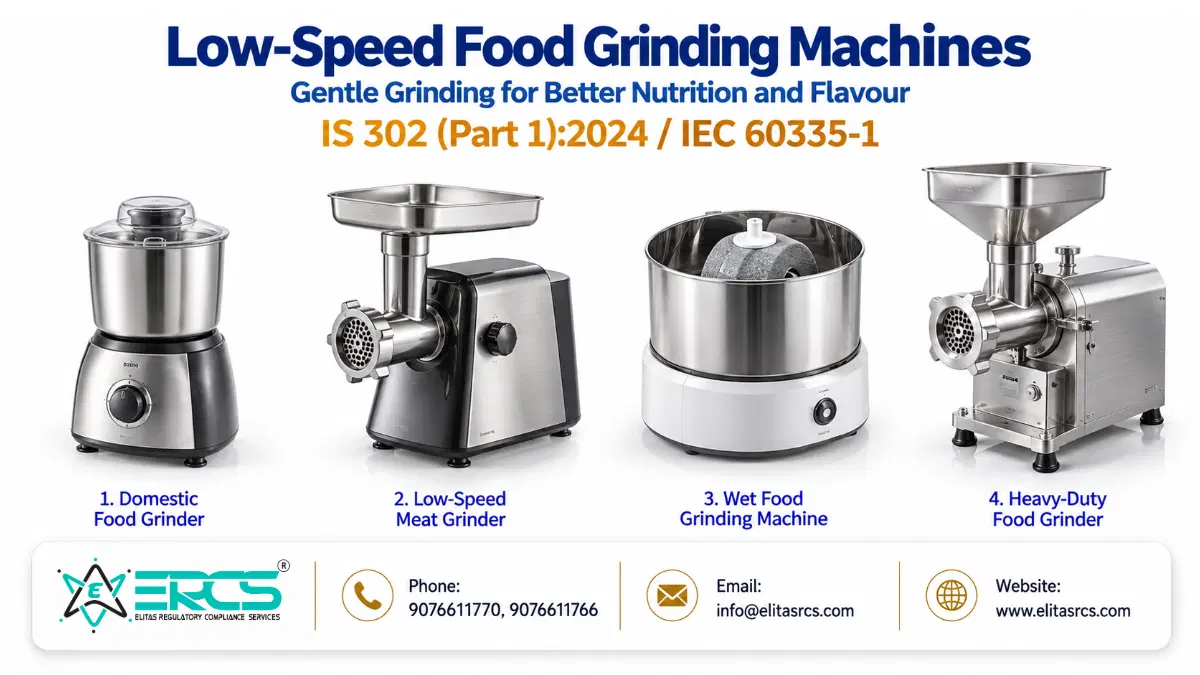
The BIS Certification of Low-Speed Food Grinding Machines are mandatory under IS 302 (Part 1): 2024/IEC 60335-1 in India. The ISI Mark Certification ensures that products, including meat grinders, grain grinders, and food processors, are safe for use and protects users from electric shock, fire risk, and mechanical hazards.
Low-speed food-grinding machines have become an important part of modern kitchens due to their ability to grind grains, spices, pulses, and other ingredients with precision and efficiency. As these appliances run on electrical power and contain moving mechanical parts, ensuring their safety is important to avoid electric shocks, overheating, fire hazards, and mechanical injuries. IS 302 (Part 1): 2024/ IEC 60335-1 is a safety standard for household and similar electrical appliances. It complies with the general safety and quality requirements for electrical appliances, including low-speed food-grinding machines.
What are Low-Speed Food Grinding Machines under IS 302 Part 1: 2024/IEC 60335-1?
Low-Speed Food Grinding Machines are electric-powered appliances for grinding, crushing, or milling food materials at lower RPMs (for instance, electric grain grinders with a capacity of up to 3L or wet/dry stone grinders) and comply with the mandatory standards of the Bureau of Indian Standards (BIS).
As per IS 302 (Part 1): 2024 / IEC 60335-1, Low-Speed Food Grinding Machines are electrical kitchen appliances designed to grind, crush, or process food materials (including grains, wet batter, meat, or vegetables) at low speeds. One of the most popular Low-Speed Food Grinding Machines is an electric wet grinder.
Key Highlights for IS 302 (Part 1) for Low-Speed Food Grinding Machines
|
Key Particular |
Important Details |
|
Applicable Standard |
IS 302 (Part 1):2024 / IEC 60335-1:2020 |
|
Product Category |
Low-Speed Food Grinding Machines |
|
Particular Requirement |
IS 302 (Part 2/Sec 209):1994 |
|
Standard Focus |
Safety of household and similar electrical appliances |
|
Electrical Safety |
Covers protection against electric shock, insulation and electrical hazards |
|
Mechanical Safety |
Addresses the safety of moving and rotating parts during operation |
|
Thermal Safety |
Requirements help control excessive temperature rise during operation |
|
Construction Safety |
Covers appliance construction, components and protection against accessible hazardous parts |
Key Benefits of ISI Mark Certification for Low-Speed Food Grinding Machines in India
ISI Mark certification ensures that low-speed food-grinding machines comply with Indian safety and quality standards, protecting consumers from electrical and mechanical hazards.
- Compulsory Legal Compliance: ISI Mark certification will enable manufacturers to meet the relevant BIS standards in advance for low-speed food-grinding machines.
- Increase Consumer Confidence: This can be achieved by assuring consumers that the product meets India's required safety and quality standards.
- Risk Prevention: Certification will help identify and mitigate risks related to electrical, mechanical, thermal, and construction issues.
- No Barriers to Market Entry: Compulsory certification requirements can prevent manufacturers from marketing their products.
- Market Competitiveness: BIS-certified products will gain better credibility and a competitive edge among manufacturers.
List of Documents Required for ISI Mark Certification of Low-Speed Food Grinding Machines
Below is the list of essential documents that are to be made available while applying for the BIS Certification for Low-Speed Food Grinding Machines:
- Company registration proof
- ID proof of authorised signatory
- Nomination form of authorised Indian representative (A.I.R.) - Only applicable to foreign manufacturers
- Lab report issued from a BIS-approved lab
- Factory layout drawing
- Trademark certificate
- Manufacturing license (wherever necessary)
Testing Parameters for Low Speed Food Grinding Machines IS 302 (Part 1)/IEC 60335-1
IS 302 Part 1: IEC 60335-1 sets out testing criteria for low-speed food-grinding machines to ensure their electrical safety, mechanical reliability, durability, and quality. During BIS testing, the appliance is evaluated for compliance with the following safety parameters:
- Protection Against Access to Live Parts: Users can be assured of their safety by preventing accidental contact with live electrical parts.
- Power Input and Current: The appliance will be checked to ensure it operates within its rated power and current limits.
- Leakage Current and Electric Strength at Operating Temperature: Insulation performance will be evaluated, and proof of protection against electric shock will be provided at the operating temperature.
- Moisture Resistance: All appliances will be tested to verify protection against moisture ingress and water exposure.
- Leakage Current and Electric Strength: After all appliances have been exposed to moisture, they will be tested again for electrical insulation.
- Stability and Mechanical Hazards: Appliances that do not remain in place will be checked, and any test performed on a moving part will be conducted to confirm it does not pose a risk of injury.
- Mechanical Strength: Evaluate an appliance's ability to resist impact and mechanical stress from normal use.
- Construction: Constructed in accordance with prescribed safety requirements.
- Internal Wiring: Check the routing, insulation, and protection of internal wiring to prevent damage.
BIS Certification Process for Low-Speed Food Grinding Machines in India
BIS Certification Steps Under Scheme-1 for BIS Certification of Low-Speed Food Grinding Machines are as follows:
1. Application Process: You have to apply for ISI using the BIS online portal. Also, a physically signed application must be submitted.
2. Document Preparation: You have to prepare documents as per your application in accordance with IS 302 Part 1 (IEC 60335-1).
3. Inspection: There will be an inspection of the suitability of production carried out by the BIS team. The BIS Official will sign the sample.
4. Product Testing: The sealed samples of the products will be sent for testing in BIS laboratories.
5. Appointing AIR: As a foreign manufacturer, you need to appoint an AIR.
6. ISI Mark Issue: Once the testing and inspection process is completed, the ISI mark will be issued by the BIS.
Both Indian and foreign manufacturers must follow the certification process to obtain the ISI Mark on their products:
- ISI/BIS Certification Process for Indian Manufacturers
- BIS FMCS Certification Process for Foreign Manufacturers
ISI/BIS Certification Cost for Low-Speed Food Grinding Machines (2026)
Below, you can find the table for the BIS license cost of low-speed food grinding machines:
|
S No. |
Particular |
Amount (INR) |
Remarks |
|
1. |
Application Fee |
1000 |
To be paid directly to BIS |
|
2. |
Audit Fee |
7000 |
To be paid directly to BIS |
|
3. |
License Fee |
1000 |
To be paid directly to BIS |
|
4. |
Sample Testing Fee |
As Applicable |
To be paid directly to BIS (Testing charges vary from product to product and lab to lab.) |
|
5. |
Minimum Advance Marking Fee |
As per the actual |
To be paid directly to BIS (Marking fee varies as per Indian Standard) |
|
6. |
Renewal Fee |
1000 |
To be paid directly to BIS |
|
7. |
Inclusion Fee |
5000 |
To be paid directly to BIS |
|
8. |
ERCS Pvt Ltd Service Fee |
Please contact info@elitasrcs.com |
|
Renewal of BIS Certification for Low-Speed Food Grinding Machines (IS 302 Part 1)
The license renewal process for BIS licenses for items such as single-walled baking ovens, as per IS 302 (Part 1), is typically carried out every 1-2 years initially, then every 5 years.
- Log In: Visit the official website of BIS and log in to your account.
- Application Submission: Select the option for license renewal in your account.
- Production Information: Enter information about the production capacity of your company.
- Self-Declaration: Submit quantities bearing the ISI Mark.
- Distributor Information: Submit a PDF file containing the list of distributors of your company.
- Fee Payment: Pay the renewal and inspection fee.
Why Choose ERCS as Your BIS Certification Consultant for Low-Speed Food Grinding Machines?
ERCS, as a leading BIS consultant, provides all the services required to help an international or domestic manufacturer properly acquire BIS certification. Our support helps the manufacturer obtain the BIS certificate promptly, enabling them to enter the Indian market with minimal hassle.
- End-to-end Support Through the ISI Certification Process: ERCS offers complete management of the BIS certification process, from application submission to BIS License Issuance.
- Expert Regulatory Guidance: ERCS's BIS Consultants have extensive training and backgrounds in providing manufacturers with comprehensive support to comply with all regulations associated with IS 302 (Part 1): 2024 IEC 60335-1.
- Documentation Assistance: ERCS assists manufacturers with the preparation, review, and organisation of all technical documentation required to comply with applicable BIS requirements.
- Coordination Between Manufacturer and BIS-Approved Laboratories: ERCS assists manufacturers with scheduling product testing at an applicable BIS-approved laboratory and with answering any questions the manufacturer may have regarding product testing.
- Foreign Manufacturer Support: ERCS assists manufacturers from other countries with the application processes for AIR and FMCS.
- Timeliness of Execution: ERCS has a proven methodology for delivering services quickly from the manufacturer's application submission to the receipt of BIS certification, enabling manufacturers to access the Indian market promptly.