BIS Certification for
Whole Milk Powder
IS 1165
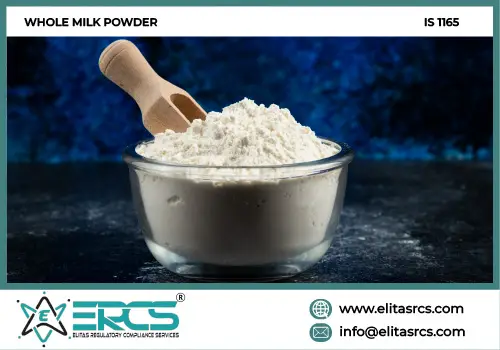
Milk powder is milk that has been evaporated to remove nearly all its moisture, giving it a far longer shelf life than liquid milk and removing the need for refrigeration. It's a key ingredient across the food industry used to reconstitute dairy products like yoghurt and milk drinks, and as a source of fat and non-fat milk solids in confectionery and baked goods.
Because it's a staple food ingredient, whole milk powder cannot be legally sold in India without BIS certification and the ISI Mark. Here's what manufacturers need to know about certifying whole milk powder under IS 1165:2022.
What Is IS 1165? Understanding the Milk Powder Standard
IS 1165 is the Indian Standard that governs milk powder, prescribing the requirements, sampling methods, and test protocols manufacturers must meet. The standard defines the quality parameters that whole milk powder must satisfy, including:
- Flavour, taste, and freedom from lumps or extraneous matter
- Moisture content
- Milk fat content
- Milk protein in milk solids-not-fat
- Insolubility index
- Total ash
- Titratable acidity
- Scorched particle content
- Contaminant limits for lead, arsenic, aflatoxin M1, and melamine
Is BIS Certification Mandatory for Milk Powder?
Yes. Under the Food Safety and Standards (Prohibition and Restrictions on Sales) Regulations, 2011, issued by the Food Safety and Standards Authority of India (FSSAI) under the Ministry of Health and Family Welfare, condensed milk (sweetened), condensed skimmed milk (sweetened), milk powder, skimmed milk powder, partly skimmed milk powder, and partly skimmed sweetened condensed milk cannot be sold in India except under the BIS Standard (ISI) Mark. Selling whole milk powder without the ISI Mark exposes manufacturers to product seizure and financial penalties.
Under IS 1165:2022, BIS grants a licence to use the Standard Mark specifically for Whole Milk Powder.
Certification Route: Domestic vs. Foreign Manufacturers
- Indian manufacturers apply under BIS Scheme-I, with a standard processing timeframe of around 30 days.
- Foreign manufacturers apply through the Foreign Manufacturers Certification Scheme (FMCS), with a standard processing timeframe of around 180 days, and must appoint an Authorized Indian Representative (AIR) to file and manage the application.
Requisites for a Milk Powder BIS Licence
- Raw material conformity as per IS 1165
- An in-house testing laboratory equipped for the mandatory tests
- Competent quality control personnel
- Full adherence to BIS guidelines for whole milk powder under IS 1165
Documents Required
Applications are assessed across four categories of documentation:
- Administrative details: Company registration, factory address, and ownership proof
- Technical details: Manufacturing process flow, raw material sourcing, and in-house test facilities
- Quality control personnel details: Qualifications and designation of QC staff
- Commercial details: Production capacity and sales documentation
BIS Certification Cost for Whole Milk Powder (Scheme-I)
|
S No. |
Particular |
Amount (INR) |
Remarks |
|---|---|---|---|
|
1. |
Application Fee |
1000 |
To be paid directly to BIS |
|
2. |
Audit Fee |
7000 |
To be paid directly to BIS |
|
3. |
License Fee |
1000 |
To be paid directly to BIS |
|
4. |
Sample Testing Fee |
As Applicable |
To be paid directly to BIS (Testing charges vary by product and lab). |
|
5. |
Minimum Advance Marking Fee |
As per actual |
To be paid directly to BIS (Marking fee varies as per Indian Standard) |
|
6. |
Renewal Fee |
1000 |
To be paid directly to BIS |
|
7. |
Inclusion Fee |
5000 |
To be paid directly to BIS |
|
8. |
ERCS Pvt Ltd Service Fee |
Please contact info@elitasrcs.com |
|
Product testing is the most critical stage of certification, since it determines whether the product meets the IS 1165 quality parameters. Manufacturers should budget for in-house test equipment as well as a possible factory pre-visit to confirm conformity ahead of the official BIS inspection.
How ERCS Supports Your BIS Certification for Milk Powder
Getting BIS certified means demonstrating that your product meets the Indian Standard Specifications (ISS) exactly as BIS officials interpret them — a process that's easier to navigate with an experienced partner. ERCS supports manufacturers through:
- Conformity assessment: Drawing on our network across the food and allied products industry and within BIS departments to verify your whole milk powder formulation against IS 1165 before you apply.
- Documentation: Preparing administrative, technical, and QC documentation to BIS guidelines, backed by experience across 150+ certification projects.
- Factory pre-visits: Conducting a pre-visit ahead of the official BIS inspection to identify and correct potential non-conformities in advance.
- Audit assistance: Briefing your team on what to expect during the BIS inspection and what needs to be ready and accessible on the day.
Why the ISI Mark Matters for Your Milk Powder Business
- The ISI Mark confirms your product meets government-mandated quality standards — and for whole milk powder, it's a legal requirement, not an option; non-compliance risks product seizure and financial penalties.
- Certified products earn stronger buyer trust, since consumers actively look for the ISI Mark as a signal of safety and consistent quality.
- Certification strengthens your market position, helping you compete more effectively and build long-term brand credibility through word-of-mouth and repeat business.
Frequently Asked Questions
Is BIS certification mandatory for whole milk powder in India?
Yes. Milk powder cannot be sold in India without the BIS Standard (ISI) Mark under the FSSAI's 2011 Prohibition and Restrictions on Sales Regulations.
How long does BIS certification take for milk powder?
Around 30 days for Indian manufacturers under Scheme-I, and around 180 days for foreign manufacturers under FMCS.
Do foreign manufacturers need a local representative?
Yes. Foreign manufacturers must appoint an Authorized Indian Representative (AIR) to file and manage the FMCS application.
What standard governs milk powder certification?
IS 1165:2022, which covers quality parameters like moisture, milk fat, protein, insolubility index, ash content, and contaminant limits.