BIS Certification for
Stainless Steel Seamless Pipes and Tubes for General Services
IS 17875
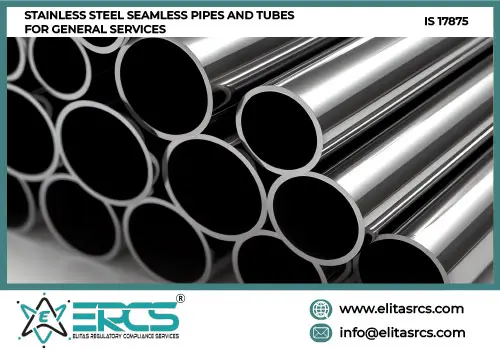
The Bureau of Indian Standards (BIS) was established on April 1, 1987, succeeding the Indian Standards Institution (ISI) founded in 1947. Replacing the ISI, the BIS Act of 1986, as amended by the BIS Act of 2016, enhances certification, including the requirement for registration of Stainless Steel Seamless Pipes and Tubes, as well as product quality control for the purpose of improving consumer safety and quality standards in India
IS 17875: Latest Quality Control Order You Must Know to Stay Compliant
BIS Certification requirements for Stainless Steel Seamless pipes and tubes
Indian Standard IS 17875:2022 can be evaluated for certification based on the following criteria:
- Chemical Composition
- Mechanical Properties
- Manufacturing Process
- Testing Methods
- Dimensional Tolerances
- Surface Finish
- Marking and Packaging
- Hardness Test
- Flaring Test
- Flattening Test
- Corrosion Test
BIS Certification Process for Stainless Steel Seamless Pipes and Tubes
Here’s the process to obtain BIS approval for your steel products. Manufacturers and importers can get a brief idea about it. Let's take a look:
- Application Submission: The manufacturer submits an application through the BIS portal along with the required documents.
- Document Verification: BIS reviews the submitted documents, including manufacturing details, quality control processes, and test reports.
- Sample Collection: BIS officials visit the manufacturing facility to collect product samples for testing.
- Factory Inspection: A detailed inspection of the production unit is conducted to verify compliance with BIS standards.
- Testing of Samples: Collected samples are tested in BIS-approved laboratories to ensure they meet the required standards.
- Review of Test Results: BIS evaluates the test results and inspection findings to determine compliance.
- Grant of License: If the product meets all BIS requirements, the manufacturer is granted a BIS certification.
- Marking Authorization: Upon certification, the manufacturer is authorized to use the BIS Standard Mark on their products.
- Surveillance and Renewal: Periodic surveillance audits and sample testing are conducted to ensure continued compliance. The certification is renewed as per BIS guidelines.
BIS License Timeline for Stainless Steel Seamless Pipes
BIS Certification for Indian Manufacturers (Often in 30 days)
BIS Certification for Foreign Manufacturers (Typically 180 Days)
Documents Required for BIS Certification As per IS 17875
- Application Form (Filled and signed)
- Manufacturing Unit Details (Company profile, factory address, etc.)
- Factory License (Issued by the relevant government authority)
- ISO Certification (If applicable)
- Quality Control Documents (Process flow, inspection, and testing procedures)
- Test Reports (As per IS 17875 from NABL-accredited or in-house labs)
- List of Manufacturing Machinery (With specifications and capacity)
- List of Testing Equipment (Including calibration certificates)
- Raw Material Details (Source and specifications)
- Organizational Structure (Details of key personnel and technical staff)
- Authorized Signatory Letter (For BIS communication)
- Product Labeling and Marking Details (As per BIS requirements)
- Previous Certification (If Any) (Such as ISO, PED, or other relevant approvals)
- Factory Layout and Production Flowchart
- BIS Undertaking & Declaration Forms (As per BIS guidelines)
BIS Certification Cost for Stainless Steel Seamless pipes and tubes
An extensive breakdown of the expenses related to ISI Mark certification for Indian Standard can be seen below:
|
S No. |
Particular |
Amount (INR) |
Remarks |
|
1. |
Application Fee |
1000 |
To be paid directly to BIS |
|
2. |
Audit Fee |
7000 |
To be paid directly to BIS |
|
3. |
License Fee |
1000 |
To be paid directly to BIS |
|
4. |
Sample Testing Fee |
As Applicable |
To be paid directly to BIS (Testing charges vary from product to product and lab to lab.) |
|
5. |
Minimum Advance Marking Fee |
As per actual |
To be paid directly to BIS (Marking fee varies as per Indian Standard) |
|
6. |
Renewal Fee |
1000 |
To be paid directly to BIS |
|
7. |
Inclusion Fee |
5000 |
To be paid directly to BIS |
|
8. |
ERCS Pvt Ltd Service Fee |
Please contact info@elitasrcs.com |
|
|
Remarks |
Including all the taxes |
||
Product testing is essential to the BIS certification process, determining whether the product's quality meets Indian standards. This explains why investing in testing facilities and establishing internal production test laboratories equipped with testing apparatus is necessary. To ensure that your product meets the requirements for BIS certification in India, we may ask you to pay for a pre-visit at your factory in addition to the fees shown in the above table.
BIS Certification Benefits for Stainless Steel Seamless Pipes
Let's discuss the primary benefits of becoming certified in BIS. Here are some things to think about:
- Assurance: Customers and regulatory agencies would receive quality certification that the steel meets the fundamental requirements of the Indian standard for structural quality. This certification would demonstrate that the product has passed stringent inspection and testing procedures.
- Increased market acceptance: Many businesses prefer products bearing an ISI designation. Materials with an ISI accreditation are required for many government tenders for large building projects, which boosts the company's chances.
- Compliance with standard regulations: ISI certification ensures compliance with IS 17875: 2022 and shields any company against fines and legal problems due to poor-quality building materials.
- Competitive Advantage: The ISI mark is an emblem of national quality and reliability, distinguishing businesses and attracting more clients.
- Customer trust: Consumers believe the ISI mark symbolizes reliability, quality, and safety, building brand reputation and customer loyalty.
- Reduced risk and liability: Suppliers, manufacturers, and users are less anxious about liability when certification minimizes the risks of structural collapse or non-conformity.
- Production Cost Efficiency: IS 17875: 2022 significantly improves manufacturing efficiency, sometimes leading to less waste and more productivity. This will result in reduced costs in the long term.