BIS Certification for
EC Grade Aluminium Rod Produced by Continuous
IS 5484
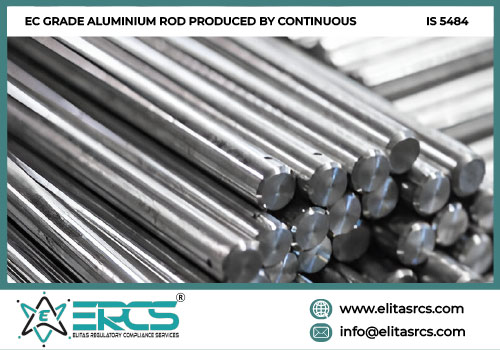
BIS certification for EC-grade aluminium rods produced by Continuous Casting and Rolling is mandatory under Indian Standard IS 5484. As per the order of the Aluminium and Aluminium Alloy Products (Quality Control) Order, issued by the Department for Promotion of Industry and Internal Trade (DPIIT), Ministry of Commerce and Industry, all producers within the country as well as exporters from other countries must have an ISI Mark (Scheme-I).
The EC-grade aluminium rods have been manufactured to meet the requirements specified in IS 5484. The requirements include chemical composition, mechanical strength, and surface finish. The BIS Certification for EC Grade Aluminium Rod ensures that the rods are designed in accordance with the code's specific requirements and that they are safe and reliable.
What are Electric EC Grade Aluminium Rods produced by Continuous Casting and Rolling
Electric EC (Electrical Conductor) Grade Aluminium Rods are continuously cast and rolled, high-purity aluminium wire rods engineered for electrical use. Electric EC (Electrical Conductor) Grade Aluminium Rods are high-purity aluminium wire rods (usually 99.5% to 99.7%+ purity) specifically developed for use as raw material in the electrical wire and cable manufacturing industry. These rods are characterised by a uniform metallurgical structure, correct dimensions and good electrical characteristics after being manufactured through the CCR process.
Key Highlights for IS 5484 for EC Grade Aluminium Rod produced by Continuous Casting and Rolling
|
Key Parameter |
Details |
|
Indian Standard |
IS 5484 |
|
Electrical Conductivity |
The aluminium rod must meet the electrical conductivity requirements specified in the standard. |
|
Chemical Composition |
Aluminium and other elements must comply with the specified chemical composition limits. |
|
Mechanical Properties |
The rod must meet the prescribed requirements for tensile strength and elongation. |
|
Dimensions |
Diameter and dimensional tolerances must conform to the requirements specified in IS 5484. |
|
Surface Quality |
The rod should be free from defects that may affect its performance or subsequent wire drawing. |
|
Testing Requirements |
Tests are carried out to verify chemical composition, electrical conductivity, mechanical properties and dimensional requirements. |
|
Conformity |
Products must comply with all applicable requirements of IS 5484 to demonstrate conformity with the standard. |
Key Benefits of ISI Mark Certification for EC Grade Aluminium Rod Produced by Continuous Casting and Rolling in India
A Quality Control Order was issued by the Ministry of Commerce & Industry in 2023, requiring these rods to comply with the Indian Standard and carry ISI Marking under the BIS license, as per Scheme-I of Schedule II of the BIS Conformity Assessment Regulations. The following are the advantages of certification:
- Market access through legal channels: The ISI stamp is compulsory under the QCO, meaning that an ISI-unmarked rod is not legal to sell, import, or export in India.
- Penalty avoidance and product seizure: Violations may result in a fine of ₹5 lakhs, imprisonment for up to 1 year, or up to 5 times the annual turnover, and seizure of the product.
- Conductivity and mechanical properties are guaranteed: The standard IS 5484:2023 specifies requirements for conductivity, tensile strength, and dimensional tolerances to ensure the rod will function properly when made into wire.
- Buyer and OEM credibility: It is common for the cable, wire-drawing, and winding industries to require ISI certification.
- Buyer and industry confidence: Buyers know that the ISI mark indicates that the products are safe and meet quality standards.
- Manufacturing processes: ISI certification requires a company to evaluate and audit its manufacturing processes.
List of Documents Required for ISI Mark Certification of EC Grade Aluminium Rod produced by Continuous Casting and Rolling
Below, you can go through the important documents for the BIS Certification process:
- Company Registration Proof
- ID Proof of Authorised Signatory
- Nomination form of Authorised Indian Representative (AIR)-required for foreign manufacturers
- Test reports from a BIS-approved laboratory
- Factory Layout Plan
- Trademark Certificate
- Manufacturing licenses (if applicable)
- Product technical specification details
Applicable Test Parameters for EC Grade Aluminium Rod produced by Continuous Casting and Rolling IS 5484
The important test criteria which apply to EC Grade Aluminium Rods, Continuous Casting and Rolling as per IS 5484:
- Electrical Resistivity/Conductivity: Tests the maximum electrical resistivity of the material in order to ensure that power transmission is maximised.
- Tensile Strength: Tests the pulling strength of the rod material to its maximum extent without failing or breaking.
- Elongation Percentage: Tests the ductility and flexibility of the material in order to confirm that the material does not break when it is stretched to form thinner rods.
- Composition and Purity: Tests whether the primary ingot of the base aluminium material conforms to the standard grades as per IS 4026 in order to reduce the level of impurities in the material.
- Dimensions and Tolerances: Tests whether the diameter and shape of the cross-section are as per specifications.
- Joints Check: Ensures that the continuous rod material is entirely continuous and that there are no joints or welds in the rod.
Step-by-Step BIS Certification Process for EC Grade Aluminium Rod Produced by Continuous Casting and Rolling in India
The process of obtaining BIS Certification IS 5484 under Scheme-1 has 6 main stages:
1. Application submission: The manufacturer should submit his application via the BIS Online Portal. A signed copy of the application should also be submitted.
2. Preparation of Documents: The required documents should be prepared according to IS 5484.
3. Inspection: BIS will conduct an inspection at the manufacturer's facility to determine the acceptability of the production, and a BIS officer will seal the product sample.
4. Product Testing: The sealed samples of the product should be sent for testing to BIS laboratories.
5. Appointment of AIR: If the manufacturer is a foreign company, then it should appoint a representative locally.
6. Granting of ISI mark: After completion of both testing and inspection procedures, the manufacturer will obtain his certificate and copy of the ISI mark from BIS.
Indian and foreign manufacturers need to complete the following steps to receive their BIS certification:
- BIS Certification Process - Indian Manufacturer
- BIS FMCS Certification Process - Foreign Manufacturer
BIS Certification Cost and Timeline (2026)
Go through the table to know the cost of BIS Certification in India for IS 5484:
|
S No. |
Particular |
Amount (INR) |
Remarks |
|
1. |
Application Fee |
1000 |
To be paid directly to BIS |
|
2. |
Audit Fee |
7000 |
To be paid directly to BIS |
|
3. |
License Fee |
1000 |
To be paid directly to BIS |
|
4. |
Sample Testing Fee |
As Applicable |
To be paid directly to BIS (Testing charges vary from product to product and lab to lab.) |
|
5. |
Minimum Advance Marking Fee |
As per the actual |
To be paid directly to BIS (Marking fee varies as per Indian Standard) |
|
6. |
Renewal Fee |
1000 |
To be paid directly to BIS |
|
7. |
Inclusion Fee |
5000 |
To be paid directly to BIS |
|
8. |
ERCS Pvt Ltd Service Fee |
Please contact info@elitasrcs.com |
|
|
Remarks |
Including all the taxes |
||
The time required for BIS certification of EC Grade Aluminium Rod produced by continuous casting and rolling is around 30-60 days for Indian manufacturers, whereas it takes about 180 days (6 months) for manufacturers outside India.
Renewal of BIS Certification for EC Grade Aluminium Rod produced by Continuous Casting and Rolling (IS 5484)
You can renew your Bureau of Indian Standards (BIS) certification by submitting a renewal application through the official Manakonline Portal before your current license expires.
- Access the Portal
- Submit Renewal Application
- Upload Documents
- In-house Test Reports
- Fee Payment
- Verification & Endorsement
Why Choose ERCS as Your BIS Certification Consultant for EC Grade Aluminium Rod Produced by Continuous Casting and Rolling?
Selecting ERCS Private Limited as the Bureau of Indian Standards (BIS) consultant provides you with a one-stop solution that guarantees the mandatory compliance of your EC Grade Aluminium Rods without hassles. Given the stringent enforcement of the Aluminium and Aluminium Alloy Products (Quality Control) Order (QCO), it is extremely important to have a knowledgeable consultant to ensure there are no issues such as delays, penalties, or rejections.
Here are the reasons as to why ERCS is the best consulting firm for your manufacturing plant:
- Professional Expertise: The experts provide assistance with mandatory Quality Control Orders (QCO) and BIS guidelines for aluminium products.
- Documentation: They help in documenting the required factory layout, quality manual, and technical files.
- Sample Testing: They help arrange testing of samples by authorised laboratories for electrical conductivity, resistivity, and chemical composition.
- Factory Inspection Preparation: The experts help you prepare for the BIS officer's inspection of your manufacturing plant.