
EPR Registration for
Television Sets
CEEW1
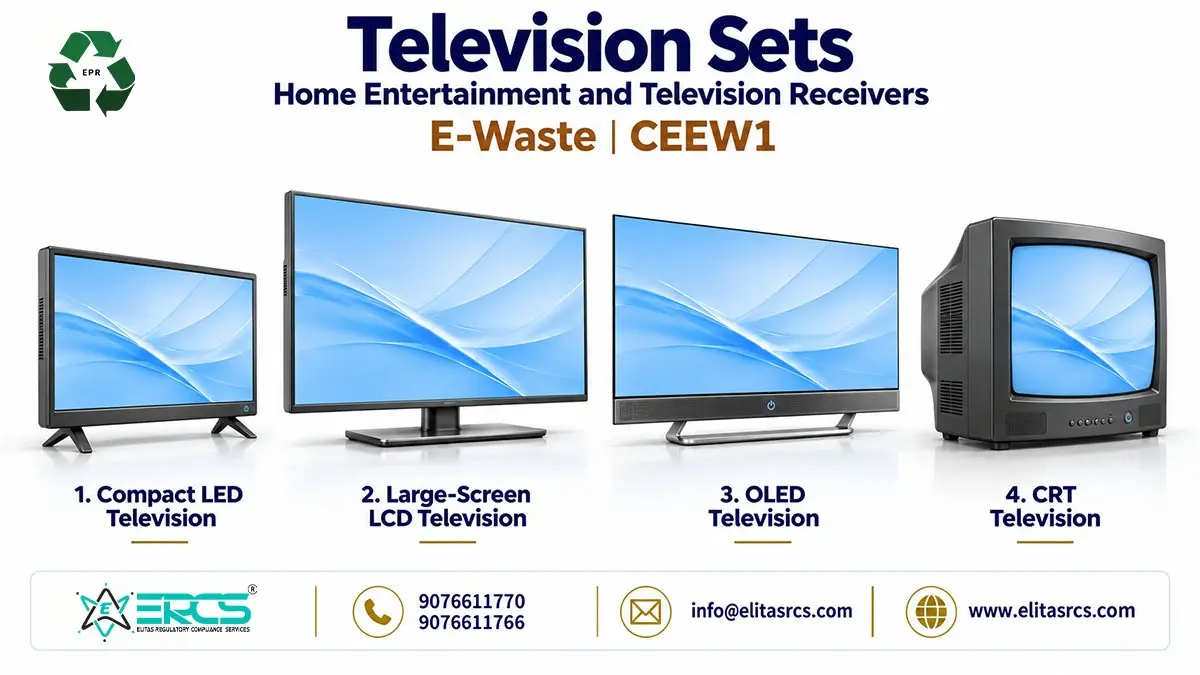
Under the E-Waste (Management) Rules, 2022, EPR registration for televisions is mandatory. Televisions (LCD and LED) come under the category code CEEW1 in Schedule I of the E-Waste (Management) Rules. Every producer in India, including manufacturers, importers, or sellers of televisions under their brand, must register.
EPR holds producers liable for collecting, recycling, and channelling the electronic waste generated by their products. Producers must register on the CPCB EPR portal and meet their recycling target each year. Failure to register or meet the targets can lead to environmental compensation under the E-Waste Rules and action under the Environment (Protection) Act, 1986.
What Are Television Sets Under CEEW1 E-Waste Category?
A television set is an electronic device that receives audio and video signals and displays them as moving pictures with sound. People use them in homes, offices, and commercial spaces, and most sets today are flat-panel LCD or LED. A television consists of a display panel, circuit boards, a plastic or metal casing, wiring, speakers, and connectors.
Under the E-Waste (Management) Rules, 2022, television sets are listed as electrical and electronic equipment in Schedule I under the category code CEEW1. When a television can no longer be used or repaired, it becomes e-waste. Because it contains glass, plastics, metals, and in some cases hazardous substances like lead or mercury, it must be recycled through authorised channels rather than disposed of as ordinary waste. The television producer remains responsible for collecting and recycling it at end of life.
Key highlights: EPR Registration for Television Sets (CEEW1)
Under the E-Waste (Management) Rules, manufacturers, importers, and brand owners of television sets must obtain EPR registration with the Central Pollution Control Board (CPCB) before manufacturing, selling, or importing them. The table highlights all the necessary details about EPR registration for television sets:
|
Particulars |
Details |
|
Law |
E-Waste (Management) Rules, 2022 |
|
Authority |
Central Pollution Control Board (CPCB) |
|
E-Waste Category |
Consumer Electrical and Electronics (CEEW) |
|
Product Covered |
Television sets (including LED and LCD TVs) |
|
EEE Code |
CEEW1 |
|
Listed Under |
Schedule I of the E-Waste (Management) Rules, 2022 |
|
Rules in Force Since |
1 April 2023 |
|
Average Life |
10 years |
|
Who Needs Registration? |
Manufacturers, producers, importers and brand owners |
|
Registration Mode |
Online, on the CPCB E-Waste EPR Portal |
|
How Obligations Are Met |
Buying EPR (recycling) certificates online from CPCB-registered recyclers. |
|
Filing Returns |
Quarterly and annual returns on the CPCB portal |
|
Registration Validity |
5 years from the date of issue |
Documents Required for EPR Registration for Television Sets
The documentation to be provided to the Central Pollution Control Board (CPCB) for EPR registration of televisions must be legal, technical, and operational. The general list of documents required is:
- Certificate of Incorporation or Business Registration Proof
- PAN Card of the Entity
- GST Certificate of Registration
- Importer Exporter Code (IEC), for importers
- Letter of Authorisation and ID Proof of the Authorised Signatory
- Factory License/Consent to Operate (In case of Manufacturers)
- List of Products (Television Models) along with Brand Names
- Sales/Import Details for previous years (Invoices/Bills of Entry)
- Trademark or Brand Ownership Proof, if any
- Declaration regarding the Hazardous Substances Limits
- Any other Documents if requested by the CPCB while filing the application
EPR Registration Process for Television Sets on the CPCB Portal
In the E-Waste Rules, 2022, television sets come under Consumer Electrical and Electronics (CEEW1). Any manufacturer, importer, or brand owner engaged in the television business must register for EPR on the CPCB EPR portal before selling or importing televisions. The process has these steps:
- Create a login: Create your entity account on the CPCB EPR e-waste portal.
- Fill in the application form: Fill in your company details, product category (CEEW1) and the brands you sell.
- Upload documents: Upload the required documents as per the prescribed format.
- Make payment: Make the required registration fee payment online.
- Review by CPCB: The authority reviews the application and can seek clarification on any aspect of the application.
- Issue of certificate: If the application is approved, the authority issues the EPR registration certificate.
- Meet the targets: Fulfil your annual targets with authorised recyclers.
- Submit quarterly and annual returns: File returns on the CPCB portal as required under the Rules.
EPR Registration Certificate Validity and Renewal for Television Sets
- Under the E-Waste Management Rules, EPR registration for television sets is valid for five years. Producers, manufacturers, importers, and brand owners must keep it valid to sell in India and clear customs.
- Validity Period: After receiving the registration, it becomes valid for five years from the date of issuance. Producers and importers may sell televisions during this validity period.
- Renewal of Registration: Renew the EPR registration certificate 120 days before expiry through the CPCB portal.
How EPR Targets Work for Television Sets
Under Schedule III of the E-Waste (Management) Rules, 2022, a producer’s recycling target for any year is a percentage of the weight of equipment sold in an earlier year. That earlier year is the target year minus the product’s average life.
For televisions (CEEW1), the average life is 9 years. The percentage is 70% for 2025-26 and 2026-27, rising to 80% from 2027-28. For example, your 2026-27 target is 70% of the weight of televisions you sold in 2017-18. Producers who have been selling for fewer years than the average life follow Schedule IV instead, where the target is 20% of the sales figure from two years back.
How ERCS Private Limited Assists with EPR Registration for Television Sets
ERCS Private Limited helps television producers, importers, and brand owners complete their EPR registration. Here is how we make the entire process of EPR registration smooth, from eligibility check to certificate issuance:
- Eligibility and category check: We confirm whether you qualify as a producer and that your products fall under CEEW1.
- Document preparation: We help you collect, review, and organise all documents as CPCB expects.
- Portal application: We create your login ID, fill out your application, upload the documents, and pay the fees.
- Follow-up with CPCB: We ensure follow-up and clarification regarding your application with CPCB.
- EPR (recycling) certificate purchase: We help you buy an EPR (recycling) certificate online from CPCB-registered recyclers to meet your target.
- Annual returns and renewal: We submit your annual returns and remind you about renewing your registration.
Contact us to start your EPR registration for television sets.