BIS Registration (CRS) for
Utility –Interconnected Photovoltaic inverters
IS 16221-2, IS 16169 and IS 17980
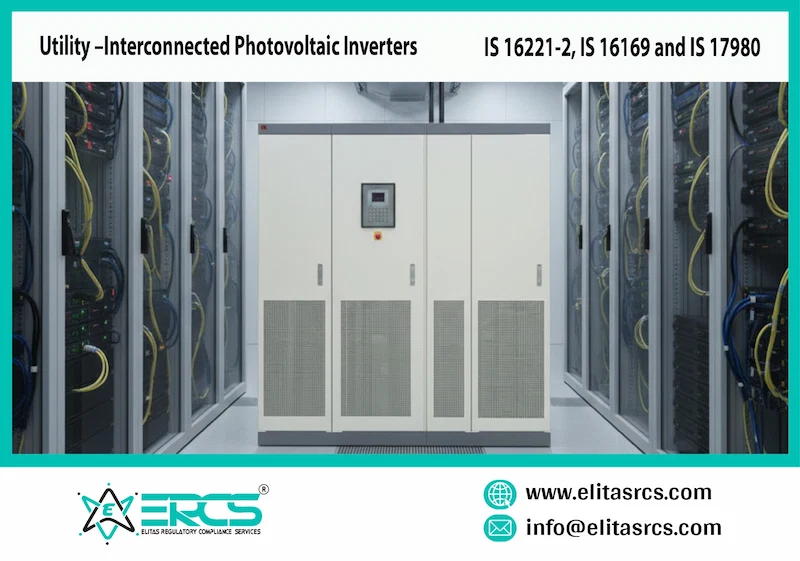
Utility-interconnected photovoltaic inverters, also known as solar inverters, help to save energy. A grid-connected photovoltaic (PV) system generates electricity from solar power and is linked to the utility grid. This system includes solar panels, one or more inverters, a power conditioning unit, and equipment to connect to the grid. As these electronic products are used in the Indian market, their quality and safety are crucial. Registering Utility-Interconnected Photovoltaic (PV) inverters with the Bureau of Indian Standards (BIS) is a must under the Compulsory Registration Scheme (CRS). This registration ensures that the inverters meet Indian safety and performance standards, specifically IS 16221-2 for safety, IS 17980, and IS 16169 for grid-tied performance. To complete the process, submit the test report from the BIS-approved lab along with the necessary documents, including ISO certificates, trademark information, and CDF/CCL forms through the BIS portal.
Key Specifications of Crystalline Silicon Terrestrial Photovoltaic (PV) modules under CRS Registration
Utility-interconnected photovoltaic (PV) inverters, or grid-tied inverters, are used to convert DC power from solar panels to AC power for direct use, net metering, or grid feeding. These inverters are very important for residential and commercial solar power systems, providing functions such as automatic shutdown during a grid outage for safety. However, these inverters have to meet the mandatory requirements of standards in India, such as IS 16221 (Part 2), IS 16169, and IS 17980, for efficiency and safety.
Key highlights under IS 16221 (Part 2), IS 16169, and IS 17980
a). IS 16221 (Part 2) - Safety Requirements:
Protection against electrical shock: Proper insulation, protective earthing, and safe touch voltages.
Mechanical hazards: Robust construction to withstand environmental and handling stresses.
Thermal hazards: Prevention of overheating during normal and abnormal operation (e.g., component failure).
Fault conditions: Ensuring the inverter fails safely without causing fire or hazards.
b). IS 16169 - Anti-Islanding Testing:
Anti-Islanding Protection: Validates that the inverter detects a utility power failure and ceases to export power within a specified time (anti-islanding detection) to protect grid personnel.
Operational Stability: Ensures the inverter remains stable during utility voltage or frequency fluctuations.
c). IS 17980 - Efficiency and Performance:
Efficiency Measurement: Sets methods for calculating and verifying the efficiency of the photovoltaic inverter.
Performance Declaration: Manufacturers must declare specific efficiency ratings for each model, which are verified by the BIS-recognized test lab.
Benefits of the BIS CRS Registration for Utility –Interconnected Photovoltaic inverters
BIS Registration India for utility-interconnected photovoltaic (PV) inverters is mandatory in India to ensure safety, quality, and grid compatibility, as per IS 16221, IS 16169, and IS 17980 norms. The major advantages are:
- Mandatory Compliance & Market Entry: It is mandatory to sell and market PV inverters in India, thereby avoiding the risk of product confiscation or litigation.
- Safety & Grid Stability: It ensures that the PV inverters adhere to very high safety standards (resistant to shock/fire) and are also synchronized with the utility grid in the correct manner, thereby avoiding grid instability.
- Improved Credibility & Brand Recognition: It serves as a quality marker, thereby boosting customer confidence and offering a competitive advantage in the renewable energy sector.
- Government Tenders: Products must take part in government-supported solar initiatives and tenders.
- Improved Quality Performance: It ensures that the products are checked for high reliability, thereby lowering maintenance costs and enhancing the overall efficiency of solar energy systems.
Document Required for IS 16221 (Part 2), IS 16169 & IS 17980
The following documents need to be prepared for a hassle-free BIS registration process:
- CDF / CCL Form
- BIS Application Form
- Manufacturing Unit Business License (English translation and local language copy)
- Business License Scope Document (English translation and local language copy)
- Manufacturer ISO Certificate
- Product Marking Label / Marking Details
- Authorization Letter (in case the signing authority is different from the manufacturing head)
- Trademark Registration Certificate
- Trademark Authorization Letter (in case the trademark is not owned by the manufacturer)
- Authorized Indian Representative (AIR) Company Registration Proof in India (for foreign manufacturers)
- Identity Proof of AIR / Authorized Signatory
- Product Technical Specification Sheet / User Manual
Applicable Test Parameters for Photovoltaic inverters
a). Safety Requirements (IS 16221 Part 2 / IEC 62109-2):
- Environmental Testing: Protection degree (IP 65 for outdoor, IP 54 for indoor) and thermal robustness.
- Protection Functions: Anti-islanding (active and passive), over/under voltage, and over/under frequency sensing.
- DC Insulation Resistance & Ground Fault: For safe functioning.
b). Performance & Efficiency (IS 16169:2019 / IS 17980:2022 / IEC 61683):
- Efficiency Measurement: Power conversion efficiency at 10%, 25%, 50%, 75%, and 90-100% loads.
- MPPT Accuracy: Static and dynamic maximum power point tracking efficiency.
- Output Power Quality: Total Harmonic Distortion (THD) and DC injection levels.
c). Grid Interconnection (IS 16169 / IS 17980):
- Reconnection Timing: Time taken to reconnect after grid stabilization (e.g., 60 seconds).
- Auto Disconnect Timing: Should disconnect within 2 seconds of a power outage.
- Grid Voltage/Frequency Variation: Should function normally during grid variations.
Process of BIS CRS Certification of Utility –Interconnected Photovoltaic inverters
There are various procedures for Indian and foreign manufacturers for registration with the Bureau of Indian Standards (BIS). To apply for BIS Registration India, kindly follow these steps:
a). For Foreign Manufacturers:
- Appoint an Authorised Representative (who is based in India) to represent the manufacturer
- Register on the Bureau of Indian Standards (BIS) portal
- Fill out an online application form
- Submit samples for testing to a Bureau of Indian Standards-accredited laboratory, and upload the results of the tests to the BIS portal
- Make payment and submit the applications
- The Bureau of Indian Standards will review the application
- If there are no queries, the Bureau of Indian Standards will issue a license on behalf of the manufacturer.
b). For Indian Manufacturers:
- Register on the Bureau of Indian Standards (BIS) portal
- Fill out an online application form
- Submit samples for testing to a Bureau of Indian Standards-accredited laboratory, and upload the results of the tests to the BIS portal
- Make payment and submit the applications
- The Bureau of Indian Standards will review the application
- If there are no queries, the Bureau of Indian Standards will issue a license on behalf of the manufacturer.
Checklist of Points for Obtaining BIS Registration of IS 16221 (Part 2), IS 16169 & IS 17980
- Identify the applicable Indian Standard (IS) for the product
- Confirm the product category under the BIS CRS-notified products
- Finalize model numbers and variants
- Select a BIS-recognized laboratory for testing
- Prepare product technical specification sheet/datasheet
- Complete testing and obtain the BIS test report
- Prepare CDF / CCL and application documents
- Arrange manufacturer and trademark documents
- Appoint an Authorized Indian Representative (AIR) (for foreign manufacturers)
- Submit the application on the BIS portal and respond to queries
- Implement BIS CRS marking after approval
- Maintain records for surveillance, renewal, and model addition
BIS CRS Registration Fees in India for Photovoltaic inverters
The fees for BIS registration of the Utility –Interconnected Photovoltaic inverters are given below:
|
COST FOR BIS REGISTRATION / ELECTRONICS PRODUCTS (Government Costs) |
|||
|
Type of Fee |
New Application |
Renewal |
Inclusion |
|
Application Fee |
1000 |
1000 |
1000 |
|
Processing Fee* |
25,000x2 = 50,000 |
25,000x2 = 50,000 |
15,000x2= 30,000 |
|
Registration Fee* |
1000 x 2 = 2000 |
1000 x 2 = 2000 |
1000 x 2 = 2000 |
|
Total |
53,000 |
53,000 |
30,000 |
|
Note* 1. The processing fee and registration fee need to be paid within 2 years, as registration numbers will be granted initially for two years. 2. The cost of BIS registration will depend on the following factors: · Location and Name of the Manufacturing Process (Overseas/ Domestic) · Types of Products and model quantity · Testing fee for the products · Govt. Fee (BIS) and ERCS Service Fee |
|||
How ERCS Private Limited Can Help You in Obtaining BIS Registration of Utility – Interconnected Photovoltaic Inverters?
ERCS Private Limited makes the BIS registration process for utility-interconnected photovoltaic inverters easier by acting as a bridge between the manufacturers and the BIS authority. They offer end-to-end consultancy services, including testing, documentation, Authorized Indian Representative services, and more, to ensure a hassle-free, timely, and compliant certification process.
- Complete End-to-End Support: Documentation, lab testing, and application filing and approval – all handled under one roof.
- Faster Approvals, Fewer Rejections: Pre-verification of documents and technical review to reduce BIS queries and delays.
- Excellent Technical Expertise: In-house compliance specialists advise you on standards, model grouping, labelling, and testing.
- AIR Services for Global Brands: Complete coordination for foreign brands entering the Indian market.
- Post-Certification Support: Assistance with marking, renewals, surveillance, and model additions.