BIS Registration (CRS) for
Rice Cooker
IS 302 (PART 2) SECTION 15
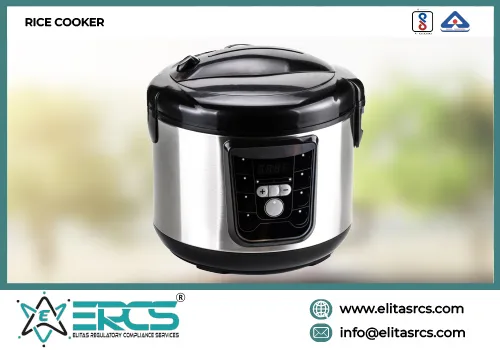
Rice cookers have become an essential piece of cooking equipment in recent days. A Rice cooker, also known as a rice steamer, has two main parts, which include its main body pot and its inner container that holds rice. The device operates through electrical power. The Bureau of Indian Standards has established a requirement for electric rice cookers to register with their Compulsory Registration Scheme since April 2021. Manufacturers must follow the standards IS 302-2-15. The main aim of BIS is to provide safety and reliability to consumers.
The standard IS 302 Part-2 provides comprehensive safety guidelines that address protection against electrical hazards, fire risks and mechanical failures. Each rice cooker undergoes extensive testing procedures at BIS-recognised laboratories to verify its compliance with performance and safety requirements. You cannot sell or import rice cookers without the necessary BIS CRS Registration, which must follow IS 302-2-15 requirements.
Key Specifications of Rice Cooker Under CRS Registration
The rice cooker has evolved into a more intelligent cooking device. A Rice cooker, an automatic cooking device, operates as a rice steamer. The development of technology has introduced additional capabilities to the system, which now includes sensors and automatic shut-off functions. The electric rice cooker simplifies cooking for people who need to prepare rice. The device enables anyone to achieve perfect rice cooking results. The device name indicates its primary function, which involves cooking rice, but it also supports more than 50 additional cooking methods.
In India, rice cookers require mandatory BIS registration, which must be obtained through the Compulsory Registration Scheme (CRS). The certification process follows Indian Standard IS 302-2-15, which establishes safety and performance standards that must be met.
Key Highlights for IS 302-2-15 for Rice Cooker
Key highlights under IS 302-2-15 for obtaining BIS Registration of Rice Cooker:
- Scope: This standard pertains to a rice cooker that will be utilised at home or a similar location that operates on nominal supply voltages (up to 250V AC).
- Construction Safety: The rice cooker shall be constructed so that electric shock hazards have been eliminated with adequate insulation, clearance and creepage distance.
- Identification Requirements: The identification label on the rice cooker should provide information on the manufacturer (or brand), model number, rated voltage, power, frequency and which BIS standard applies to the product.
- Electrical Safety Testing: The following electrical safety tests must be performed on rice cookers: earth continuity (where applicable), insulation resistance, dielectric strength and leakage current.
- Cooking Performance: The rice cookers will operate within acceptable temperature limits under normal use.
- Safety in Abnormal Conditions: The rice cooker is safe during periods of either overload or other abnormal operating conditions.
- Mechanical Integrity: The construction, component, and power cord connections are all to be designed for mechanical integrity and strength.
BIS Registration Benefits for Rice Cookers Under Scheme II
Key Advantages of BIS CRS Registration for Rice Cookers:
- Basic Compliance and Market Access: In India, it is required to ensure compliance with Laws relating to the manufacture and importation of electric rice cookers in order to avoid detention by customs at ports of entry and to prevent rejection of shipments by Indian Customs.
- Consumer Confidence and Quality Assurance: Establishing that the product meets applicable criteria for being high quality, safe, and dependable (IS 302-2-15: 2009) will generate trust and credibility for the manufacturer's brand.
- Delivery of Safety Assurance: The testing of the product for electrical safety provides manufacturers with assurance that their products do not present hazards to users (e.g., electric shock, insulation failure, overheating).
- Competitive Advantage: The presence of the BIS Standard Mark with an R-number on the product differentiates it from other products in the market that are not certified and of lower quality.
- Reduced Liability and Risk: The award of the BIS mark reduces the risk of recalls, legal issues or injuries and thus reduces the amount of money the manufacturer can expect to lose due to those events.
- Access to Tenders: The award of the BIS mark is a must-have in order to be eligible to bid on tenders from government entities and other buyers of large quantities of products.
Documents Required for BIS Registration of IS 302-2-15 in India
Below, you can go through the list of important documents required for CRS Registration of IS 302-2-15:
- Complete BIS application (Form I) and registration form.
- Test Report (sample constructor confirmation) from a BIS test laboratory.
- CDF (Component Details List) and CCL (Construction Details List).
- Technical specification sheet or user manual for rice cookers.
- Business Licence; includes translation into English (if applicable) and the Business Licence Scope.
- ISO certificate of the manufacturing facility.
- Trademark certificate/authorisation letter.
- Label/marking details for product.
- Authorisation letter for the signing individual, signed by the owner/company.
- Photo ID of authorised signer.
- Designation of authorised Indian representative (AIR).
- Registration proof of the AIR company/nomination letter.
Applicable Test Parameters for Rice Cookers for BIS Registration of IS 302-2-15
Relevant Testing Parameters for (IS 302-2-15):
- Electrical Protection and Insulation: Test to ensure protection from electric shock, moisture resistance and insulation resistance.
- Thermal and Fire Hazard Protection: Testing and evaluation of heating elements, temperature control and resistance to abnormal heat and/or fire.
- Mechanical Strength & Construction: Durability testing of components, internal wiring and structural safety of the cabinet.
- Performance Measurement: While primarily focused on safety, additional testing for boiling time and operational reliability is often conducted.
- Markings and Instructions for User: Verification of correct labelling and instructions for use.
Checklist of Points to Consider for BIS Registration of Rice Cooker
Here is an easy-to-understand checklist of items on how to obtain BIS Registration of Rice Cooker (as per IS 302-2-15) in the form of a complete series of single-point list items:
- A rice cooker must fall under the BIS Compulsory Registration Scheme (CRS).
- The relevant Indian Standard for rice cookers is IS 302-2-15.
- Rice cookers shall have a rated voltage not greater than 250 V AC.
- Rice cookers are designed to be used in homes and/or similar locations.
- To be a rice cooker, it must be safe from electric shock.
- Rice cookers shall have sufficient insulation, creepage distance, and clearances.
- All live parts must be inaccessible during normal operation.
- The rice cooker shall pass the requirements for insulation resistance and dielectric strength.
Process of BIS CRS Certification of IS 62368 (Part 1) in India
The registration process varies for Indian and foreign manufacturers. Firstly lets take a look on steps to obtaining registration as a Foreign Manufacturer:
a). Steps of BIS Registration for Foreign Manufacturers:
- You need AIR from India, and this person must act as a representative for your company.
- You must register an account on the BIS portal.
- Once you are registered for an account, you may then proceed to apply for your BIS application by completing an online BIS Application.
- Testing of samples should be done at a BIS-accredited laboratory. The laboratory results file should be uploaded to the BIS portal.
- Pay the fee to BIS and then submit the application to BIS.
- The BIS will then review your application.
- If there are no deficiencies indicated in the application, BIS will issue a Certificate of Conformance (License)
b). The following is an overview of the steps applicable to domestic manufacturers:
- You have to register for an account on the BIS portal.
- After you have successfully created an account by registering, you can then move ahead with filling out and submitting your application for BIS using the Online BIS Application.
- You need to get the testing of your samples done at a BIS laboratory and upload the results file on the BIS Portal.
- You will have to pay the necessary fee to BIS, and then your application will have to be submitted
BIS CRS Registration Fees in India for IS 302-2-15
The cost for BIS registration of the Rice Cooker is given below:
|
COST FOR BIS REGISTRATION / ELECTRONICS PRODUCTS (Government Costs) |
|||
|
Type of Fee |
New Application |
Renewal |
Inclusion |
|
Application Fee |
1000 |
1000 |
1000 |
|
Processing Fee* |
25,000x2 = 50,000 |
25,000x2 = 50,000 |
15,000x2= 30,000 |
|
Registration Fee* |
1000 x 2 = 2000 |
1000 x 2 = 2000 |
1000 x 2 = 2000 |
|
Total |
53,000 |
53,000 |
30,000 |
|
Note* 1. The processing fee and registration fee need to be paid within 2 years, as registration numbers will be granted initially for two years. 2. The cost of BIS registration will depend on the following factors: · Location and Name of the Manufacturing Process (Overseas/ Domestic) · Types of Products and model quantity · Testing fee for the products · Govt. Fee (BIS) and ERCS Service Fee |
|||
Why Choose ERCS Private Limited for BIS Registration of IS 302-2-15?
ERCS Private Limited can be your best choice as a BIS CRS Consultant for rice cookers in India. Please go through the important factors:
- Invested in Providing Support for Electrical Safety Expertise: Supports all essential electrical safety standards, including IS 302 (Part 2/Section 15. Providing specialist advice covering the most critical tests of electrical appliances.
- Comprehensive Service Portfolios: In addition to providing services for registering products for Indian Standards, ERCS are also the Authorised Indian Representative (AIR) for manufacturers from foreign countries.
- Proactive Support with Compliance: Conduct pre-audit inspections to discover any issues prior to the manufacturing, so when the manufacturing facility undergoes its Bureau of Indian Standards (BIS) audit.
- Knowledge and Experience of Staff: They have more than 20 qualified engineers who have a wealth of experience working in ISI mark or BIS CRS certification and will be able to provide the most cost-effective and reliable services.
- Single Source for Process Management: Manage the complete process from testing done by laboratories recognised by BIS to ensure that you have been fully certified by BIS, and that there is no likelihood of non-conformance at all.