BIS Registration (CRS) for
Power inverters for use in photovoltaic power system
IS 16221 Part-2 and 61683
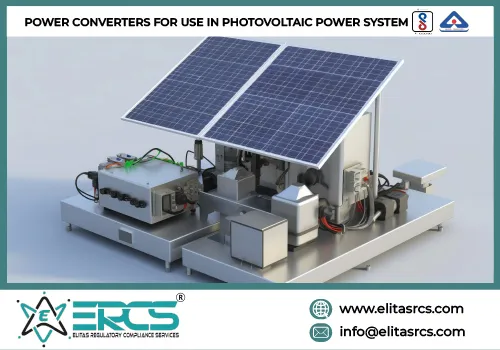
Power Inverters for use in Photovoltaic Power Systems transform direct current from multiple solar panels into alternating current. Microinverters work with individual solar panels to transform direct current into alternating current. The system needs advanced control algorithms that maintain continuous operation to monitor grid conditions and adjust converter output. These Electronic products must obtain BIS CRS Registration under Scheme-II of Schedule-II, which requires compliance with IS 16221-2 for safety and IS 61683 for efficiency. The Indian Standard 16221-2 establishes guidelines for electrical and mechanical safety, including protection against shocks, thermal hazards, and islanding events, while IS 61683 evaluates inverter efficiency and operational performance.
Key Specifications of Power Inverters under CRS Registration
Power inverters used in photovoltaic (PV) power systems convert direct current (DC) generated by solar panels into alternating current (AC) suitable for grid supply or local consumption. Power inverters function as vital parts of solar photovoltaic systems because they enable the system to convert energy and connect to both grid and off-grid power systems. The product use grid-interactive, stand-alone, and hybrid inverter types, which support operation with batteries and other energy storage devices. While obtaining BIS Registration IS 16221 (Part 2) and IS 61683 comply with safety performance and environmental standards.
Key Highlights under IS 16221-2 & IS 61683
The power inverters used in photovoltaic power systems must comply with Indian standards through the BIS CRS. The two primary standards are IS 16221 (Part 2) (safety requirements for PV inverters) and IS 61683 (efficiency measurement of power conditioners). The Ministry of New and Renewable Energy issued a Quality Control Order that requires all solar inverters to follow these specific standards.
IS 16221 (Part 2) (Safety Requirements) provides essential safety requirements.
- Safety Scope: The system protects users through electrical shock protection, energy hazard protection, fire safety measures, and mechanical hazard protection during normal operation and fault conditions.
- Key Tests: Insulation resistance, protective earthing, and touch voltage and thermal stability tests protect against potential overheating dangers.
- Application: The Compulsory Registration Scheme (CRS) requires all grid-tied and off-grid solar inverters to meet Indian safety standards.
The IS 61683 (Performance Standards) document contains essential information on its key features and operational requirements.
- Efficiency Measurement: The standard establishes Power Inverter efficiency measurement standards that photovoltaic systems must follow.
- Compliance Verification: Efficiency testing results must be declared by manufacturers for every product model they produce.
- New Implementation Rule: All BIS licenses issued on or after July 27 ,2025, need to follow this standard together with IS 16221-2 requirements.
Benefits of the BIS CRS Registration for Power Inverters
The BIS Mark on Power Inverters provides multiple benefits to users. The certification helps businesses establish market presence, which leads to better customer trust and prevents legal problems while making it easier for customs procedures and delivering a business edge.
- Legal Compliance and Market Access: Mandatory for selling inverters, solar inverters, and UPS in India, it prevents legal issues, penalties, and ensures smooth customs clearance for imports.
- Consumer Confidence and Trust: Acts as a quality mark that reassures users about product safety and reliability.
- Safety Assurance: The system protects users from electrical hazards, which include shocks, fires, and equipment failure that occurs when voltage levels exceed safe limits or when overheating happens.
- Competitive Advantage: Certified products stand out in the market, demonstrating superior quality and performance compared to non-certified, cheaper alternatives.
- Quality Standardisation: The process requires manufacturers to follow established technical standards, which results in increased product reliability.
- Enhanced Reliability: The system guarantees that inverters maintain their work ability and power efficiency across different electricity supply scenarios.
Document required for BIS registration under IS 16221-2 & IS 61683
- Duly signed BIS Application Form (Form VI).
- Test Report from a BIS Laboratory (report not older than 90 days) meeting both the requirements of IS 16221-2 (Safety) and IS 61683 (Efficiency).
- Critical Components List/Construction Data Sheet (for transformers, capacitors, PCB, etc).
- User Manual/Technical Specification Sheet
- Schematic and PCB layout.
- Label/Marking information
- Copy of license showing manufacturer's address and terms allowed.
- Proof of Business Incorporation
- Trade Mark Authorisation Letter
- Nomination Form of Authorised Indian Representative (AIR)
- Notarised Affidavit of Foreign Manufacturer.
Applicable Test Parameters for Power Inverters IS 16221-2 & IS 61683
This standard provides requirements for safety related to photovoltaic system power converters from electrical, thermal, and mechanical hazards.
- Electric shock protection: Insulation, earthing, and touch voltage must be validated.
- Voltage Test: Insulation resistance and dielectric strength must have the ability to withstand high voltage.
- Thermal Cycling: Gradual temperature increase and thermal stability evaluation of the thermal cycling operation.
- Environmental protection: Protection against backfeed voltage to prevent accidental flow of voltage into the PV array or the grid from the inverter whilst turned off.
- Mechanical integrity: Verification of the enclosure's integrity.
- Marking & labelling: Labels must be permanently affixed and legible.
Process of BIS CRS Certification for Power Inverters IS 16221-2 & IS 61683
For registration with the Bureau of Indian Standards (BIS), the Indian and foreign manufacturers have to follow different procedures for BIS Registration Certificate. The following are the procedures to register:
a). Steps for Foreign Manufacturer Registration:
- Appoint an Authorised Representative to act as a representative of the foreign manufacturer
- Create an online account on the Bureau of Indian Standards (BIS) portal
- Complete an online application
- Submit samples for testing at a Bureau of Indian Standards-accredited laboratory, and submit test results for those samples to the BIS Portal.
- Make the payment for the application fees and submit the application.
- The Bureau of Indian Standards will respond to your application.
- If there are no issues with your application, the Bureau of Indian Standards will issue a license on behalf of the foreign manufacturer.
b). Steps for Indian Manufacturer Registration:
- Create an online account on the Bureau of Indian Standards (BIS) portal
- Complete an online application
- Submit samples for testing at a Bureau of Indian Standards-accredited laboratory, and submit test results for those samples to the BIS Portal.
- Make the application fee payment and submit the application.
Checklist of Points for Obtaining BIS Registration of IS 16221-2 & IS 61683
- Ensure no significant differences exist between the mass-production samples and those being tested to prevent being rejected or losing your permission to operate.
- You should finish finalising your design before you have done any tests, as major design changes will need re-tests and new registration.
- You need to get the correct categorisation of your product, as classification will apply different standards to your product as a result.
- Ensure you check the declared electrical ratings carefully, as BIS will check the electrical ratings used against the electrical figures in your tested products before they register you.
- Having good quality control and trackability systems in place is important to stay compliant once you have been approved.
- Be aware of QCO / BIS guidelines for labelling, installation instructions, and safety warnings as they are changing quickly to comply with new regulations associated with solar inverters.
BIS CRS Registration Fees in India for Power Inverters
The fees for BIS registration of the Power Inverters for use in Photovoltaic Power Systems are given below:
|
COST FOR BIS REGISTRATION / ELECTRONICS PRODUCTS (Government Costs) |
|||
|
Type of Fee |
New Application |
Renewal |
Inclusion |
|
Application Fee |
1000 |
1000 |
1000 |
|
Processing Fee* |
25,000x2 = 50,000 |
25,000x2 = 50,000 |
15,000x2= 30,000 |
|
Registration Fee* |
1000 x 2 = 2000 |
1000 x 2 = 2000 |
1000 x 2 = 2000 |
|
Total |
53,000 |
53,000 |
30,000 |
|
Note* 1. The processing fee and registration fee need to be paid within 2 years, as registration numbers will be granted initially for two years. 2. The cost of BIS registration will depend on the following factors: · Location and Name of the Manufacturing Process (Overseas/ Domestic) · Types of Products and model quantity · Testing fee for the products · Govt. Fee (BIS) and ERCS Service Fee |
|||
Why Choose ERCS Private Limited for BIS Registration of IS 16221-2 & IS 61683?
ERCS Private Limited is the first choice for BIS registration of power inverters (IS 16221-2 & IS 61683) because of their expert, end-to-end consultancy services, including documentation, NABL lab testing, and coordination with BIS authorities. They provide specialised support for overseas manufacturers through Authorised Indian Representative (AIR) services, ensuring faster approval, fewer rejections, and comprehensive post-approval support.
- ERCS has in-depth knowledge of the regulations related to photovoltaic inverters, such as safety, performance, and efficiency standards as specified in IS 16221-2 and IS 61683.
- Handles the entire BIS CRS process, from document preparation and submission to testing and approval.
- Helps with product testing at BIS-approved labs to ensure compliance with safety, efficiency, and performance standards.
- The team of experts reduces rejections by providing correct technical documentation, test report analysis, and submission.
- Offers Authorised Indian Representative (AIR) services to facilitate certification for international brands entering the Indian market.