BIS Registration (CRS) for
Microwave Ovens
IS 302-2-25
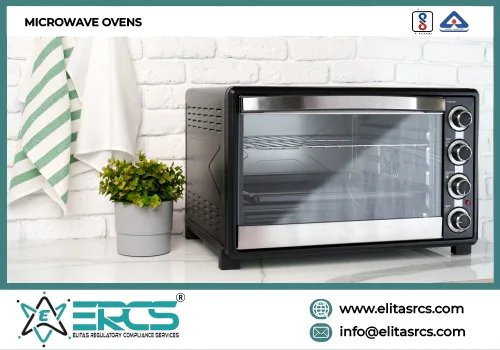
The BIS Registration for Microwave Ovens under the CRS is compulsory as it is the most important appliance used in households. The prototype of the microwave was created by Percy Spencer while at Raytheon Corporation. His microwave was invented in 1945 and eventually developed into microwave ovens, which became popular household appliances worldwide. They are appliances that use microwave radiation to cook food, heat it, or defrost it. The basis of microwave operation is the electromagnetic waves heating the food inside, hence cooking or reheating it.
An increase in demand for household appliances has led to tighter regulations concerning safety, quality, and performance. One such regulation is the Bureau of Indian Standards (BIS). Certification under the compulsory registration scheme for microwave ovens, hence, as per Indian Standards IS 302-2-25, a microwave oven should be registered with the BIS before it is sold, imported, or distributed in India.
Specification for Microwave Ovens under BIS Scheme-II
Microwave ovens have become a must-have kitchen appliance to quickly cook, heat, or defrost food. They work by producing electromagnetic radiation or microwaves (energy) in the microwave frequency range. When a microwave oven is turned on, the microwaves pass through the container into the food, causing the water molecules in the food to vibrate, making friction to produce heat, essentially cooking the inside of the food first which makes this style of cooking efficient and economical too.
There are many kinds of microwaves including Solo, Grill and Convection microwaves. The BIS Certification of this product is compulsory as it provides quality, safety, and standard to the product.
Key aspects of IS 302-2-25
Let’s go through the key specification of IS 302-2-25:
1. Scope: Household microwave ovens and ovens of a similar nature including combination microwave ovens which can grill and convection heat.
2. Rated Voltage and Frequency:
- Operating Voltage: 220V – 240V AC.
- Frequency: 50 Hz.
3. Microwave Radiation Leakage:
Microwave radiation leakages shall not exceed 5 mW/cm² at a distance of 5 cm from any surface of the oven under both normal and fault conditions.
4. Constructional Requirements:
Door Interlock System: At least two independent interlocks for ensuring that the oven stops when the door opens.
- No microwaves shall be generated when the door is opened or not closed properly.
- Effective shielding to avoid leakage of microwave energy.
- The oven surface shall have smooth surfaces and edges to minimize injury to the user.
5. Dielectric Strength: No breakdown shall occur under 1250V AC for 1 minute.
6. Insulation Resistance: 7 MΩ minimum with dry conditions.
7. Earthed Resistance: 0.1 ohm maximum.
8. Protection against electric shock: Appliances classified as Class I (earthed).
9. Temperature Rise: During normal operation and conditions, the surface temperatures will not reach excessive levels to cause burns or fire.
10. Mark information: Name of manufacturer/importer, a model number, rated input power, rated supply voltage, supply frequency, and BIS registration number.
BIS Registration Process for Microwave Ovens
The BIS (Bureau of Indian Standards) registration process for microwave ovens includes several steps. Now, let’s review the BIS CRS Registration process. The BIS Scheme-II outlines different processes for both Domestic (Indian) and foreign manufacturers.
A) Process for Foreign Manufacturers
Go through the table below to complete the BIS CRS registration:
- Nominate an Indian representative to represent a foreign manufacturer.
- Submit an online application
- Have a sample tested at a BIS-approved laboratory.
- Submit a hard copy of your application along with the sample test report, either online or offline.
- BIS officials will verify the application
- Obtain the license
B) Process for Domestic Manufacturers
Below, we have mentioned the process of domestic manufacturers:
- Apply online or offline
- Along with a sample testing report from a BIS-approved laboratory.
- BIS officials will verify the application before granting the license
C) Essential Criteria for BIS CRS Registration
BIS approval for CRS Indian standards must comply with four essential pillars. Without these four requirements, the applicant is unable to move forward with the CRS Registration process. The following are the requirements to achieve BIS registration in India.
- Manufacturer: Only manufacturers receive CRS BIS licenses, never importers or sellers. An importer may act on behalf of a foreign manufacturer in BIS applicant forms, but importers don't get a license.
- Manufacturing Address: The application process documents must include detailed address information for manufacturing. If the manufacturer has multiple factory sites for one product, then it must get a BIS CRS Registration Certificate for each factory.
- Product: Every product will require its license. If it has different models that fall under the same product classification, one license/registration number will cover all models of that product classification. In other words, one license tracks one product classification with multiple models.
- Brand/trademark: Each brand/trademark presented with the product will need its own BIS license.
Recommendations for Authorized Indian Representative (AIR) for Microwave Ovens Certification
In foreign stakeholders' efforts to obtain a Bureau of Indian Standards (BIS) certificate for their operations in India, they must procure an Authorized Indian Representative (AIR) unless they have a branch office in India. The AIR will act as the importers' representatives, will manage the certificate and submit the application for certification, and assist with any inquiries.
- When the foreign manufacturer chooses an AIR, there are also a few recommendations to follow.
- If the foreign manufacturer has an office/branch office in India, this office can be appointed as the AIR.
- If the foreign manufacturer does not have an office/branch in India, but the proprietor or registered user of the brand/trademark can be appointed as the AIR.
- If the foreign manufacturer does not have an office/branch or shareholding stakeholder in India but appears to have a registered user/proprietor of the brand, this can be appointed as the AIR.
BIS CRS Registration Cost in India for IS 302-2-25
The fee for BIS registration is provided in the table below:
|
COST FOR BIS REGISTRATION / ELECTRONICS PRODUCTS (Government Costs) |
|||
|
Type of Fee |
New Application |
Renewal |
Inclusion |
|
Application Fee |
1000 |
1000 |
1000 |
|
Processing Fee* |
25,000x2 = 50,000 |
25,000x2 = 50,000 |
15,000x2= 30,000 |
|
Registration Fee* |
1000 x 2 = 2000 |
1000 x 2 = 2000 |
1000 x 2 = 2000 |
|
Total |
53,000 |
53,000 |
30,000 |
|
Note* 1. The processing fee and registration fee need to be paid within 2 years, as registration numbers will be granted initially for two years. 2. The cost of BIS registration will depend on the following factors: · Location and Name of the Manufacturing Process (Overseas/ Domestic) · Types of Products and model quantity · Testing fee for the products · Govt. Fee (BIS) and ERCS Service fee |
|||
Essential Documents Required Under BIS CRS Registration
The following list mentioned below is mandatory for IS 302:
- Completed Testing forms CDF /CCL FORM
- Completed BIS Application form
- Business licensing of manufacturing unit
- ISO certificate of the manufacturer
- Marking label/marking details on the product.
- Authorization letter.
- Trademark certificate
- Proof of company registration for an authorized Indian representative in India, or a nomination letter for AIR.
- Technical specifications sheet of the product/manual.
Why Choose ERCS?
ERCS is a BIS CRS Certificate Consultant, providing full assistance in getting you a BIS CRS (Compulsory Registration Scheme) certification. In addition, you will have the advantage of getting an affordable and quick service to help in advertising your products and services to the public and trust your service or product.
Here are some suggestions as to why you may choose ERCS for BIS CRS registration:
- Experienced team: ERCS has an experienced team that understands the nuances of BIS registration, specifically about the CRS scheme.
- Determining product applicability: ERCS assists in determining the product applicability under the CRS and whether registration is required.
- Assisting in document preparation: ERCS helps prepare all the required documents and ensures they are included in the application.
- Act as a paper trail between you and BIS: ERCS acts on your behalf & performs as a middleman between you and BIS for better communication and efficiency.
- Simple experience: ERCS works to alleviate the complexity of any BIS registration and help make the experience as simple as possible.