BIS Registration (CRS) for
Electronic Clocks with Mains Powers
IS 302-2-26
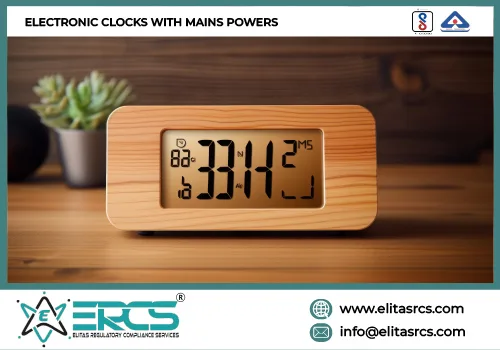
Electronic clocks are designed for accurate timekeeping in private homes, schools, and the public domain. Since they receive mains electricity for their power supply, they must be electrically safe and perform well. Therefore, the Bureau of Indian Standards (BIS) has published the IS 302-2-26 Quality Control Order (QCO), which mandates CRS Registration before the sale or use of an electronic clock. The CRS Registration demonstrates that they all comply with IS 302-2-26 requirements of electrical safety, performance, and parts durability.
BIS CRS Registration is mandatory for all manufacturers, importers, and brand owners. Here, it demonstrates quality and reliability, builds consumer trust, and increases acceptance in the market. We will go over the major compliance requirements, testing standards, and documentation, as well as the registration process for BIS CRS - enabling businesses to achieve certification quickly and with confidence.
Specification for Electronic Clocks with Mains Power under BIS Scheme-II
Electronic clocks that operate on mains power must comply with IS 302-2-26 and are certified under the Bureau of Indian Standards (BIS) Compulsory Registration Scheme (CRS). This standard specifies safety requirements to protect against hazards such as electric shock and fire, along with guidelines for construction, isolation, and performance. Manufacturers are required to register their products, undergo testing by a BIS-approved laboratory, and meet specific documentation requirements before they can legally sell these products in India.
Key Aspects of IS 302-2-26
Below, you can go through the specification of Indian Standard 302-2-26:
- Scope: Applies to mains-operated electric clocks, including alarm clocks and clocks with electrical winding mechanisms, with a rated voltage not exceeding 250𝑉 AC or DC.
- Safety and protection: Mandates protection against electric shock, fire, and mechanical hazards during normal use and through fault conditions.
- Construction requirements: Specifies constructional aspects, including insulation, construction, temperature limits, and moisture resistance to ensure safety and durability.
- Performance and stability: Requires stable performance and reliable power components, ensuring thermal protection and preventing issues like short circuits
- Compliance: Adherence to this standard is mandatory for products to receive BIS certification, which is necessary for market access in India.
- Mandatory testing: Includes a range of tests to verify compliance, such as Power input and current, Heating or temperature rise, and more.
Prerequisites For Obtaining Bis Registration
Now, let’s go through the basic requirements for obtaining BIS CRS Registration in India:
- Manufacturers: A BIS license is issued to the manufacturer. An importer or Trader is not eligible to get a BIS license. An importer can be an Authorized Indian Representative (AIR) of a foreign manufacturer license will be issued to the Manufacturer.
- Manufacturing Address: The Manufacturer has to mention the same address in the application as mentioned in the Business License. If a manufacturer has more than one manufacturing location, then a separate BIS license/Registration is required for each location.
- Products: Each product Category/ Indian Standard requires a BIS Registration number. But if the same product category includes several models or series models, one License / Registration Number can cover all Series models of the same product category or lead model.
- Brands / Trademarks: For every/brand or Trademark, a separate BIS Registration Number is required.
Procedure for Obtaining CRS Registration for Electronic Clocks with Mains Powers
The BIS Registration process differs for domestic (Indian) manufacturers and foreign manufacturers. Let’s review the registration process under the BIS CRS Scheme:
Process for a Foreign Manufacturer
- Nominate an Indian Representative who will act on behalf of the Foreign Manufacturer.
- Fill out the application form online.
- Samples will need to be tested in a BIS-approved laboratory. The hard copy of the application and the testing report will need to be submitted online or offline.
- BIS officials will review your application.
- A license will be issued.
Process for the Domestic Manufacturer
- Submit an application form online or offline.
- Along with the samples chosen and tested, a BIS laboratory-approved testing report is provided.
- The application will be processed by BIS agents.
List of Documents Required Under BIS CRS Registration
Below, you can go through the important documents required for CRS Registration under IS 302-2-26
- The BIS application form was filled out properly.
- Name and address documentation for the factory and the applicant.
- Third-party lab test report in accordance with Indian Standards
- If the Application is signed by an authorised signatory, an authorization letter from the CEO in that person's name is necessary.
- The Indian Agent and Nomination Form information applies to overseas or international manufacturers.
- Technical information on the items, including the PCB layout, the schematic diagrams, the user guide, and the critical component list
- Recognition receipt
- Undertaking and Affidavit certified with ID Proof and authorised Native Representative's signature" (in case of the foreign or overseas manufacturer)
- Official Test Results from the BIS Laboratory
BIS CRS Registration Cost of Electronic Clocks in India
The fee for BIS registration is provided in the table below:
|
COST FOR BIS REGISTRATION / ELECTRONICS PRODUCTS (Government Costs) |
|||
|
Type of Fee |
New Application |
Renewal |
Inclusion |
|
Application Fee |
1000 |
1000 |
1000 |
|
Processing Fee* |
25,000x2 = 50,000 |
25,000x2 = 50,000 |
15,000x2= 30,000 |
|
Registration Fee* |
1000 x 2 = 2000 |
1000 x 2 = 2000 |
1000 x 2 = 2000 |
|
Total |
53,000 |
53,000 |
30,000 |
|
Note* 1. The processing fee and registration fee need to be paid within 2 years, as registration numbers will be granted initially for two years. 2. The cost of BIS registration will depend on the following factors: · Location and Name of the Manufacturing Process (Overseas/ Domestic) · Types of Products and model quantity · Testing fee for the products · Govt. Fee (BIS) and ERCS Service fee |
|||
Why Choose ERCS Private Limited for CRS Registration Under IS 302-2:26
In order to obtain BIS registration and produce a product that conforms to Standard quality, the manufacturer should check that the product meets the prescriptive Indian Standard Specifications (ISS), which we will directly communicate to you from the applicable BIS officials of the Indian Standards. The ERCS Private Limited will be your friend, philosopher, and guide in the entire assessment of your product by the relevant authorities/ departments.
ERCS Pvt. Ltd has created an extensive network within the Electronic Industry and various BIS departments to assist in efficiently assuring product electrical clocks with mains power in accordance with IS 302-2:26.