BIS Certification for
Slicing Machines
IS 302 Part 1:2024/IEC 60335-1
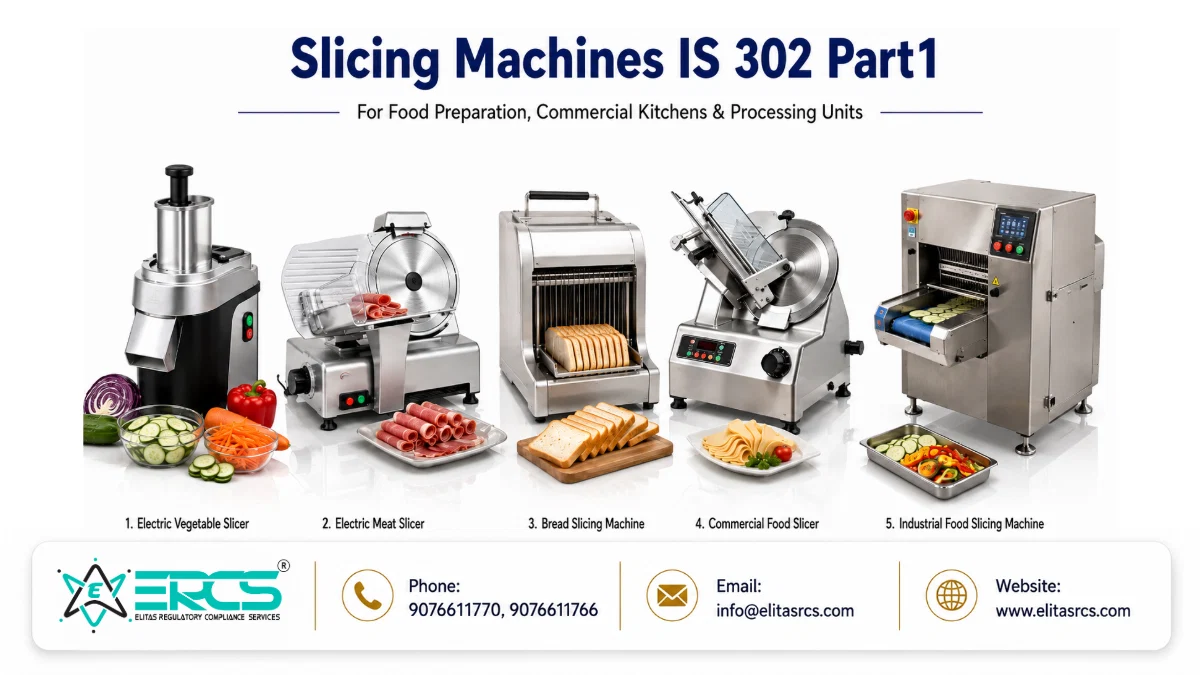
BIS Certification for Slicing Machines is a legal requirement in India to ensure compliance with safety and quality standards. BIS has developed the standard IS 302 Part 1:2024/IEC 60335-1for slicing machines that will compel the manufacturers and the importers to manufacture safe and quality products by maintaining the protection standards, and also increase the trust of the consumers in their products.
In today's competitive environment, slicing machines are essential equipment widely used in homes, restaurants, and the food processing industry to efficiently prepare a variety of ingredients. Hence, these machines must be safe.BIS certification addresses the safety of slicing machines by ensuring they are not exposed to risks such as overheating, mechanical hazards, and fire under the Household, Commercial and Similar Electrical Appliances Quality Control Order (QCO), 2026, which must be rated up to 250 V AC (single-phase), up to 480 V for other appliances.
What are Electric Slicing Machines IS 302 Part 1:2024/IEC 60335-1?
The electric splicing machine, also known as a fusion splicer, is an electronic device used to permanently join two optical fibre cables by melting or welding them together using electric arcs. Electric slicing machines are electronic appliances designed to cut food into uniform slices. This machine contains a motorised cutting blade, enabling users to easily slice products with minimal effort.
The machine can be found in various locations, including homes, restaurants, bakeries, hotels, supermarkets, meat processing plants, and commercial kitchens. Depending on the type of machine, an electric slicer can slice bread, vegetables, fruits, cheese, meat, and other foods. Electric Slicing Machines IS 302 (Part 1):2024 / IEC 60335-1 are motorised food preparation appliances governed by Indian safety standards.
Key Highlights for IS 302 (Part 1)/IEC 60335-1 for Electric Slicing Machines
Below you can go through the highlights of Electric slicing machines under IS 302 (Part 1)IEC 60335-1:
- Scope: Applies to safety aspects of electric slicing machines for commercial kitchens and food processing installations, as per IS 302 (Part 1): 2024 / IEC 60335-1:2020.
- Compulsory Certification: The ISI mark is mandatory for the manufacturing, importation, and distribution of electric slicing machines in India under the Household, Commercial and Similar Electrical Appliances QCO.
- Certification Scheme: Granted under Scheme-I of the BIS (Conformity Assessment) Regulations, 2018.
- More Than Households: Although “household” is part of the title of the QCO, the scope extends to commercial and light industrial appliances, including slicing machines in hotels and restaurants.
- Electric Safety: Tests include earth continuity, dielectric strength, and leakage current tests to prevent electric shock.
- Thermal Safety: The heating test verifies that the motor and other exposed parts remain within acceptable temperature limits throughout operation.
- Mechanical Safety: Testing blade guarding and reliability of construction considering the machine’s moving blades.
Key Benefits of ISI Mark Certification for Electric Slicing Machines in India
Legal Compliance and Market Access: Ensures that manufacturers and importers can legally sell household and commercial electric slicing machines in India without facing heavy penalties or product seizures.
- Electrical and Operational Safety: The compliance framework verifies that machines meet the strict requirements of IS 302 (Part 1), protecting users from electric shock, fire hazards, and mechanical risks.
- Consumer Trust and Reliability: Displaying the ISI mark provides buyers with government-backed assurance of product durability, quality, and performance.
- Competitive Advantage: Certified appliances stand out in the market, allowing MSMEs and larger brands to bid for government tenders and appeal to quality-conscious consumers.
List of Documents Required for ISI Mark Certification of Electric Slicing Machines
To get the ISI Mark Certification for electric slicing machines in India by the Bureau of Indian Standards (BIS) (in compliance with standard IS 302 (Part 1): 2024), some administrative, technical, and factory documents need to be submitted.
- Certificate of Business Registration of the manufacturer/firm
- Factory License or manufacturing plant information
- Filling out the BIS application form with a supporting declaration
- Technical specification sheet of the product
- Flow chart of the manufacturing process
- List of manufacturing machinery with its installed capacity
- Details of the testing facilities available in-house
- Test reports of products carried out in BIS-recognized laboratories
- Quality control/Inspection procedure document
- Raw materials and critical component information
- Authorisation letter of the signatory with identification proofs
- Address proof of the company
Testing Requirements for IS 302 (Part 1)/IEC 60335-1 for Slicing Machines
The testing parameter requirements under IS 302 (Part 1):2024, which is a general safety standard, Certification Scheme 1. By aligning with the IEC 60335-1 framework, the certification is designed so that appliances meet globally recognised benchmarks, making it safe and suitable for working environments:
- Temperature Limits for Heating: The motor and electrical components should operate safely without overheating, even under abnormal conditions, such as when the blade jams or the appliance runs continuously.
- Stability: Ensure the appliance remains balanced and does not exhibit any hazardous characteristics when stationary on a flat surface or when making large slices.
- Power Input and Current: Ensure that the rated power input and current lie within acceptable limits.
- Identification and Instructional Markings: Appliances should be fitted with identification and instructional markings that show the voltage rating, power consumption, manufacturing date, etc.
- Leakage Current & Electrical Strength Test: The appliance's leakage current and electrical strength are measured at normal operating temperature.
BIS Certification Process for Slicing Machines
Obtaining the BIS ISI mark certification can be complex for both foreign and domestic manufacturers, as it involves a comprehensive review of the manufacturing unit to ensure full compliance. Manufacturers must follow the process to obtain BIS certification:
- The applicant needs to identify the appropriate Indian standard and complete the application form.
- Make sure all documentation is complete and send it to the BIS via their official website.
- BIS will conduct an inspection of the facilities.
- A BIS Inspector will seal the sample collected during the factory inspection and send it to a BIS-approved lab.
- If BIS raises an objection regarding non-conformity, the applicant needs to rectify it and communicate back to BIS.
- The ISI certificate is issued to the applicant if all the test criteria are met.
- As a foreign manufacturer, you should have an AIR.
Both Indian and foreign manufacturers need to follow the following procedure for "BIS certification":
- ISI Mark Certification Process for Indian Manufacturers
- BIS FMCS Certification Process for Foreign Manufacturers
Cost of BIS Certification for Slicing Machines
Below, you can go through the table for the BIS Certification cost of Slicing Machines:
|
S No. |
Particular |
Amount (INR) |
Remarks |
|
1. |
Application Fee |
1000 |
To be paid directly to BIS |
|
2. |
Audit Fee |
7000 |
To be paid directly to BIS |
|
3. |
License Fee |
1000 |
To be paid directly to BIS |
|
4. |
Sample Testing Fee |
As Applicable |
To be paid directly to BIS (Testing charges vary from product to product and lab to lab.) |
|
5. |
Minimum Advance Marking Fee |
As per the actual |
To be paid directly to BIS (Marking fee varies as per Indian Standard) |
|
6. |
Renewal Fee |
1000 |
To be paid directly to BIS |
|
7. |
Inclusion Fee |
5000 |
To be paid directly to BIS |
|
8. |
ERCS Pvt Ltd Service Fee |
Please contact info@elitasrcs.com |
|
Renewal of BIS Certification for Slicing Machines IS 302 Part 1:2024/IEC 60335-1
For BIS Certification Renewal of Slicing Machines under IS 302 (Part 1):2024 / IEC 60335-1:2020, you have to apply online at the BIS Manak official website at least 30 to 90 days prior to the expiration of the license:
- File Application: Submit the online renewal application form on the BIS website before the license expiration date.
- Pay Fees: Pay the license renewal fee and the advance inspection fees.
- Factory Inspection: The BIS officer inspects to verify the manufacturing process.
- Product Testing: Provide the latest sample testing report from the BIS-approved laboratory, as and when required, for verification as per the revised IS 302 Part 1:2024 standards.
- License Renewal: If verification is successful, BIS grants license renewal.
Why Choose ERCS Private Limited for BIS Certification?
ERCS Private Limited is a BIS certification consultancy specialising in electrical and electronic products, including slicing machines and other kitchen and food-prep appliances. As a comprehensive service provider, ERCS manages every aspect of the BIS certification process, from documentation and coordination of product testing in BIS-approved laboratories to direct engagement with BIS authorities, helping businesses avoid costly delays or product rejections once their products reach the market.
ERCS offers specialised support for both Indian and foreign brands, including BIS registration and Authorised Indian Representative (AIR) services for companies entering the Indian market. Backed by years of experience delivering successful BIS certification projects, ERCS is recognised for its professional documentation preparation, thorough understanding of BIS regulations, and strong relationships with BIS-approved testing laboratories.