BIS Certification for
Single Row Deep Groove Ball Bearings
IS 6455
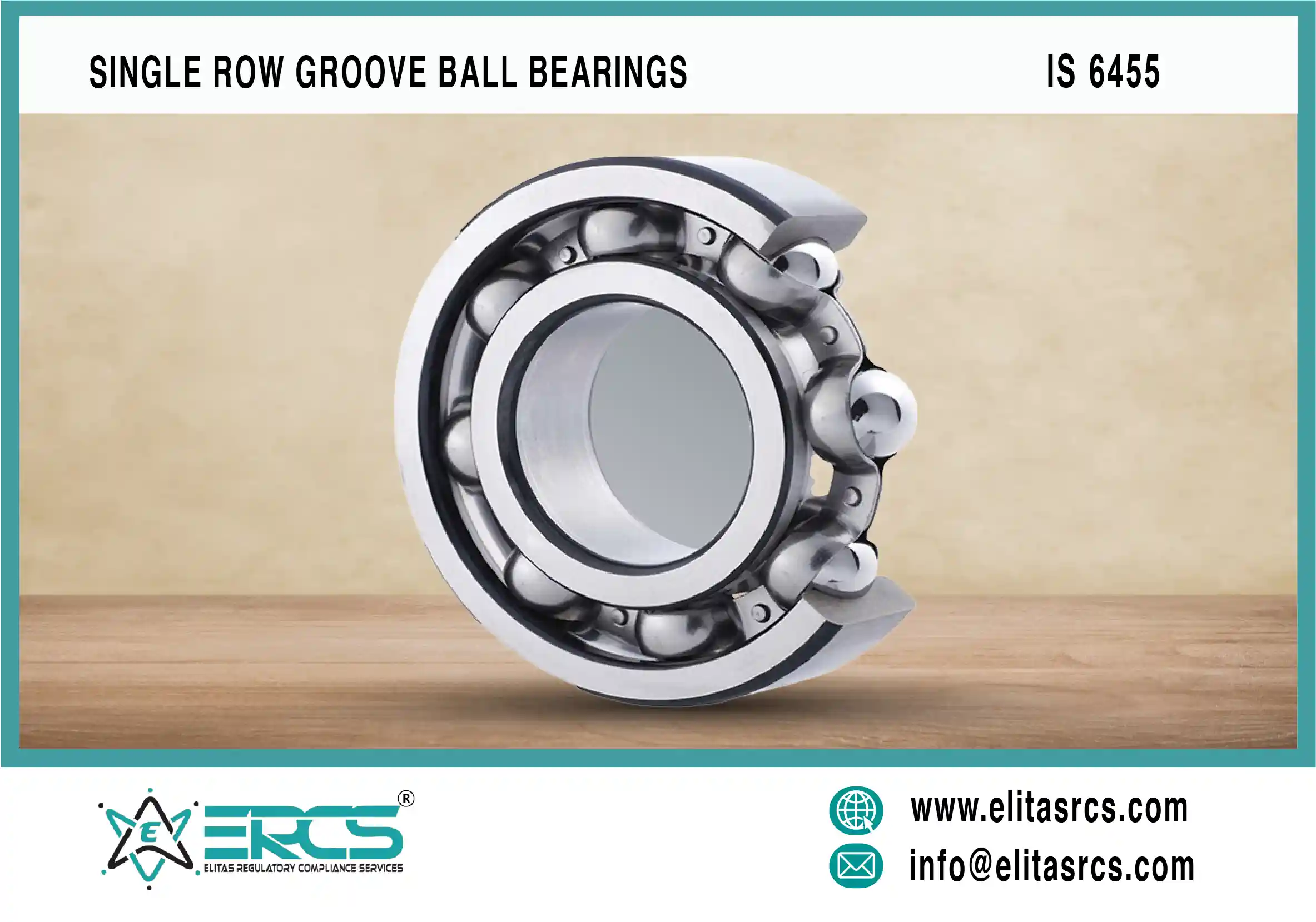
The Bureau of Indian Standards (BIS) is an assurance of product quality, safety, and reliability. Under the Comulsory Registration Scheme (CRS) or ISI Mark Scheme, the BIS uses a standard for the products being manufactured to meet specific Indian standards, which must be met before being sold into the domestic market. BIS certification is required for mechanical and industrial products such as single row deep groove ball bearings according to IS 6455.
The certification by BIS shows that the bearing was manufactured to safely carry the operational weight and, from the operational aspect, to operate under Indian industrial conditions.
Key Specification of IS 6455
This standard, IS 6455, describes the requirements of Single Row Deep Groove Ball Bearings as specified by the Bureau of Indian Standards (BIS). The document provides technical details for these bearings, including dimensions, material properties, and performance characteristics.
Key Aspects of IS 6455
- Bearing Type: Single Row Deep Groove Ball Bearings.
- Scope: This standard defines general requirements for the bearings, covering topics like dimensions, materials, manufacturing process, and performance.
- Specifications: The standard itself will lay down detailed specifications for all aspects related to the bearing, including:
a) The bearings' dimensions must be defined based on the bore, outside diameter, width, and other factors.
b) Materials shall specify the materials permitted for each bearing component, such as ball, cage, and housing materials.
c) Performance will specify the parameters such as capacity, speed, etc., for operational use of the bearings.
d) Testing-Generalized methods are specified for testing these bearings for compliance with the stated specifications.
BIS Certification Scope of Single Row Deep Groove Ball Bearings
BIS certification for single-row deep raceway ball bearings covers quality, safety, and performance as per IS 6455. It subjects the product to Indian standards of manufacturing through-hardened, induction-hardened, or case-hardened materials. Precision bearings for the airframe and instruments find no place under this scope.
BIS Certification Process for Single Row Deep Groove Ball Bearings IS 6455
The BIS certification process for taper roller bearings is intended to make sure the products are in conformity with IS 6455 and the stringent quality parameters. The procedural method of certification follows a definite conformity assessment scheme as laid down in the BIS Act, 2016.
1. Know the Standard (IS 6455)
- IS 6455: Specification for Single Row Deep Groove Ball Bearings- This standard specifies the requirements for materials, dimensions, construction, testing, and performance of bearings.
- Get a copy of the standard from the BIS website or the BIS Sales Counter.
2. Check Applicability and Type of Certification
Establish whether the product is for domestic sale (ISI Marking) or for export only.
Based on this, certification may be:
- ISI Mark Certification (Indian market)
- FMCS (Foreign Manufacturers Certification Scheme) - if the manufacturing unit is abroad.
3. Prepare Manufacturing Premises
Ensure manufacturing as per the requirements of IS 6455.
An in-house laboratory with the full range of testing facilities required for checking (dimensional measurement, hardness, radial clearance, etc.) should be established.
Implementation of quality-control measures is necessary to ensure continued compliance.
4. Submit an Application for BIS Certification
- Online application through the BIS Manakonline portal
Documents Required:
- Company registration document
- ISO 9001 certificate (if available)
- Manufacturing process flowchart
- Details of machinery and in-house testing equipment
- Quality control manual
- Test reports (in some cases)
5. Testing and Inspection of Products
By the way, factory inspection will be conducted by the BIS officers. Samples will also be drawn. Samples will be tested either in your lab (if recognized) or in a BIS-approved lab. Test results must adhere to IS 6455.
6. Granting of License
If all conditions are satisfied and test results are satisfactory, the ISI license shall be granted by BIS. The license enables a product to be marked with the ISI Mark along with the license number.
7. Post-Certification Obligations
- Payment of the Marking Fee and Annual License Fee.
- Continue Production Records and Testing Records.
- Allow Surprise Inspection by BIS Officials.
- American-lists of Renewal (usually for 1 or 2 years).
8. Documents Checklist Summary
- Company and Manufacturing Unit Registration
- ISO Certificate (optional)
- Quality Control Documents
- Manufacturing Process Chart
- Test Equipment Calibration Certificate
- Product Test Reports
What are the timelines for Single Row Deep Groove Ball Bearings BIS Certification?
Under the Quality Control Order (QCO) 2025, Single Row Deep Groove Ball Bearings must be certified by the Bureau of Indian Standards (BIS). The QCO states that manufacturers must have a current BIS license in order to use the ISI Mark.. The implementation timeline for this certification is as follows :
- General Manufacturers: 6 months from the notification date.
- Small Enterprises: 9 months from the notification date.
- Micro Enterprises: 12 months from the notification date.
This timeline indicates that manufacturers have a specified period from the notification date to comply with the certification requirements. The exact notification date can be obtained from the official BIS website or the Department for Promotion of Industry and Internal Trade (DPIIT).
What are the Documents required for BIS Certification of Single Row Deep Groove Ball Bearings IS 6455?
If you're looking to get BIS (Bureau of Indian Standards) Certification for Single Row Deep Groove Ball Bearings according to IS 6455, you'll need to gather a few important documents and pieces of information. Here’s a quick rundown of what you’ll typically need:
- Application Form (Form V)
Make sure to fill this out with all the relevant details about your product and manufacturing unit.
- Factory Registration Documents
This includes your company registration certificate and a list of the machinery and test equipment you have on hand.
- Manufacturing Process Flow Chart
A detailed chart that outlines the entire process from raw materials to the finished product.
- Quality Control Documents
You’ll need your internal quality assurance plan (QAP) along with details about your in-house testing facilities and calibration.
- Test Reports
Provide the latest test reports from either your in-house lab or a third-party lab, all in line with IS 6455.
- Raw Material Details
Include information about the sources, specifications, and quality control measures for your raw materials.
- Drawing/Design of Bearings
Detailed technical drawings that show dimensions, material specifications, tolerances, and more.
- Authorization Letter
If someone else is submitting the application on your behalf, you’ll need to include this letter. Make sure you have all these documents ready to streamline the certification process
Here's the BIS process for both Indian and foreign manufacturers. Click the links below to learn more in detail:
Check the BIS Certificate for Indian Manufacturers (BIS Certification in India)
Check the BIS Certificate for Foreign Manufacturers (FMCS License in India)
BIS Certification Cost for IS 6455
Go through the table to know the cost of BIS Certification for IS 6455:
|
S No. |
Particular |
Amount (INR) |
Remarks |
|
1. |
Application Fee |
1000 |
To be paid directly to BIS |
|
2. |
Audit Fee |
7000 |
To be paid directly to BIS |
|
3. |
License Fee |
1000 |
To be paid directly to BIS |
|
4. |
Sample Testing Fee |
As Applicable |
To be paid directly to BIS (Testing charges vary from product to product and lab to lab.) |
|
5. |
Minimum Advance Marking Fee |
As per actual |
To be paid directly to BIS (Marking fee varies as per Indian Standard) |
|
6. |
Renewal Fee |
1000 |
To be paid directly to BIS |
|
7. |
Inclusion Fee |
5000 |
To be paid directly to BIS |
|
8. |
ERCS Pvt Ltd Service Fee |
Please contact info@elitasrcs.com |
|
How can ERCS help with obtaining BIS Certification?
In the assortment of services offered by ERCS, BIS Consultant for getting a BIS Certification, the following are included: assistance with document processing, conducting a pre-inspection factory visit, preparation for the BIS audit, and advice on compliance. In addition, ERCS will be assisting you throughout the entire process to attain certification.
ERCS will assist you in ensuring that your product complies with the Indian Standard Specification (ISS) and will ensure correct documentation as per BIS requirements. They undertake a factory pre-visit inspection to observe any major nonconformities, giving you the opportunity to address them even before the BIS inspection. ERCS will facilitate your team in the BIS audit preparation by instructing them on the exact documentation and procedure.