BIS Certification for
Self-Aligning Roller Bearings
IS 6454
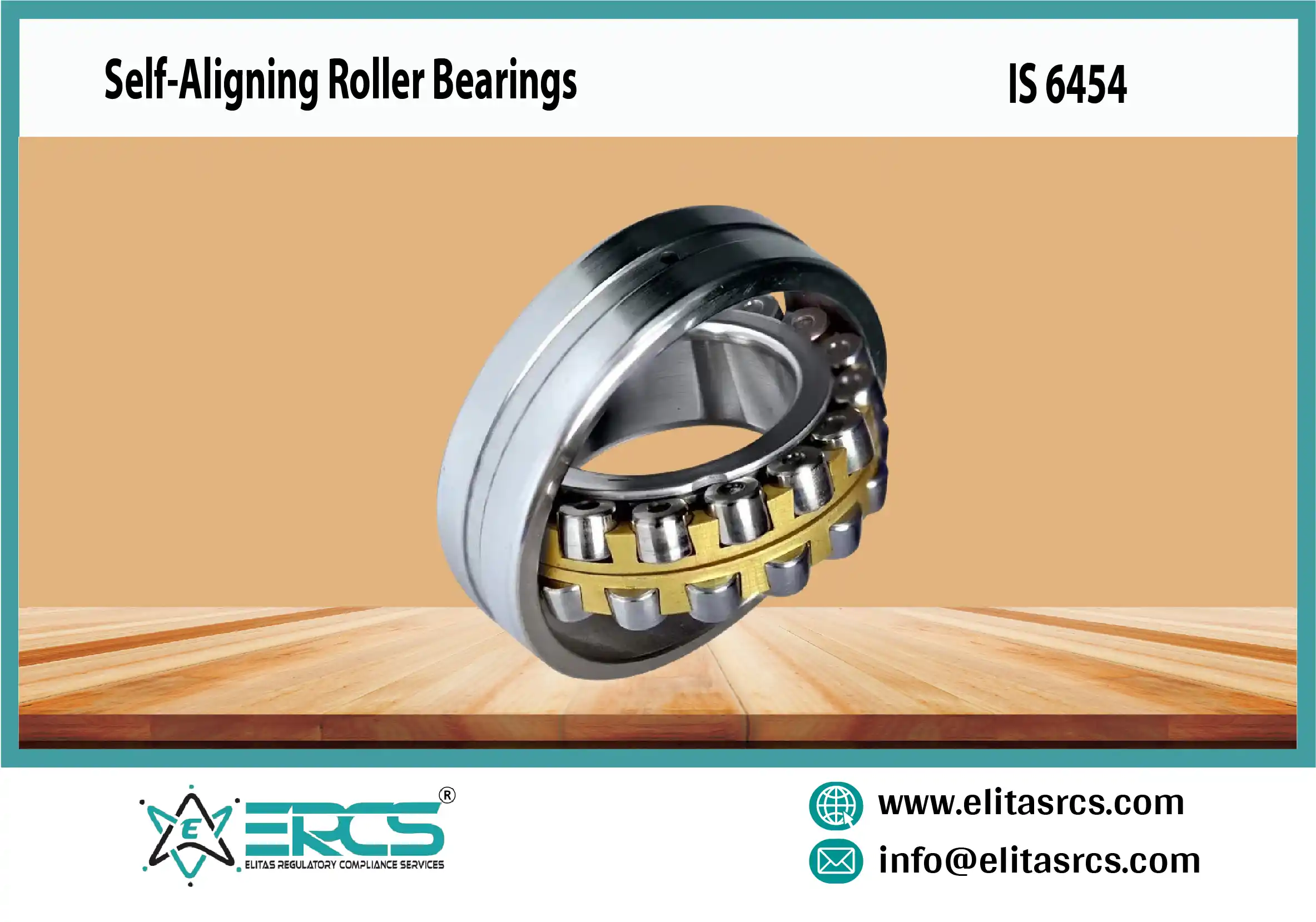
The standards of IS 6454 set forth by the Bureau of Indian Standards (BIS) outline the quality and performance requirements for self-aligning roller bearings in India. The standards and regulations set forth by BIS ensure that those bearings under their watch are subservient to safety, meet specifications concerning dimensional accuracy, consist of specified parentage materials, and have reliable performance.
Now, certification under BIS by self-aligning roller bearings is necessary as mandated under the quality control order from the Ministry of Commerce and Industry, Government of India.
Self-aligning roller bearings have applications in heavy machinery, mining equipment, and mechanical systems that need to push the bias in radial and axial loads. The certification of BIS will ensure quality and reliability for critical applications.
Overview of Self-Aligning Roller Bearings Certification
This kind of bearing takes on heavy radial loads while allowing for misalignment, making it indispensable for the mining, construction, automotive, and heavy machinery industries. They can bear shaft deflection and mounting errors without affecting performance and life.
Key Specification of IS 6454
IS 6454 defines the requirements for self-aligning roller bearings. Both single-row and double-row bearings are covered under this standard. According to this standard, bearings should comply with precise mechanical and dimensional tolerances and to provide durability and serviceability in demanding applications.
Types:
- Single-row self-aligning roller bearing
- Double-row self-aligning roller bearing
Designation System: Bearing designations are code-defined after the following sequence:
- Bore diameter
- Dimension series
- Tolerance class (e.g., P5)
- Radial clearance group (e.g., C3)
- Tapered bore indication (e.g., XK)
1. Scope and Application
IS 6454 applies to self-aligning roller bearings, which usually have two rows of symmetrical barrel-shaped rollers.
These bearings are designed to support heavy radial loads and moderate axial loads in both directions.
The spherical outer ring raceway allows self-alignment capability, making them suitable for all applications that have shaft misalignment or deflection.
2. Types of Bearings Covered
Bearings with cylindrical bores.
Bearings with tapered bores (usually 1:12 and 1:30).
Variants with or without seals in combination with cages (e.g., steel, brass, polyamide).
3. Dimensional and Tolerance Requirements
The boundary dimensions of the bearing (bore diameter, outside diameter, width) should be according to ISO 15.
Tolerances for dimensions and internal running accuracy should comply with ISO 492 so that interchangeability is ensured.
Internal clearance levels must comply with ISO 5753-1.
4. Requirements for Materials
Rings and rolling elements must be made from bearing-quality steel of reasonably high quality, generally as per IS 4398 standards or equivalent. It should sustain specifications such as:
- After heat treatment, it should have high hardness of around 58–65 HRC.
- It should have high fatigue strength and be tough and wear-resistant.
- Control of the non-metallic inclusions and quality of the surface finish.
5. Load Ratings and Performance
Dynamic and static load ratings, respectively C and C₀, shall be computed by ISO 281 and ISO 76.
Bearing shall give rated performance in standard load and speed conditions with no undue noise or vibration or temperature rise.
BIS Certification Scope of Self-Aligning Roller Bearings
The BIS Certification, according to IS 6454 is primarily intended to confirm that self-aligning roller bearings utilized in machinery in industries adhere to high standards of quality and safety. The certification is relevant for bearings employed in heavy-load, heavy-vibration, and misalignment environments, which makes them essential in industries like mining, power generation, cement, steel, and heavy engineering.
BIS Quality Control Order (QCO) for Self-Aligning Roller Bearings
The Bureau of Indian Standards (BIS) has notified a Quality Control Order (QCO) on Self-Aligning Roller Bearings, with the standard being IS 6454. The QCO makes it mandatory for self-aligning roller bearings produced, imported, or distributed in India to adhere to the Indian Standard mentioned above.
Process for Obtaining BIS Certification for Self-Aligning Roller Bearings is 6454
To obtain BIS (Bureau of Indian Standards) certification for self-aligning roller bearings, do the following:
1. Choose the Applicable Standard: Indian Standard you will use to certify self-aligning roller bearings is IS 6454.
2. Apply for BIS Certification: Complete the BIS application form and submit it to the Bureau of Indian Standards with all supporting documents. In case the manufacturer is located outside India, ensure to nominate an Authorized Indian Representative (AIR) by forwarding the requisite Nomination Form.
3. Factory Inspection: BIS officials will make an initial inspection of the production facility to assess the quality control measures and production process. They'll investigate the test arrangement and traceability of raw materials.
4. Product Testing: A sample of the self-aligning roller bearings will be drawn from the production batch and tested at BIS-approved test laboratories. This test will assure conformance to the applicable Indian Standards.
5. Testing and License Granting: The outcome of the tests and the factory audit will be examined to establish whether the products conform to the standards. Provided all goes well and the factory complies with BIS requirements, a license will be granted, and the manufacturer can affix the Standard Mark (ISI) on their bearings.
6. Follow-up Monitoring: Following a routine check, follow-up monitoring will be conducted by BIS. Foreign and Indian manufacturers can obtain certification.
- BIS Mark Certification Procedure for Indian Manufacturers
- BIS Mark Certification Procedure for Foreign Manufacturers
What are the timelines for Self-Aligning Roller Bearings BIS Certification?
India has various timelines for BIS certifications for different types of producers. It includes BIS Certifications for Indian Manufacturers, issued generally within 30 days, and BIS Certifications for Foreign Manufacturers are issued within 180 days.
Documents Required Under BIS Certification of Self-Aligning Roller Bearings
The following is a more detailed analysis of the needed documents:
1. Test Reports of the Product:
BIS-recognized test labs' Test Reports: This will indicate that your self-aligning roller bearings satisfy the requirements of the relevant Indian Standard (for instance, IS 6454).
- Raw Material Test Certificates: Submit documents to establish that your raw materials satisfy the required standards.
- Test certificates copies of Raw Materials: These are to be asked for if the associated manufacturer tests are outsourced to a 3rd party test laboratory.
2. Application Documents:
- Application Form: Fill in the application form for BIS certification. This can be downloaded on the BIS or ASC Group websites.
- Certificate of Incorporation: Documentation of legal registration of the Company.
- Undertaking of Compliance: A formal statement that your bearings meet the applicable Indian Standard.
- Describe Manufacturing Process: Include your factory layout, plant layout, and quality control support personnel.
- Inspection and Test Plan: Give a summary of your inspection and test plan that varies from the BIS standard scheme.
3. Other pertinent documents:
- ISO Certificate (if required): A copy of the ISO certificate, whereby the manufacturer is certified by ISO standards.
- Nomination Letter for Authorized Indian Representative (AIR): Since you are a foreign manufacturer, you will nominate your authorized Indian representative.
Cost of Product Certification for Self-Aligning Roller Bearings
Go through the table to know the cost of BIS Certification for IS 6454:
|
S No. |
Particular |
Amount (INR) |
Remarks |
|
1. |
Application Fee |
1000 |
To be paid directly to BIS |
|
2. |
Audit Fee |
7000 |
To be paid directly to BIS |
|
3. |
License Fee |
1000 |
To be paid directly to BIS |
|
4. |
Sample Testing Fee |
As Applicable |
To be paid directly to BIS (Testing charges vary from product to product and lab to lab.) |
|
5. |
Minimum Advance Marking Fee |
As per actual |
To be paid directly to BIS (Marking fee varies as per Indian Standard) |
|
6. |
Renewal Fee |
1000 |
To be paid directly to BIS |
|
7. |
Inclusion Fee |
5000 |
To be paid directly to BIS |
|
8. |
ERCS Pvt Ltd Service Fee |
Please contact info@elitasrcs.com |
|
|
Remarks |
Including all the taxes |
||
How ERCS Can Help you in Obtaining BIS Certification?
ERCS, as a BIS certification consultant, can help in attaining BIS certification by providing you with specialized advice during the entire certification process from product assessment to document completion and submission. Liaising between manufacturers and BIS authorities, ERCS will ensure compliance and will have thorough expertise in improving the entire certification process.
ERCS will evaluate whether a product might apply to the BIS certification process and if it aligns with Indian Standards for product safety and quality. ERCS will assist with the development of the required documentation necessary for BIS certification to ensure that everything is accurate to your best ability and all relevant documentation is accounted for.