BIS Certification for
Mixed Polyolefin Fibre Ropes
IS 14929
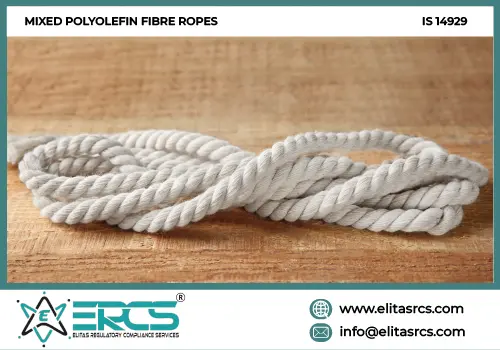
It is important to get the BIS certification for mixed polyolefin fibre ropes under IS 14929, as these ropes are made to mark high levels of quality, safety, and durability during their manufacture. The rigorous quality criteria prescribed by the Bureau of Indian Standards for ropes, in compliance with this certification, ensure that these ropes are manufactured using premium materials along with the exact specification. A BIS license would make the product much more reliable. It would give the buyer and manufacturer confidence that the product delivers all the requisite regulatory compliance, minimum risk, and consistency in batches of production.
The BIS certificate for mixed polyolefin Fibre ropes falls under Scheme 1. It is one of the most widely used schemes for product certification in India. When customers look for ropes bearing the ISI mark, they arrive at a product that comes with an assurance of BIS standards. The ISI mark certification itself exemplifies how a rope stands up to benchmarks in matters concerning safety, durability, and performance, which compels even the customer to be confident and even trust the reliability of the product.
Latest BIS Quality Control order update for Mixed Polyolefin Fibre Ropes
The Ropes and Cordages (Quality Control) Order has been released by the Ministry of Textiles. The date of this order's implementation was April 1, 2025. It is noted in this order that ropes and cordages must meet certain requirements in order to prevent variations in product quality. In India, small and medium-sized businesses (SMEs) must comply by July 1, 2025. As the enforcement body for the quality and conformance of national standards, the Bureau of Indian Standards is assigned to ISI mark certification. The standard mark of such certified products will continue to bear the BIS license.
An Overview Mixed Polyolefin Fibre Ropes IS Specification 14929: 2022
This standard outlines the testing procedures as well as the physical, chemical, and production criteria for Mixed Polyolefin Fibre Ropes. For the same, the following must be taken into account:
1. Material composition
2. Diameter and tolerance
3. Tensile strength
4. Elongation at break
5. Knot-breaking strength
6. Abrasion resistance
7. Water absorption
8. UV resistance
9. Specific gravity
Permission to use the Standard ISI Mark on Mixed Polyolefin Fibre Ropes is granted in accordance with IS 14929.
Indian Standards (IS 14929:2022) : ISI Mark Certification Process
The following procedures must be followed in order to obtain an ISI mark certification in India:
1. Application: It provides BIS production and product information for the issue of a license as per it.
2. Document checking: BIS checks the documents as per IS 14929:2022
3. Factory audit: IS 14929:2022, as applicable, the BIS will check its factories on production and quality control measures.
4. Sample Test: Selected samples are tested to ensure that it meets the requirements made.
5. License Release: BIS issues a license for the usage of the mark "ISI" once they are assured that it will adhere to the standard.
6. Periodic Inspection and Testing: To maintain compliance, regular inspection and testing take place.
7. Renewal of License: The application for renewal is done on test result and periodical inspections basis.
What is the BIS Certification Achieving Timeline for Mixed Polyolefin Fibre Ropes IS 14929
India offers several BIS certification schedules for various producer categories. They are:
- BIS Product certification for Indian Manufacturers (Often in 30 days)
- BIS Certification for Foreign Manufacturers (Typically 180 Days)
What conditions must be met in order to receive a BIS license under IS 14929:2022?
The following procedures can be used to get a BIS license for mixed polyolefin Fibre ropes (14929:2022):
1. Application Submission: The applicant has to submit the application along with all supporting documents to BIS. This incorporates business details, specifications of the product, and manufacturing data.
2. Conformity of Standards: IS 14929:2022 shall conform to the corresponding manufacturing, chemical, and physical characteristics in Indian Standards.
3. Factory Inspection: In case of factory inspection by BIS, the equipment used in the manufacturing facility is to be checked, as are the manufacturing processes, quality control measures, and compliance to relevant standards.
4. Quality control systems: The manufacturer's established quality control system shall cover all production monitoring, material inspection, and management of non-conforming goods.
5. Samples of testing ropes produced shall be tested in laboratories approved by BIS: Performance standards of IS 14929: 2022 shall be met by all parts, including rope.
6. Accommodation of Test Equipment: To meet the requirements of quality products against specified parameters, elongation strength testing equipment shall be made available by the manufacturer.
7. Compliance with BIS Norms: As per the Bureau of Indian Standards (Conformity Assessment) Regulations, 2018, the manufacturer shall, under its own arrangements, carry out quality testing at such intervals as are reasonable.
8. Labelling Requirements: Among other things, the product packaging must adhere to the BIS labelling requirement, which includes the ISI mark.
9. Surveillance and Monitoring: In order to guarantee ongoing conformity, the manufacturer must allow BIS to perform surveillance visits and random sampling.
10. License renewal: Following the first issuance of the BIS license, it will be granted periodically following comparable testing and inspection processes.
What is the BIS certification Cost for Mixed Polyolefin Fibre Ropes?
An extensive estimate of the expenses related to ISI Certification for Indian Standard 14929:2022 may be seen below.
|
COST FOR BIS REGISTRATION / ELECTRONICS PRODUCTS (Government Costs) |
|||
|
Type of Fee |
New Application |
Renewal |
Inclusion |
|
Application Fee |
1000 |
1000 |
1000 |
|
Processing Fee* |
25,000x2 = 50,000 |
25,000x2 = 50,000 |
15,000x2= 30,000 |
|
Registration Fee* |
1000 x 2 = 2000 |
1000 x 2 = 2000 |
1000 x 2 = 2000 |
|
Total |
53,000 |
53,000 |
30,000 |
|
Note* 1. The processing fee and registration fee need to be paid within 2 years, as registration numbers will be granted initially for two years. 2. The cost of BIS registration will depend on the following factors: · Location and Name of the Manufacturing Process (Overseas/ Domestic) · Types of Products and model quantity · Testing fee for the products · Govt. Fee (BIS) and ERCS Service fee |
|||
In the BIS Certification Process, product testing is the most important step because it determines whether the product's quality meets Indian standards. The same justifies investing in testing facilities in order to install test equipment for internal production test laboratories.
A pre-visit at your production may be required in addition to the expenses mentioned in the above table to ensure that your product meets the relevant Indian Standard and BIS standards for its BIS certification.
The advantages of obtaining ISI certification for IS 14929
The primary benefits of BIS Scheme 1 accreditation are as follows:
1. Customers and regulatory agencies would receive quality certification: Steel meets the fundamental requirements of the Indian standard for structural quality. It would demonstrate that this product has passed stringent testing and inspection procedures.
2. Greater market acceptance: Many businesses prefer to use products that have received ISI approval. The company's chances are increased because materials with an ISI accreditation are required for many government tenders for large construction projects.
3. Conventional guidelines are adhered to: The ISI accreditation protects any business from the fines and legal issues associated with employing subpar building materials and guarantees that IS 14929 is obeyed.
4. Competitive Advantage: The ISI mark serves as a national symbol of quality and dependability, setting businesses apart and ultimately drawing in more customers.
5. Customer confidence: The ISI mark is trusted by consumers as a representation of dependability, quality, and safety, which enhances the brand's standing and fosters more customer loyalty.
6. Decreased risk and accountability: Manufacturers, suppliers, and end users are less concerned about accountability when certification reduces the likelihood of structural breakdowns or non-compliance issues.
7. Production Cost Efficiency: Manufacturing that complies with IS 14929:2022 is far more efficient, which sometimes results in lower waste and more efficiency. The consequence will be lower long-term costs. Therefore, obtaining the ISI mark for the IS 14929:2022 accreditation can truly aid in customer happiness, business expansion, and safer structural applications.
ERCS Private Limited's contribution to the BIS's approval of your product
For a product to be certified by BIS and to be of standard quality, the maker must ensure that it conforms to the Indian Standard Specifications (ISS), which we translate for you directly from the BIS authorities in compliance with the Indian Standards. ERCS Private Limited will act as your counsellor during the entire process of getting the clearance of the relevant departments or authorities for your belongings.
ERCS Private Limited is responsible for the following tasks:
- Verifying that your product conforms: IS standards helps guarantee that the product complies with Indian standards. To achieve this, ERCS Pvt. Ltd. has established multiple BIS departments and a vast industrial network.
- Effective documentation while following BIS guidelines: To facilitate the industry's BIS certification procedure, guidelines have been developed. Our team has a wide range of industry ties and has finished over 100 projects. We are able to understand the Indian Standard Specifications and BIS recommendations, which we then explain to the Quality Control Personnel in order to accurately and effectively document your product in accordance with the BIS guidelines.
- A pre-visit to your factory can be paid for: As part of the BIS certification procedure, the factory is inspected by the BIS authority officer. There must be no non-conformities for the BIS inspection to be successful. Our team will organize a preview to achieve this.
- Help with BIS audits: We will guide you through the full BIS inspection procedure and inform you of the necessary preparations.