BIS Certification for
Refined Zinc
IS 209
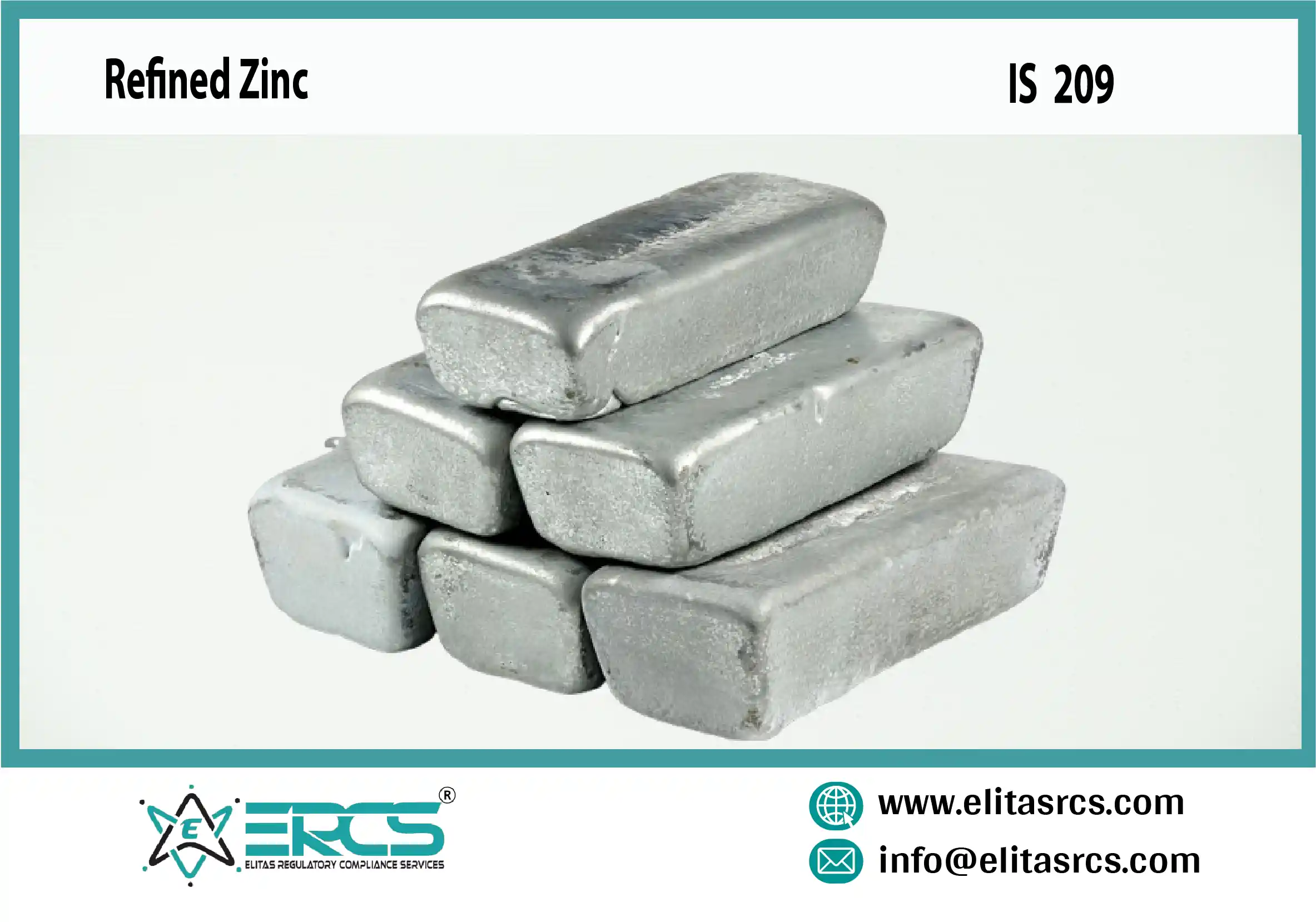
BIS Certification for refined zinc ingots is crucial in the Indian Market. This provides benefits to both businesses and consumers as it assures the quality of the product. The Indian government is enforcing quality and standardization in the non-ferrous metals market.
The Ministry of Mines has issued a Quality Control Order (QCO) for Refined Zinc, which mandates the BIS/ISI certification under IS 209 for Refined Zinc Ingots. Once notified, manufacturers, importers, and sellers of refined zinc need to acquire a Bureau of Indian Standards (BIS) certification to legally operate within the Indian Market.
Many sectors in industry rely on refined zinc, including galvanizing, casting, and alloy production. This move will strengthen the product's quality, ensure consistency, and protect end-users across different sectors. Let’s delve deeper and know more about Product certification and its process.
IS 209: BIS Quality Control Order (QCO)
Refined Zinc Quality Control Order (QCO) mandates that all manufacturers, importers, and sellers of refined zinc in India must have a BIS license and adhere to IS 209. This QCO ensures the quality and consistency of refined zinc products in the Market to end-users in a range of sectors.
In other words, refined zinc designated for distribution in India (Except for importing) must fulfill the specifications published in IS 209 under the Bureau of Indian Standards (BIS). This Order, The Refined Zinc (Quality Control) Order, 2025, will become applicable six months after its announcement. The order is for both BIS Certification for Foreign Manufacturers and Indian Manufacturers. It is important to note that this does not pertain to goods or articles exported outside of India.
What is the Scope for Refined Zinc: IS 209
This standard outlines the requirement for virgin zinc in ingot form. It doesn’t cover the specification for secondary zinc or zinc used for galvanizing, addressed in IS 4699, titled “Refined Secondary Zinc (First Revision),” and IS 13229, which pertains to "Zinc for Galvanizing," respectively.
Refined Zinc IS 209 Certification Overview
Refined Zinc IS 209 is an Indian Standard that specifies the requirements of refined zinc ingots. This grade ranges from Zn99.995 to Zn98.65, utilized in different industrial applications such as alloying, galvanization, and die casting. Let’s go through the Important specifics of the ISI Mark:
1. Grade Definition: The standard specifies five different grades of zinc ingots, each with a certain minimum content of zinc.
a). Zn99.995;
b). Zn99.99;
c). Zn99.95;
d). Zn99.5;
e). Zn98.65
2. Industrial Use: These grades find application in a range of industrial uses, such as galvanization, alloying, die casting, and others.
3. BIS Standard Mark: These grades find application in a range of industrial uses, such as galvanization, alloying, die casting, and others. Zinc ingots shall be manufactured from liquid refined zinc by a continuous or non-continuous technique.
4. Shape, Size & Surface of Product: The shape & size of the product must be according to the agreement between the purchaser and supplier. The surface of the Ingot must be free of surface corrosion and adhering foreign material.
5. Chemical Composition: To obtain BIS Certification, the chemical composition must comply with the limits specified in Indian standards(Refer Table 2 of Amd.2 of IS 209-1992). All Ingots or bundles of ingots should be marked or labelled with at least the following minimum information, unless otherwise agreed upon by the producer and the user:
a). The cast/lot number;
b). The grade of the material.
c). Indication of the source of manufacture, that is, the name or trademark of the manufacturer; and
d). The mass of an ingot or bundle.
This standard doesn’t cover the requirement of re-melted secondary zinc produced by ‘sweating’ or ‘remelting’.
Product Specification of Refined Zinc
A Refined zinc ingot is a solid block of very pure zinc metal; it is usually over 99% zinc. Created by smelting and purification processes, they are utilized as raw materials by different industries like galvanizing and battery manufacturing. These refined zinc solid blocks are created with high-purity processes, and they are important in the making and construction of other industrial purposes. This is why BIS Certification of Refined Zinc is so important.
Zinc is employed for various uses in the market and is a prominent factor in numerous industries like galvanizing, building construction, chemical plants, automotive industries, roofing, and cladding applications, etc. All these need to comply with the prescribed BIS IS 209 to remain compliant and legally acceptable for the Indian market.
Steps for Obtaining BIS License for Refined Zinc IS 209
Let’s go through the steps for obtaining a BIS certificate for your product:
- Register your organization on BIS Manakonline
- Fill out a BIS license application online.
- The following will be inspected by BIS officials when they inspect your manufacturing unit:
- Methods and Processes of Production
- Testing equipment and quality control procedures for the finished products
- Handling and storage & and packaging facilities
- Product samples are taken to a BIS-accredited lab for testing. IS 209 standards test the samples for tensile strength, elongation, chemical resistance & more.
- BIS Officer tests in-house products and inspection documents to ensure compliance with the standard.
The BIS certification process can be completed to certify the product for both Indian & foreign manufacturers:
- BIS Mark Certification Process for Indian Manufacturers
- BIS Mark Certification Process for Foreign Manufacturers
BIS Certification Timeline for IS 209
In India, different BIS certification schedules are available for various categories of producers. They include BIS Certification for Indian Manufacturers, which is typically issued within 30 days, and BIS Certification for Foreign Manufacturers, which usually takes around 180 days.
Important Documents Required Under BIS Certification of Refined Zinc
Here's a more specific list of required documents for BIS product certification:
1. Registration: This form is used to start the process of certification.
2. Organization Details: Gives a proper organizational structure of the factory. Indicates the floor plan of the manufacturing plant. Confirms the address of the factory.
3. Manufacturing Process & Standards: Describes the manufacturing processes in detail. Graphically illustrates the manufacturing steps, lists the equipment utilized in the manufacturing process. Provides details of the source, type, and specifications of raw materials.
4. Quality & Safety Measures: Describes the quality control measures adopted. Provides details of the safety measures adopted.
5. Product & Test Reports: Lists the various grades, types, and sizes of the purified zinc ingots. Laboratory test reports by BIS-accredited testing laboratories establishing
adherence to IS 209.
6. Company & Identity Information: Registration details, company name, and address. In case the application is signed by someone other than the CEO. Eligibility verification of the applicant. If relevant, evidence of being a micro, small, or medium enterprise.
7. Other Relevant Documents: Could be necessary based on the needs of the certification scheme. A statement of compliance with the applicable Indian standards
Cost of Product Certification for Refined Zinc
Go through the table to know the cost of BIS Certification for IS 209:
|
S No. |
Particular |
Amount (INR) |
Remarks |
|
1. |
Application Fee |
1000 |
To be paid directly to BIS |
|
2. |
Audit Fee |
7000 |
To be paid directly to BIS |
|
3. |
License Fee |
1000 |
To be paid directly to BIS |
|
4. |
Sample Testing Fee |
As Applicable |
To be paid directly to BIS (Testing charges vary from product to product and lab to lab.) |
|
5. |
Minimum Advance Marking Fee |
As per actual |
To be paid directly to BIS (Marking fee varies as per Indian Standard) |
|
6. |
Renewal Fee |
1000 |
To be paid directly to BIS |
|
7. |
Inclusion Fee |
5000 |
To be paid directly to BIS |
|
8. |
ERCS Pvt Ltd Service Fee |
Please contact info@elitasrcs.com |
|
|
Remarks |
Including all the taxes |
||
Benefits of Getting a BIS Certification for Refined Zinc
Let’s go through the benefits of obtaining BIS certification:
- BIS certification guarantees that processed zinc ingots conform to certain quality specifications, such as composition and physical properties, by IS 209:2024.
- BIS certification makes market access easier, particularly in the Indian market, and enables businesses to tap into new opportunities.
- The BIS/ISI mark establishes trust and confidence among customers since it testifies that the product has undergone testing and conformity to quality.
- BIS certification guarantees compliance by manufacturers with applicable regulations to stay away from legal problems and fines.
- Products bearing the BIS certification are seen as more reliable and trustworthy, thereby improving the overall reputation of the manufacturer.
Why ERCS is the Best BIS Consultant for Obtaining ISI Mark?
BIS Certificate agent at ERCS Private Limited makes sure that your product is IS compliant. The team assures that the documentation of the product will be as per BIS standards by thoroughly understanding the Indian Standard Specifications and BIS recommendations. Employees with more than 150 projects of experience translate these requirements into the quality control team. ERCS explains the complete BIS inspection process in detail so that everybody is aware of what to carry to the inspection. Their staff makes sure that the required documents and procedures are in place for an audit to be effective.