BIS Certification for
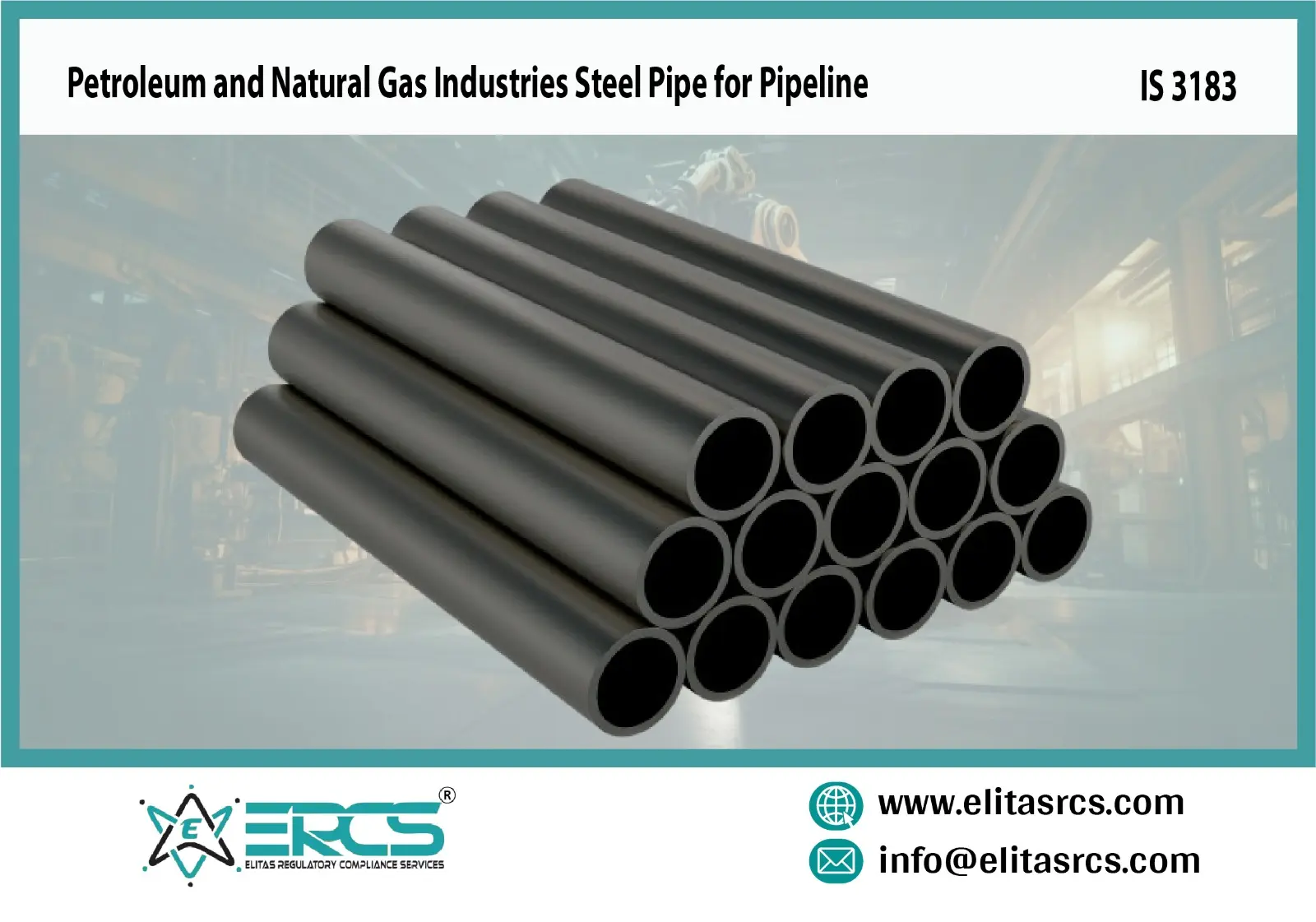
Petroleum and Natural Gas Industries Steel Pipe for Pipeline
IS 3183
BIS/ISI Mark certification of IS 3183 for steel pipes for the petroleum and natural gas industries under the Indian standard ensures the quality and safety requirements of the product. The primary question that arises in the minds of manufacturers regarding product certification of IS 3183 is whether it is mandatory or not.
Yes, steel pipes for the petroleum and natural gas industries must have ISI Mark certification under the mandatory BIS certification scheme, especially for products like welded pipes and seamless pipes, and tubes. To get BIS Certified for Steel Pipes for the petroleum and natural gas industries, manufacturers must meet the requirements of the latest version of the standard, which is IS 3183. This involves applying online through the Bureau of Indian Standards (BIS) portal, fulfilling the product manual’s requirements for testing and record-keeping, and obtaining.
BIS License for Petroleum and Natural Gas Industries Steel Pipe for Pipeline
The BIS License for Steel Pipes and Tubes ensures the quality, safety, and reliability of the product to avoid failures or leakage in high-risk pipeline systems. Steel pipe is a critical component in the petroleum and natural gas industries, used in pipelines that transport fluids over long distances, with its high strength, durability, and ability to withstand high pressures. The pipes are manufactured using special carbon or stainless steel alloys, as seamless and welded pipes, as per stringent standards.
Key Specification of IS 3183
Indian Standard IS 3183 specifies requirements for seamless and welded steel pipes used in pipeline transportation systems for the petroleum and natural gas industries. This standard aligns with API Specification 5L.
- The standard divides steel pipes into two specification levels: PSL1, which offers a standard quality level for line pipes, and PSL2, which has more stringent requirements.
- Seamless (SMLS): Pipes without welded seams, typically hot-formed.
- Welded: Includes various welding processes such as Continuous Weld (CW), Electric Weld (EW), High-Frequency Weld (HFW), Submerged-Arc Weld (SAW), and others.
- Key chemical elements: The standard sets maximum limits for elements like copper, nickel, chromium, and molybdenum. For grades up to L360/X52, intentional additions of copper, chromium, and nickel are not permitted.
- Strength properties: Minimum yield strength and tensile strength are defined for different grades. For example, some grades require minimum yield strengths ranging from 245 MPa to 485 MPa.
Requirements for Obtaining ISI Mark Certification for Steel Pipes and Tubes
Now, let’s know about the basic requirements for a manufacturer to obtain a BIS License for IS 3183:
- Applicable Indian Standards: The manufacturer must identify and manufacture products in accordance with the relevant IS standard.
- Manufacturing Infrastructure: Ensure proper machinery and infrastructure for consistent production.
- In-house Testing Facilities: Have an in-house lab with all required and calibrated testing equipment.
- Quality Management System: Maintain a documented quality control process
- Application to BIS: Apply through the BIS portal with all required details.
- Factory Inspection by BIS: BIS visits the factory to verify the setup and witness product testing.
- Product Testing and Approval: BIS may send product samples to an independent lab for verification.
ISI Certification Process for IS 3183
To apply for the Bureau of Indian Standards (BIS) certificate for your product, it is recommended that you follow the instructions and steps below:
- Application Step: First, the manufacturers are to register on the BIS portal and register for a license or certificate by completing the application form.
- Documentation Step: This involves gathering all documentation, including factory licenses, plans for how quality is controlled, and specifications for all the raw materials.
- Testing Step: The samples will go to a BIS-registered laboratory for testing their chemical composition.
- Factory Visit Step: The BIS officers will inspect all of the quality-controlled documents, as well as the layout of the factory.
- Approval Step: Once the factory has been satisfactorily inspected, the BIS will then approve the license, allowing the manufacturer to use the Standard mark, indicating the tin ingots meet the respective Indian Standards.
Timeline for BIS License of Petroleum and Natural Gas Industries Steel Pipe for Pipeline
The timeline for obtaining a BIS license for spiral-welded pipes varies based on the manufacturer's location, generally ranging from 30 to 90 working days for Indian manufacturers and 5 to 6 months for foreign manufacturers. Imports must also work through an Authorized Indian Representative (AIR).
Documents Required for BIS Certification of IS 3183
Manufacturers seeking certification by the Bureau of Indian Standards (BIS) for IS 3183, regarding steel pipes for pipeline transportation systems, would be required to furnish extensive documentation. While the exact documentation may differ, below are typically the documents requested by BIS for both domestic and foreign manufacturers.
- Duly filled BIS certificate registration form (Form VI)
- Company registration certificate (for example, UDYAM, GST, etc.)
- Proof of factory address
- Manufacturing process flowchart
- List of manufacturing machinery
- Organizational chart and relevant details of the key technical staff
- Specifications of the product, including grade, size, and type
- Raw material test certificates
- Testing reports either in-house or by a third party for the product
- Quality control manual /SOPs
- List of in-house testing equipment and their calibration certificates
In the case of foreign manufacturers (if needed):
- Nomination of Authorised Indian Representative (AIR) and Details for Foreign Manufacturers Certification Scheme.
Cost of Product Certification for Steel Pipe for Pipeline
Go through the table to know the Cost of BIS Certification India for IS 3183:
|
S No. |
Particular |
Amount (INR) |
Remarks |
|
1. |
Application Fee |
1000 |
To be paid directly to BIS |
|
2. |
Audit Fee |
7000 |
To be paid directly to BIS |
|
3. |
License Fee |
1000 |
To be paid directly to BIS |
|
4. |
Sample Testing Fee |
As Applicable |
To be paid directly to BIS (Testing charges vary from product to product and lab to lab.) |
|
5. |
Minimum Advance Marking Fee |
As per actual |
To be paid directly to BIS (Marking fee varies as per Indian Standard) |
|
6. |
Renewal Fee |
1000 |
To be paid directly to BIS |
|
7. |
Inclusion Fee |
5000 |
To be paid directly to BIS |
|
8. |
ERCS Pvt Ltd Service Fee |
Please contact info@elitasrcs.com |
|
|
Remarks |
Including all the taxes |
||
Why Choose Us as a Top BIS Consultant?
Choose ERCS Private Limited to be your partner for BIS consulting because of their extensive experience with steel and other regulated products, a full range of services, international access, and a client-focused approach. With ERCS, the whole process from the beginning to the end is handled, including all testing requirements, and an update on regulatory changes whenever regulations are modified to ensure compliance for Indian and Foreign manufacturers.
ERCS offers a full-service program to assist its clients, which includes Indian Standard Specifications recommendations, government department coordination, and guidance through the entire certification process.