BIS Certification for
Horizontally cast iron double flanged pipes for water, gas, and sewage
IS 7181
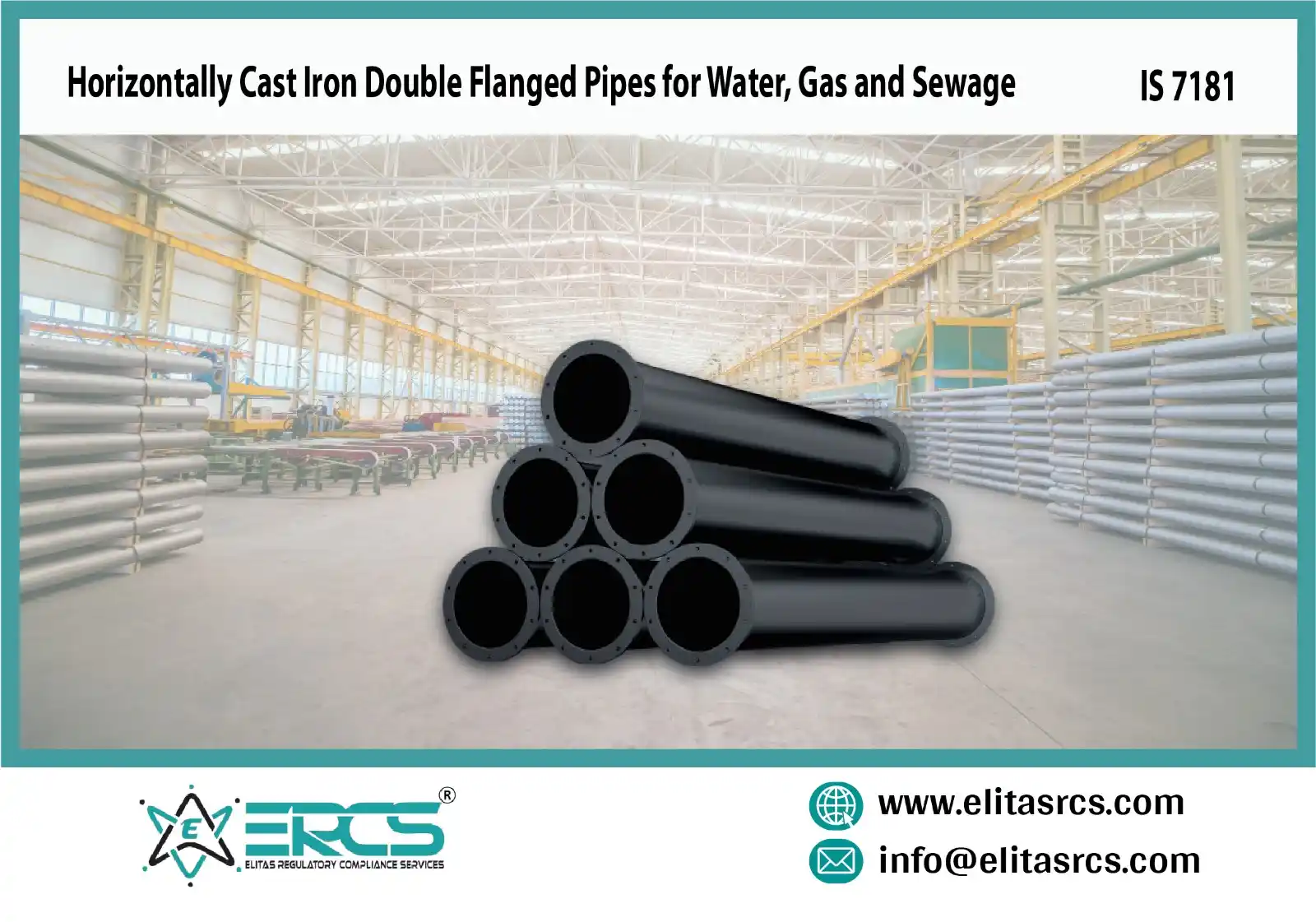
The Bureau of Indian Standards provides BIS certification for horizontally cast iron double-flanged pipes for water, gas, and sewage, under the Indian Standard (IS) 7181. To obtain ISI certification, manufacturers must comply with IS 7181 to ensure safety, quality, and reliability for consumers. The BIS license for horizontally cast iron double-flanged pipes (as per IS 7181) requires manufacturers to demonstrate compliance with the standard through the BIS Certification Scheme I, which includes maintaining quality control and conducting necessary tests, such as dimensional accuracy, mechanical strength, and hydraulic tests. Let’s know more about how to get ISI Mark on horizontally cast iron pipes, its process, cost, timeline, and more.
Overview of BIS License for IS 7181
Manufacturers of horizontally cast iron double flanged pipes are required to secure a BIS license to meet safety and quality standards. These pipes have strong piping systems that have flanges and are secured at the flange joints with nuts, bolts, and rubber gaskets to form a seal.
These pipe systems are typically used for exposed or above-ground piping. They are commonly seen in water, gas, and sewage applications. "Horizontally cast" means that the pipe production process involved pouring molten iron into a horizontal mold.
Key Specification of IS 7181
Pipes must be clearly marked with the BIS Standard Mark, which demonstrates that they meet quality and safety requirements at a national level for water, gas, and sewage applications once they are Certified.
- Specification: The material must meet minimum requirements for tensile strength and Brinell hardness.
- Casting: The pipes are produced manufacturably using a horizontal casting process.
- Double flanged: The pipes feature a flange at each end, allowing the two pipes to be securely bolted together.
- Nominal size and lengths: The specification applies to various DN sizes, although a licensed length of pipe is usually 3 meters. The pipe manufacturer's weight chart shows sizes that range from 80 mm to 1500 mm.
- Puddle flanges: Amendment 5 to the specification has added a requirement for integrally cast puddle flanges, which can be either parallel or inclined to the end flanges, although the minimum thickness required is now based on the nominal diameter of the pipe.
BIS Requirement for Horizontally cast iron double flanged pipes for water, gas, and sewage Certification in India
The requirements below outline the essential steps to obtain ISI Mark certification for IS 7181:
- Compliance with IS 7181: You must comply with IS 7181, which includes your horizontally cast iron double flanged pipe complying with the technical and quality parts of the standard relating to water, gas, and sewerage applications.
- Online Application Submission: You must apply to BIS (Bureau of Indian Standards) through the appropriate online application format.
- Document Submission: This requires that you gather all of the requisite documents, including KYC Documents, Manufacturing Process, Testing Equipment, Raw Material, and Factory Test Report
- Factory Inspection: You will need to have your factory inspected by a Bureau of Indian Standards official to verify all aspects of the manufacturing operations and quality control, and in-house testing facilities.
- Physical Testing of Samples: BIS will distribute sealed samples of your products to a BIS-approved laboratory to test against compliance with the standard.
- Issuance of Certification: If all inspections and tests are completed to standard, BIS will issue certification and allow you to proceed with the use of the BIS Standard Mark (ISI mark) on the products.
ISI Certification Process for IS 7181
Apply for the Bureau of Indian Standards Certificate for the product. The process below describes how it is usually done:
- Application process: The manufacturers must register on the BIS portal and then register for a license or certificate based on the application form.
- Documentation: Gathering the appropriate documentation, which will include the factory license, quality control plan, raw material specifications, etc.
- Testing process: The samples will be sent to a BIS-registered laboratory to test the components of the tin ingots’ chemical composition.
- Factory inspection: The BIS officers will perform an inspection of the quality control documentation and the layout of the factory.
- License: After satisfactory factory inspection, the BIS will grant a license to the manufacturer to use the Standard mark, which will verify that the tin ingots are compliant with the relevant Indian Standards.
Timeline for BIS License of Spiral-Welded Pipes
The expected timeline to receive a BIS license for horizontally cast iron double flanged pipes is around 30 days for Indian manufacturers and 180 days for foreign manufacturers. This is also the typical amount of time given for BIS certification after examining the manufacturer's infrastructure, quality control, and testing facilities to verify that the product is safe and reliable within the scope of the relevant Indian Standard (this is likely IS 7181).
Documents Required for BIS Certification of IS 7181
Below, you can go through the list of Documents Required for ISI Mark Certification:
- Duly filled BIS certificate registration form (Form VI)
- Company registration certificate (e.g., UDYAM, GST, etc.)
- Factory address proof
- Manufacturing process flow diagram
- List of manufacturing machinery
- Organization chart with key technical staff details
- Product specifications (grade, size, type)
- Raw material test certificates
- In-house or third-party product test reports
- Quality control manual / SOPs
- List of in-house testing equipment with calibration certificates
- For foreign manufacturers (if applicable):
- Nomination of Authorized Indian Representative (AIR)
- Foreign manufacturing site details
Cost of Product Certification for Spiral-Welded Pipe
Go through the table to know the cost of BIS Certification India for IS 7181:
|
S No. |
Particular |
Amount (INR) |
Remarks |
|
1. |
Application Fee |
1000 |
To be paid directly to BIS |
|
2. |
Audit Fee |
7000 |
To be paid directly to BIS |
|
3. |
License Fee |
1000 |
To be paid directly to BIS |
|
4. |
Sample Testing Fee |
As Applicable |
To be paid directly to BIS (Testing charges vary from product to product and lab to lab.) |
|
5. |
Minimum Advance Marking Fee |
As per actual |
To be paid directly to BIS (Marking fee varies as per Indian Standard) |
|
6. |
Renewal Fee |
1000 |
To be paid directly to BIS |
|
7. |
Inclusion Fee |
5000 |
To be paid directly to BIS |
|
8. |
ERCS Pvt Ltd Service Fee |
Please contact info@elitasrcs.com |
|
|
Remarks |
Including all the taxes |
||
Why Choose ERCS for ISI Mark Certification?
ERCS Private Limited is the top BIS Certification consultant for Indian and Foreign manufacturers. Select ERCS for the ISI Mark certification process, including documentation, factory pre-inspections, and coordination with the BIS authorities, which would ease the complexity and burden on the manufacturers throughout the difficult process. ERCS has specific knowledge of and access to the Indian Standards, with wide connections throughout the steel supply chain and with BIS departments. They will assist in expediting the certification so that companies can become compliant and grow their businesses in the Indian context.