BIS Certification for
Gas, Oil and Solid-Fuel Burning Appliances Having Electrical Connections
IS 302 Part 1:2024 IEC 60335-1
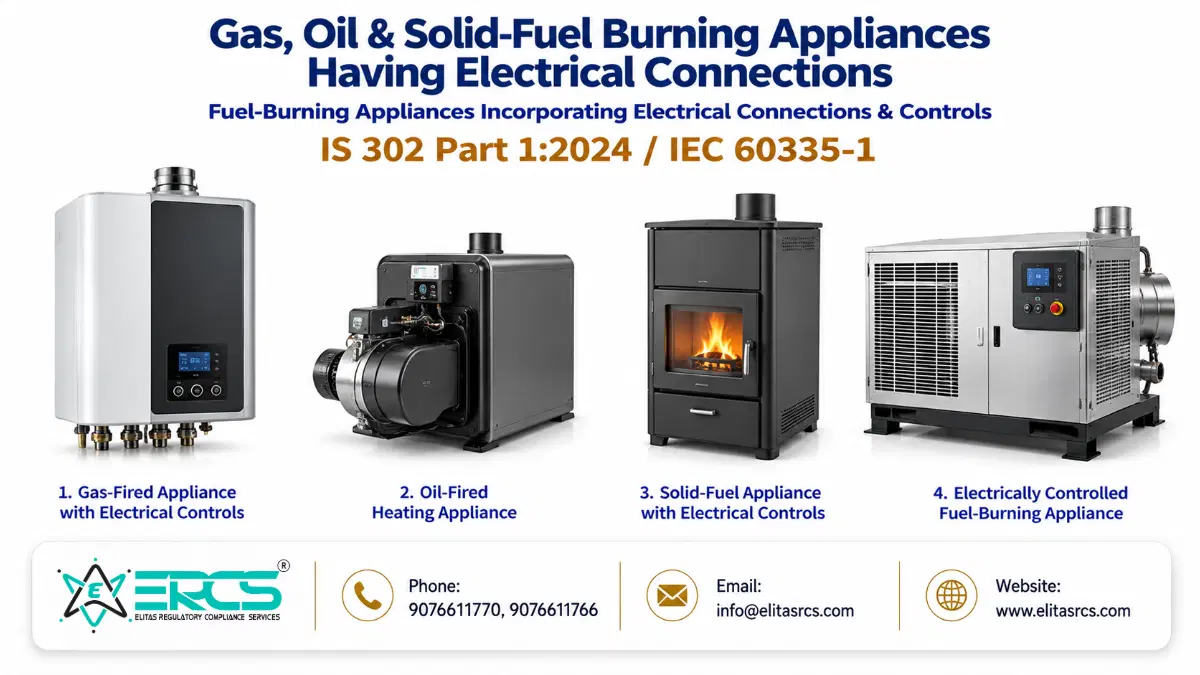
BIS Certification for Gas, Oil, and Solid-Fuel-Burning Appliances with Electrical Connections is a major requirement for manufacturers and importers supplying these products in the Indian market, with electrical safety requirements in mind. According to IS 302 Part 1:2024, which is aligned with IEC 60335-1, under the Safety of Household, Commercial and Similar Electrical Appliances (Quality Control) Order, 2026, it covers electrical safety requirements, including electrical, mechanical and thermal safety of the appliance.
Because these products use both fuel and electricity, ensuring product safety is important to protect users from electrical hazards, fire risks, and overheating. BIS certification helps manufacturers meet regulatory obligations, build credibility, reduce safety risks, and support smooth entry into the Indian market.
What are Gas, Oil and Solid-Fuel Burning Appliances Having Electrical Connections under IS 302 Part 1: 2024/IEC 60335-1?
Gas, oil, and solid-fuel-burning appliances having electrical connections are heating or cooking devices that run primarily on combustible fuels (such as natural gas, LPG, heating oil, wood, or coal) but also include electrical components, controls, ignition systems, or blowers.
Because these appliances combine flammable fuels with electrical wiring, they require rigorous safety testing under standards such as IS 302 (Part 1) to prevent fires, electric shock, fuel leaks, or explosions. As per the QCO, the appliances have a rated voltage not exceeding 250 V for single-phase and 480 V for others, including DC-supplied and battery-operated appliances.
BIS Testing Parameters Under IS 302 (Part 1): 2024?
The Gas, Oil, and Solid-Fuel-Burning Appliances with Electrical Connections operate in extreme environments. Thus, testing is conducted under IS 302 (Part 1): 2024 (harmonised with IEC 60335-1:2020). The major testing parameters include:
- Electric Shock Protection Test: Testing accessible live parts to protect the user from electric shock when using, refuelling, or cleaning.
- Heating (Thermal) Test: Testing the temperature rise of electrical components, such as ignition modules, solenoids, and motors, to assess potential fire risks
- Abnormal Operation Tests: Testing the effects of abnormal operations, such as blocking the gas vent or a fan motor failure, that could pose a fire or electric shock hazard.
- Heat and Fire Resistance Test: Testing non-metallic electrical parts with a glow wire and a needle flame to verify fire resistance.
- Water-Resistance Test: Ensuring that the enclosure of the electrical components protects the circuitry from water, leaks, or fuel or oil spills.
- Creepage Distance and Clearance Test: Ensuring the distances between electrical parts are sufficient to prevent electrical arcing in hazardous environments.
List of Documents Required for Gas, Oil and Solid-Fuel Burning Appliances Having Electrical Connections
Keeping all required documents ready before you apply helps avoid delays in ISI Mark certification. Incomplete or mismatched documents are a common reason for BIS application queries. Check the complete List of Documents Required for ISI Mark Certification of Gas, Oil, and Solid-Fuel-Burning Appliances Having Electrical Connections.
The ISI Mark Certification Process for Gas, Oil and Solid-Fuel Burning Appliances Having Electrical Connections in India
Before applying for BIS certification for Gas, Oil, and Solid-Fuel-Burning Appliances with Electrical Connections, one should be aware that the timeline depends on several factors. While the process usually takes 35-50 days for Indian manufacturers, it usually takes around 4-6 months for foreign manufacturers.
Follow the certification process below to obtain the ISI Mark on your products:
- BIS Certification Process for Indian Manufacturers
- BIS Certification Process for Foreign Manufacturers
What is the Cost of BIS Certification in India (2026)?
Below, you can go through the table for the BIS Certification cost of the Gas, Oil, and Solid-Fuel-Burning Appliances with Electrical Connections:
|
S No. |
Particular |
Amount (INR) |
Remarks |
|
1. |
Application Fee |
1000 |
To be paid directly to BIS |
|
2. |
Audit Fee |
7000 |
To be paid directly to BIS |
|
3. |
License Fee |
1000 |
To be paid directly to BIS |
|
4. |
Sample Testing Fee |
As Applicable |
To be paid directly to BIS (Testing charges vary by product and lab). |
|
5. |
Minimum Advance Marking Fee |
As per actual |
To be paid directly to BIS (Marking fee varies as per Indian Standard) |
|
6. |
Renewal Fee |
1000 |
To be paid directly to BIS |
|
7. |
Inclusion Fee |
5000 |
To be paid directly to BIS |
|
8. |
ERCS Pvt Ltd Service Fee |
Please contact info@elitasrcs.com |
|
Why Choose ERCS as Your BIS Certification Consultant?
With ERCS as your BIS consultant for Gas, Oil, and Solid-Fuel-Burning Appliances with Electrical Connections, you are assured of compliance with safety regulations (for instance, IS 302 Part 1: 2024).
ERCS provides end-to-end assistance with BIS Certification and ISI Mark from Conconsultancy India. ERCS, ensures the avoidance of any customs issues, seizure of goods, and/or penalties arising from non-compliance.
- BIS Certification Process, including documentation and licence approval, is handled by ERCS.
- Product testing will be conducted in BIS-recognised laboratories.
- We help you prepare and verify all technical documents needed for BIS licence approval.
- Our BIS agents' experience in BIS regulations ensures error-free, time-saving approvals.
- Customised BIS certification services for Indian and overseas manufacturers and importers.