BIS Certification for
Food Waste Disposers
IS 302 Part 1:2024/IEC 60335-1
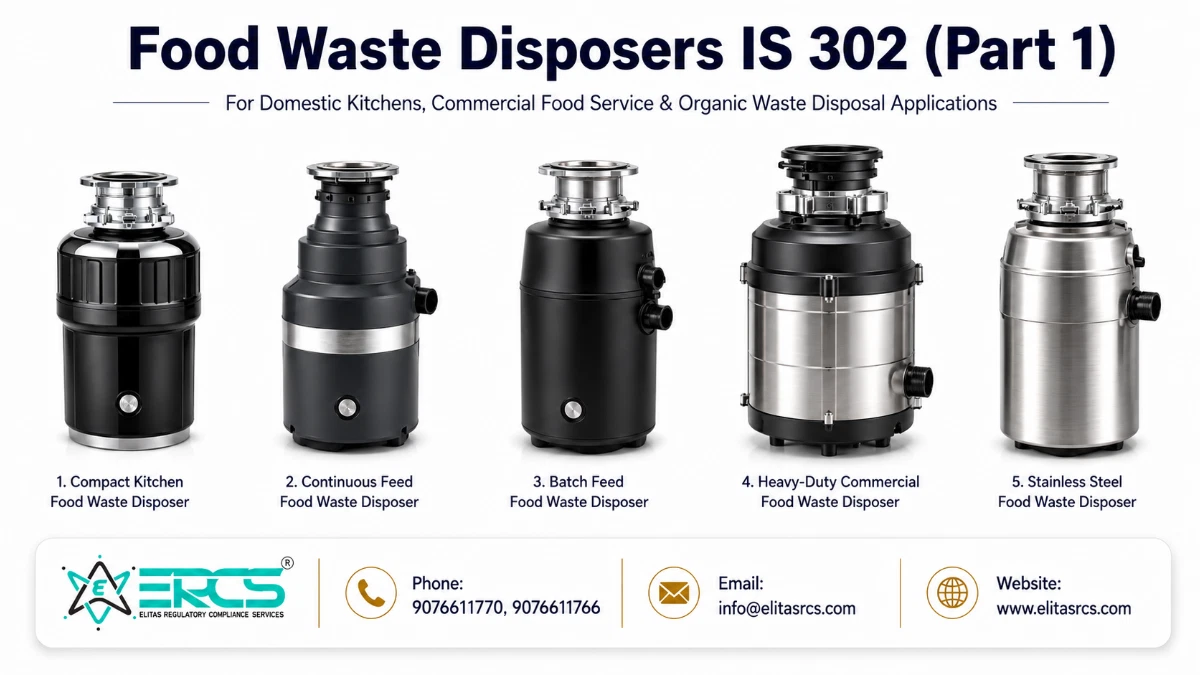
BIS Certification for Food Waste Disposers is mandatory in India; this certification is specified under IS 302 Part 1. Manufacturers must comply with the safety and quality standards for food waste disposers set by the Bureau of Indian Standards (BIS). This product is widely used in residential and commercial settings, including restaurants, hotels, and other commercial kitchens. All Food Waste Disposer products must meet the criteria set out in the Safety of Household, Commercial, and Similar Electrical Appliances Quality Control Order (QCO), 2026.
The IS 302 Part 1 is aligned with the internationally recognised IEC 60335-1, which lays down general safety requirements for household and similar electrical appliances. It helps protect users against electric shock, mechanical damage, moisture, and abnormal operation. Products that meet these criteria at BIS-recognised laboratories can obtain the BIS Standard Mark (ISI Mark), thereby ensuring consumer safety. BIS Certification is important for manufacturers to comply with Indian standards under the BIS Act 2016, as non-compliance can lead to product seizures and bans from the Indian market.
What are Food Waste Disposers under IS 302 Part 1: 2024/IEC 60335-1?
A food waste disposer (garbage disposal unit) is an electric device installed under the kitchen sink, beneath the trap. It breaks food particles into fine pieces so that they pass freely through the plumbing system and enter the wastewater system. Food Waste Disposers within the IS 302 (Part 1): 2024 / IEC 60335-1: 2020 standard are electric, motor-driven kitchen appliances designed to grind and dispose of organic food waste through conventional drainage systems.
Key Highlights for IS 302 (Part 1) for Food Waste Disposers
|
Key Particular |
Important Details |
|
Applicable Standard |
IS 302 (Part 1):2024 – Safety of Household and Similar Electrical Appliances – Part 1: General Requirements |
|
International Reference |
IEC 60335-1:2020 |
|
Product Category |
Food Waste Disposers |
|
Electrical Safety |
Covers general safety requirements intended to protect users from electrical hazards. |
|
Protection Against Electric Shock |
Includes requirements for protection against contact with live electrical parts. |
|
Mechanical Safety |
Addresses safety aspects related to moving parts and the appliance's mechanical construction. |
Key Benefits of ISI Mark Certification for Food Waste Disposers in India
IS 302 Part 1: 2024 ensures that food waste disposers comply with the national mandatory standard for safety, quality, and performance in India.
- Product Safety Assurance: Helps ensure that food waste disposers comply with BIS electrical and safety standards.
- Consumer Trust Building: The ISI mark builds trust in the product's safety and compliance.
- Helps with Mandatory BIS Requirements: Helps meet the mandatory BIS requirement if the product is under the relevant QCO. Food Waste Disposers are included by BIS under IS 302 (Part 1): 2024.
- Improving Product Quality: Conformity assessment helps improve product quality.
- Risk Reduction of Safety Hazard: Appropriate testing helps to determine any risk of electrical or operational hazards.
List of Documents Required for ISI Mark Certification of Food Waste Disposers
ISI Certification Documents for Food Waste Disposers are as follows:
- Certificate of Incorporation (CoI)
- Property tax payment slip
- Insurance certificate
- If the property is rented, then a rent agreement needs to be provided
- Telephone bill
- Electricity bill
- or bank statement
- Aadhaar card of the Director of the company
- Voter ID card
- Driving license (DL);
- Test report;
- List of manufacturing machinery
Applicable testing parameters for Food Waste Disposer IS 302 (Part 1)/IEC 60335-1
The list of tests evaluated for the food waste disposer appliances under IS 302 Part 1/IEC 60335-1, as mandated by the Bureau of Indian Standards, for protecting its users from certain accidental hazards:
- Electric Shock Protection: Determines whether insulation is sufficient, whether live parts are out of reach, and whether the appliance can safely handle expected leakage current while withstanding high-voltage peaks.
- Earth Continuity Check: Ensures that the resistance between the appliance's accessible metal parts and earth remains low enough to prevent the risk of electric shock.
- Electric Strength Test: Conducts high-voltage tests to confirm that insulation will not break down under maximum voltage conditions.
- Abnormal Operation Tests: These tests simulate abnormal conditions, such as the device boiling dry or experiencing control malfunctions, to demonstrate that there is no risk of fire or deformation.
- Heat and Flame Resistance: Electric parts, especially live parts, should be resistant to fire and ignition.
- Moisture Resistance: Tests ensure that spills and cleaning processes do not allow water to penetrate, which could lead to insulation problems.
BIS ISI Certification Process for Food Waste Disposer in India
Procedure to Obtain BIS Certification Scheme-1 for Food Waste Disposer Under BIS Certification is as Follows:
- Procedure for Applying for BIS Certification: The first step to obtain BIS Certification Scheme-1 for your food waste disposer is to apply through the BIS website. Moreover, physically signed applications are also required.
- Appointment of AIR: As a foreign manufacturer, you must appoint an AIR.
- Documentation: This step requires documentation for your application, in accordance with IS 302 Part 1 (IEC 60335-1).
- Inspection: This step involves a BIS inspection of the production process's suitability and the signing of the sample by a BIS officer.
- Product Testing: This step involves testing sealed samples of your product at BIS laboratories.
- ISI Mark Issuance: Finally, the ISI mark will be provided to you by BIS after the above procedure is completed.
For detailed information and to learn about the procedure for obtaining the BIS Certification. Both domestic and foreign manufacturers must follow:
- BIS Mark Certification Process for Indian Manufacturers
- BIS Mark Certification Process for Foreign Manufacturers
BIS Certification Cost Food Waste Disposer, 2026
Below, you can go through the table for the BIS Certification cost of the Food Waste Disposer:
|
S No. |
Particular |
Amount (INR) |
Remarks |
|
1. |
Application Fee |
1000 |
To be paid directly to BIS |
|
2. |
Audit Fee |
7000 |
To be paid directly to BIS |
|
3. |
License Fee |
1000 |
To be paid directly to BIS |
|
4. |
Sample Testing Fee |
As Applicable |
To be paid directly to BIS (Testing charges vary by product and lab). |
|
5. |
Minimum Advance Marking Fee |
As per the actual |
To be paid directly to BIS (Marking fee varies as per Indian Standard) |
|
6. |
Renewal Fee |
1000 |
To be paid directly to BIS |
|
7. |
Inclusion Fee |
5000 |
To be paid directly to BIS |
|
8. |
ERCS Pvt Ltd Service Fee |
Please contact info@el itasrcs.com |
|
Renewal of BIS Certification for Food Waste Disposers (IS 302 Part 1)
BIS Licensees with a BIS License for Food Waste Disposers should renew their license on the BIS Manakonline portal before it expires. According to BIS, licenses issued under Scheme-I can be extended for a period of one to five years, subject to the relevant conditions and fees.
- Application Filing: Submit your application for a license extension through the BIS portal well in advance of the current license's expiry.
- Documentation & Compliance: Update your documentation, including manufacturing and production details and quality control test results, in accordance with IS 302 (Part 1):2024.
- Factory Inspection: BIS may carry out the verification process or factory assessment based on the conditions of Scheme-I (ISI License Scheme).
- Fee Settlement: Pay the annual license fees, marking fees, and other inspection fees as required by BIS.
Why Choose ERCS as Your BIS Certification Consultant for Food Waste Disposers?
ERCS Pvt. Ltd. has developed a vast network within the Electrical appliances industry and various BIS departments to help ensure conformity of the food waste disposer product with IS 60335.
We are familiar with the Indian Standard Specifications & BIS guidelines and provide the most suitable interpretation to the Quality Control Personnel, enabling reliable and effective documentation of your product in accordance with the BIS guidelines.
A pre-visit can be paid for at your factory premises. During the BIS certification process, an officer from the BIS authority visits the factory to conduct an inspection. To achieve good results, the BIS inspection should proceed smoothly without any non-conformities. With this goal in mind, our team will organise a pre-visit to your factory premises so that the required changes can be implemented to eliminate sources of fallibility.
We will explain the entire procedure for conducting a BIS inspection and make you aware of the items that need to be prepared and made readily available at the time of the inspection.