BIS Certification for
Electric Sieving Machines
IS 302 (Part 1)
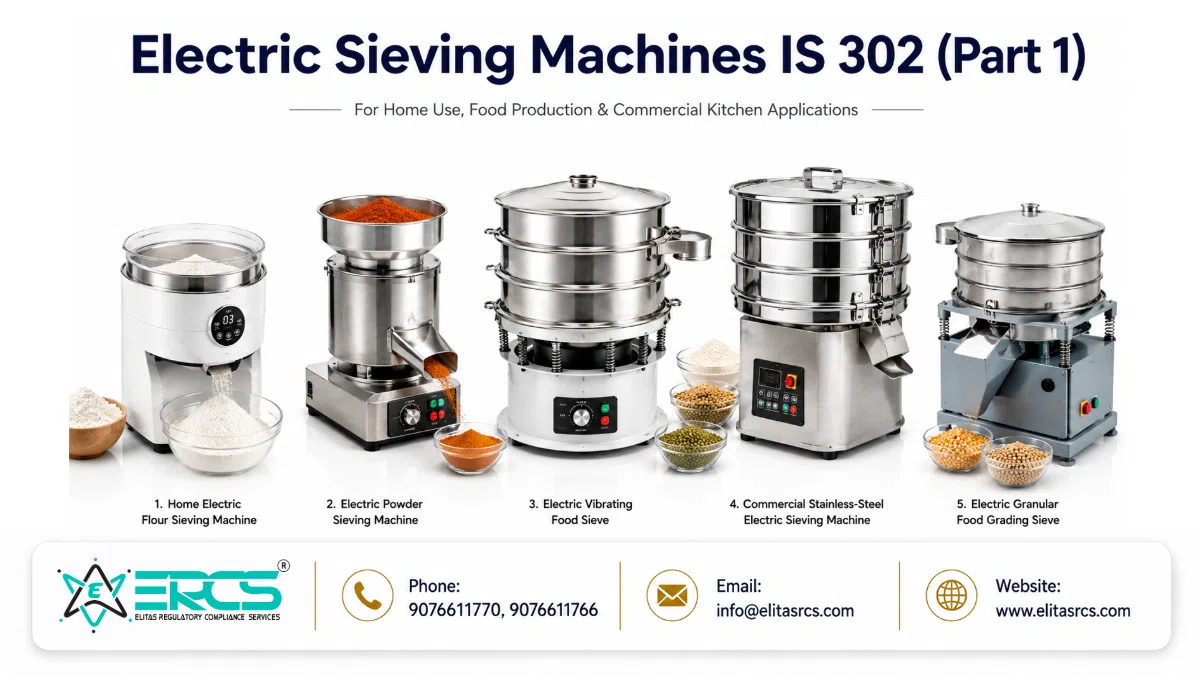
The BIS Certification of Electric Sieving Machines is mandatory under the Safety of Household, Commercial and Similar Electrical Appliances (Quality Control Order). The products should fulfil all the technical and safety requirements specified in IS 302 (Part 1):2024/ IEC 60335-1. This certification is required to legally manufacture, sell, or import these appliances in the Indian Market.
Electric Sieving Machines have a variety of uses in homes, food production, and commercial kitchens for sorting, filtering, or grading food products in powder or granular form. Due to the rising popularity of these products, it is important to ensure that they are safe to use, work properly, and are produced in accordance with all required specifications. Obtaining the ISI Mark not only protects you from electric shock but also adds value to your product, allowing the manufacturer to legally sell it in India with the ISI mark and certification.
What are Electric Sieving Machines IS 302 (Part 1) IEC 60335-1?
Electric Sieving Machines use electrical energy to rapidly separate powders, granules, and liquids by particle size. This entire process is carried out using electricity, eliminating manual labour. The mandatory safety requirements for Electric Sieving machines (also referred to as electric sifting machines) are set out in IS 302 Series (Part 1) & IEC 60335. These safety requirements outline the safety requirements for electric sifting machines, which are motor-driven machines, for quick separation/filtering of dry powders/granules/slurry (liquid mixtures of dry powder and liquid).
Key Highlights for IS 302 (Part 1)/IEC 60335-1 for Electric Sieving Machines
Shock Prevention:
- Live parts are insulated, so no accidental contact is possible. Accessible safety extra-low voltage outlets are strictly regulated.
Earthing and Terminals - Proper earthing of metallic components is required to avoid electrical leakage.
Insulation Resistance:
- Evaluated for electrical strength and leakage currents to prevent catastrophic failure.
Heating Performance:
- Evaluated to ensure the machine's motor and internal electronics do not exceed maximum permitted temperature limits during normal and heavy-duty usage.
Abnormal Operation Tests:
- Assesses fire and safety risks when components are stalled, blocked, or subjected to electrical faults (e.g., locked rotor conditions).
Mechanical Strength:
- The external body, supporting structures, and terminal housing are tested to ensure they withstand physical impacts and continuous, heavy vibrations without cracking or breaking.
Moisture Resistance
- Machines are tested for safe operation in humid environments (standard for food/material processing).
Key Benefits of ISI Mark Certification for Electric Sieving Machines in India
The ISI Mark Certification for electric sieving machines demonstrates compliance with the Indian Safety and Quality Standards. By obtaining the ISI Mark, manufacturers and Importers can:
- Avoid Penalties: Manufacturing and selling electric sieving machines without obtaining an ISI mark is illegal, and certification helps you avoid heavy penalties and business closure.
- Uninterrupted Sales: This will ensure manufacturers' production remains uninterrupted and seamless across all states in India.
- Risk Mitigation: Certification will ensure that machines have been verified to be safe from electrical hazards, overheating, and fire.
- Quality Assurance: Certification provides a long-term guarantee that moving parts, electrical components, and wiring will be structurally sound for both industrial and domestic applications.
- Verified Quality: The ISI Mark will provide buyers with the assurance of high-quality performance, allowing them to make an easier buying decision.
- Competitive Advantage: Products with the ISI Mark will receive strong preference from buyers in the marketplace compared to those without certification, thereby increasing revenues and sales.
List of Documents Required for ISI Mark Certification of Electric Sieving Machines
Below, you can go through the important documents required for BIS Certification of your product under Sieving Machines in India:
- Business Registration
- Company PAN Card & GST Certificate
- Factory/Trade License
- Address Proof
- Authorized Signatory
- Trademark Certificate
- Factory Location Plan
- Layout Plan
- Manufacturing Process Flowchart
- List of Machinery
- Product Specifications
- Raw Material Details
- Testing Equipment List
- Test Reports
Applicable Test Parameters for Electric Sieving Machines IS 302 (Part 1) IEC 60335-1
Electric sieving machines are required to have BIS certification (ISI Mark) under IS 302 (Part 1) / IEC 60335-1. The test assesses the overall electrical safety, mechanical endurance, and thermal performance of the electric sieving machine to ensure the machine is safe for use in both home and commercial food-processing environments.
- Protection Against Electric Shock: Verifies the integrity of the insulation by confirming that the user is protected from live internal parts.
- Heating Performance: The temperature rise of the motor and its internal components is monitored to ensure they do not exceed safe operating limits during continuous use.
- Mechanical Strength: The physical impact, vibration and stress that the external body and supporting parts will withstand whilst the machine is operational are tested.
- Moisture Resistance: The machine is tested under controlled conditions in humid or damp environments to emulate the conditions in which it will operate, which is critical for food and kitchen appliances.
- Earthing Protection: Verifies that the machine is earthed to protect against electric shock should the insulation fail.
- Fire and Heat Resistance: Tests whether the non-metallic components/ materials and external parts can withstand fire and heat caused by abnormal conditions.
- Sieving Efficiency and Balance: When the machine is sifting heavy loads, its operation must be stable and free of vibrations. Therefore, the sieving machine is tested to ensure it provides the correct filtration.
- Electrical Power Cable and Supply Cord Safety: The power supply to the electric sieving machines will be tested for durability, flexibility, and the cord's anchoring against wear and tear.
Step-by-Step BIS Certification Process for Electric Sieving Machines in India
For you to obtain the Indian standard certification via the BIS scheme 1, you will need to complete each of the following steps:
- Submit Application: The Manufacturer submits a BIS application via the BIS online portal.
- Document Preparation: The Manufacturer prepares all necessary documentation in accordance with IS 302 Part 1/IEC 60335-1.
- Factory Inspection: BIS officers conduct a factory inspection of the Manufacturing location to evaluate its processes.
- Product Testing: The Manufacturer provides product samples to BIS Labs for testing.
- Obtain ISI Mark: Following testing and inspection, BIS will issue a Certificate to the Manufacturer.
(If you're a foreign Manufacturer, you need to appoint an Authorised Indian Representative (AIR))
Both Indian and foreign manufacturers must follow the process to obtain BIS certification:
- BIS Certification Process for Indian Manufacturers
- BIS Certification Process for Foreign Manufacturers
BIS Certification Cost for Electric Sieving Machines (2026)
Below, you can go through the table for the BIS Certification cost of Sieving Machines:
|
S No. |
Particular |
Amount (INR) |
Remarks |
|
1. |
Application Fee |
1000 |
To be paid directly to BIS |
|
2. |
Audit Fee |
7000 |
To be paid directly to BIS |
|
3. |
License Fee |
1000 |
To be paid directly to BIS |
|
4. |
Sample Testing Fee |
As Applicable |
To be paid directly to BIS (Testing charges vary from product to product and lab to lab.) |
|
5. |
Minimum Advance Marking Fee |
As per actual |
To be paid directly to BIS (Marking fee varies as per Indian Standard) |
|
6. |
Renewal Fee |
1000 |
To be paid directly to BIS |
|
7. |
Inclusion Fee |
5000 |
To be paid directly to BIS |
|
8. |
ERCS Pvt Ltd Service Fee |
Please contact info@elitasrcs.com |
|
Renewal of Certification for Electric Sieving Machines IS 302 (Part 1) IEC 60335-1
To renew your BIS Certification for Electric Sieving Machines per IS 302 (Part 1) or IEC 60335-1, you must submit your renewal application through the Manakonline Portal before your current license expiration date. The standard has been updated to IS 302 (Part 1), and therefore, a factory audit and updated lab test reports are required. Renewal Validity: ISI Mark licences under Scheme I are initially granted for 1–2 years and can be renewed, typically annually or biannually. Renewal for up to 5 years is possible in certain cases based on compliance history.
Why Choose ERCS as Your BIS Certification Consultant for Electric Sieving Machines?
If you choose ERCS for your BIS certification consultant for electric sieving machines, they will ensure that you have an efficient route to certification compliance. ERCS manages all aspects of compliance with IS 302 standards, including categorising the product, conducting lab tests, auditing manufacturers' facilities, and obtaining the necessary licenses.
- Assists in understanding the specific requirements for Electric Sieving Machines regarding BIS standards, certification procedures and compliance obligations.
- Prepares, assists in reviewing and submits all technical, legal, and regulatory documentation necessary for BIS certification.
- ERCS provides end-to-end assistance in arranging product testing at BIS-accredited laboratories and facilitates logistical concerns related to testing.
- Evaluate how the specifications of your products compare to the applicable requirements of IS 302 (Part 1) / IEC 60335-1 and outline any gaps in compliance.
- Assist you in filing the application with BIS accurately and will continue to communicate with BIS throughout the certification process until complete.
- ERCS provides manufacturers with guidance on factory audits, inspections, and quality assurance process preparation.
- Proactive compliance management services to reduce delays and speed up certification approval.
FAQs
Q1. What is the BIS certification for electric sieving machines?
Ans. The BIS Certification for Electric Sieving machines under IS 302 (Part 1) is mandatory for manufacturers, importers, and sellers to ensure the product meets strict consumer safety and quality guidelines.
Q2. Is BIS certification mandatory for sieving machines?
Ans. Yes, BIS Certification is mandatory for Sieving machines in India. If you avoid certification, you may face penalties, product seizure or heavy fines.
Q3. Under which certification scheme are Electric Sieving Machines certified?
Ans. The Electric Sieving Machines are classified under the BIS Scheme I (ISI Mark) of the Bureau of Indian Standards.
Q4. How to get BIS Certification for Electric Sieving Machines in India?
Ans. Application Submission → Documentation Preparation → Factory Inspection → Product Testing in BIS-Recognised Lab → BIS Evaluation → Grant of BIS License → Use of ISI Mark on Electric Sieving Machines.
Q5. How long does it take to obtain BIS Certification for Electric Sieving Machines?
Ans. Obtaining BIS Certification for Electric Sieving Machines under IS 302 Part 1/IEC 60335-1 takes 30 to 60 days for domestic manufacturers and 3 to 6 months for foreign manufacturers.