BIS Certification for
Electric Noodle Makers
IS 302 Part 1 / IEC 60335-1
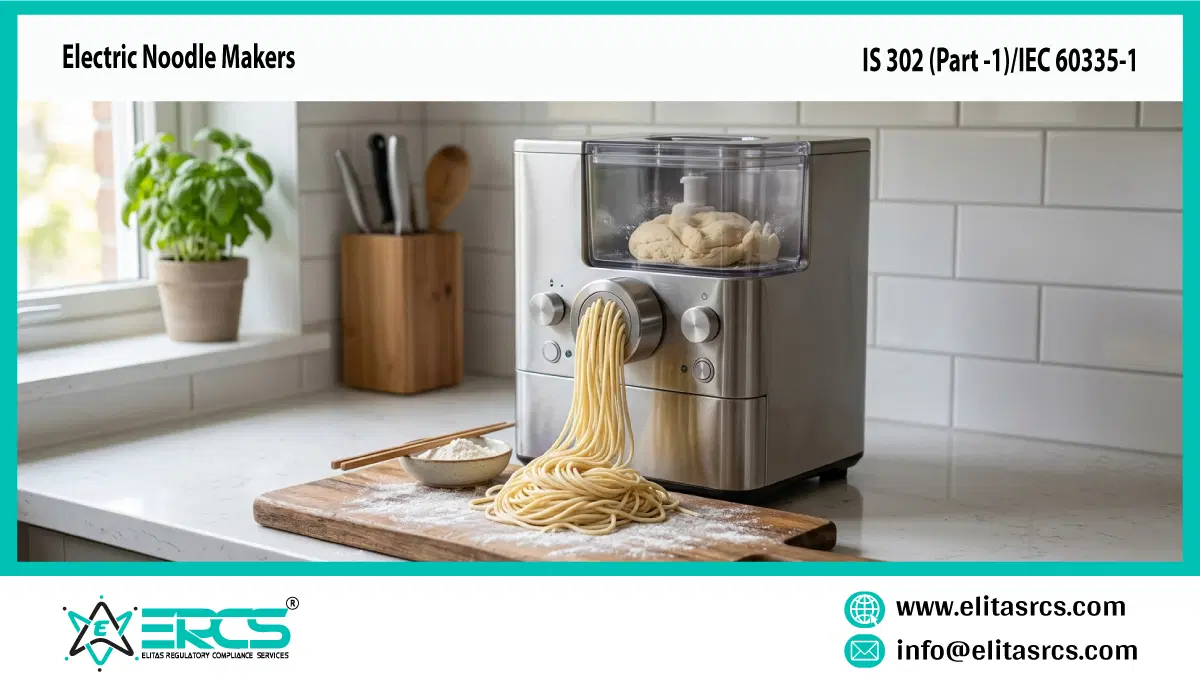
BIS Certification for Electric Noodle Makers under IS 302 Part 1 is mandatory for manufacturing and importing these appliances in India by ensuring they meet strict safety and quality standards. The Bureau of Indian Standards issues the certificate in accordance with IS 302, Part 1, which is aligned with IEC 60335-1. This certification helps manufacturers to demonstrate that their appliances are user-protected and safe from electrical hazards and failures. The Government of India has issued the Safety of Household, Commercial, and Similar Electrical Appliances (Quality Control) Order, 2026, effective from 1st October, 2026.
Electric Noodle Makers under IS 302 Part 1/IEC 60335-1
Electric Noodle Makers are motorised kitchen appliances that automate kneading, mixing, and pressing dough to produce noodles or other traditional snacks. These appliances are widely used in household and commercial kitchens to simplify the process of making fresh noodles.
IS 302 Part 1 IEC 60335-1 is the Indian standard that specifies safety requirements for electrically operated appliances. Ensuring their safety and performance in line with Indian standards is important. Certifying it helps manufacturers produce high-quality electric noodle makers.
Key Highlights of IS 302 (Part 1) for Electric Noodle Makers
|
Parameters |
Requirements |
|
Applicable Indian Standard |
Electric noodle makers must comply with IS 302 Part 1 / IEC 60335-1 under the Safety of Household, Commercial, and Similar Electrical Appliances (Quality Control) Order, 2026 |
|
Voltage tolerance |
The appliance must remain safe and stable when the supply voltage fluctuates between ± 10% of its declared rated voltage |
|
Mechanical strength |
Verifies that the moving parts of the appliances and structural components are protected against accidental contact during operation. |
|
Protection against Moisture |
The parts are likely to be wet during the operation or daily use to ensure they do not create short-circuit or shock hazards |
|
Food contact safety |
All materials that are in direct contact with the dough or noodles must be non-toxic and corrosion-resistant. |
Benefits of BIS Certification for Electric Noodle Makers
The electric noodle makers bring various benefits for manufacturers in terms of building their brand reputation in the market:
- Mandatory Legal Compliance: Selling non-certified noodle makers is illegal; the standard ensures these appliances minimise the risk of thermal and electrical hazards.
- Guaranteed Electrical & Mechanical Safety: Certification requires products to undergo rigorous testing before receiving the ISI mark, ensuring their safety and quality.
- Enhanced Consumer Trust: The ISI mark serves as a government assurance of quality and safety, making consumers more likely to purchase certified products over uncertified ones.
- Competitive Market Advantage: Certified products serve as benchmarks across the Indian market, free from regulatory hurdles or customs delays.
- Global Alignment: BIS testing aligns with international standards, making it easier for manufacturers to expand their businesses and export products to global markets.
Documents required for BIS Certification of Electric Noodle Makers
The list of important documents required for obtaining the ISI mark for an electric noodle maker:
- Business license/Registration Certificate
- ID Proof of Authorised Signatory
- Nomination form of Authorised Indian Representative (AIR)for foreign manufacturers (if applicable)
- Test reports from a BIS-recognised laboratory
- Factory Layout Plan
- Authorisation letter or Trademark Certificate
- Manufacturing licenses (if applicable)
- Product technical specification details
Applicable Test Parameters for Electric Noodle Makers IS 302 (Part 1)
These test parameters of IS 302 Part 1 are aligned with IEC 60335-1 to ensure electrical safety and hygiene, and to evaluate mechanical safety:
- Electrical Safety: Ensure the internal parts are fully insulated and verify that the external parts are properly grounded to prevent electric shock.
- Mechanical Safety: Test motors and gears to verify functional stability, ensure they are protected against accidental contact, and confirm they withstand drops without exposing them to hazardous parts.
- Thermal Safety & Abnormal Operation: check the outer housing temperature limits and overload protection.
- Food Safety & Hygiene: check that the materials that come into contact with the flour, dough, and noodles must be non-toxic, food-grade, and compliant with hygiene standards
- Construction & Markings: appliances must have accurate markings to ensure users know exactly how to operate the noodle maker safely.
Process for obtaining BIS Certification of Electric Noodle Makers
Manufacturers must follow the necessary BIS Certification procedure:
Step 1: Appoint an AIR - foreign manufacturers must appoint an Authorised Indian Representative (AIR) for communication with BIS on their behalf.
Step 2: Application Submission - Fill out the BIS application form via the BIS online portal.
Step 3: Documentation Preparation - prepare all the documents, including technical documentation and product specifications, with attached BIS test reports, and pay the applicable fees.
Step 4: Scrutiny and factory inspection - BIS officials will review your documents and verify your test reports, and may conduct a product or factory inspection.
Step 5: Product Sample Testing - send samples to BIS-recognised labs to conduct safety and quality tests and verify compliance with Indian Standards.
Step 6: Grant of License- Upon satisfactory completion of the factory inspection and product sample testing, BIS will issue the BIS License to the manufacturer.
Indian and foreign manufacturers need to complete the following steps to receive their BIS certification:
- BIS Certification Process for Indian Manufacturers
- BIS Certification Process for Foreign Manufacturers
Cost of BIS Certification under IS 302 Part 1
The total cost of obtaining BIS certification under IS 302 (Part 1): IEC 60335-1 includes:
|
S. No |
Particular |
Amount (INR) |
Remarks |
|
1. |
Application Fee |
1000 |
To be paid directly to BIS |
|
2. |
Audit Fee |
7000 |
To be paid directly to BIS |
|
3. |
License Fee |
1000 |
To be paid directly to BIS |
|
4. |
Sample Testing Fee |
As Applicable |
To be paid directly to BIS (Testing charges vary from product to product and lab to lab.) |
|
5. |
Minimum Advance Marking Fee |
As per actual |
To be paid directly to BIS (Marking fee varies as per Indian Standard) |
|
6. |
Renewal Fee |
1000 |
To be paid directly to BIS |
|
7. |
Inclusion Fee |
5000 |
To be paid directly to BIS |
|
8. |
ERCS Pvt Ltd Service Fee |
Please contact info@elitasrcs.com |
|
Validity Period and BIS Licence Renewal India
According to the Bureau of Indian Standards BIS), you can renew your licence for a period ranging up to 5 years, and the applicable fees are paid annually. Manufacturers are required to submit renewal applications to the Bureau of Indian Standards (BIS) well before their current licence expires. If you fail to comply with the requirements, your products may face legal penalties and fines.
Why choose ERCS Private Limited as your BIS Certification Consultant
As a top BIS Consultant India, we provide comprehensive guidance to both foreign and domestic manufacturers through a customer-driven approach, enabling them to obtain their certification efficiently and in compliance, including:
- ERCS has an experienced team with extensive experience in BIS regulations and certification procedures.
- We provide comprehensive assistance from documentation development, submission, and review to certification issuance.
- Proven knowledge/experience in meeting the certification requirements related to electrical and electronic products.
- Accurate guidance regarding the BIS Indian Standards that may apply to your product, which are associated with compliance obligations.
- Timely information regarding changes to regulations and certification requirements.
- Streamlined processing of the application to minimise processing delays.
FAQs
Q1.What voltage tolerance is required for electric noodle makers under IS 302 Part 1?
Ans: The appliance must remain safe and stable during operations when the supply voltage fluctuates within ±10% of the declared rated voltage.
Q2. Is BIS certification mandatory for electric noodle makers in India?
Ans: Yes. Under the Safety of Household, Commercial, and Similar Electrical Appliances (Quality Control) Order, 2026, BIS certification under IS 302 Part 1 / IEC 60335-1 is mandatory for selling these appliances, and selling non-certified noodle makers is illegal in India.
Q3. Which Indian Standard applies to electric noodle makers?
Ans: Electric noodle makers must comply with IS 302 Part 1, which aligns with the international standard IEC 60335-1that covers the safety of household and similar electrical appliances.
Q4. What happens after sample testing and factory inspection during BIS certification?
Ans: Once BIS officials verify the factory inspection, document, and product sample test results, the BIS Licence is granted to the manufacturer, allowing them to use the ISI mark on their products.
Q5.What is the timeline for BIS certification?
Ans: BIS certification typically takes 3 to 6 months from application to approval. Timelines vary as per product types.