BIS Certification for
Electric Iron
IS 302 (Part 2/Sec 3)
Planning to manufacture or import electronic irons in India? Then securing BIS Certification for Electric Iron IS 302 (Part 2/Sec 3) is the first and most crucial step for the legal Indian market. The ISI Mark is mandatory under the BIS Act, 2016, to ensure safety for dry, steam, and cordless irons with rated voltage not exceeding 250 V. As per the Electrical Wir es, Cables, Appliances and Protection Devices and Accessories (Quality control) order, all the manufacturers of safety household and similar electrical appliances, Electric irons are obligated to obtain ISI Mark Certification. BIS Certification ensures that the electric iron has been tested for various parameters, including insulation, thermal management, voltage handling, and overall construction. This certification applies to appliances not intended for household use.
Overview of Electric Iron IS 302 (Part 2/Sec 3)
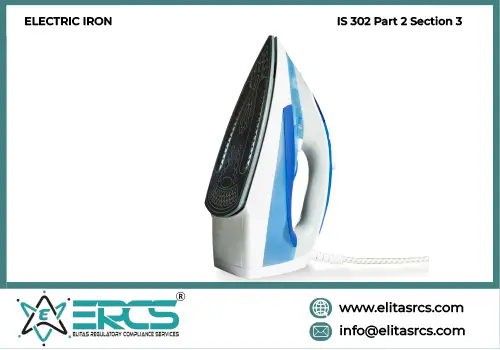
An electric iron is an essential household electrical device used for removing wrinkles from fabrics. It comprises a metal, triangular, flat soleplate, usually made of metal, heated internally by a nichrome wire. Modern electric irons have thermostatic controls and non-stick coatings. They have varying powers, ranging from 300W to 1000W, including those used with steam. BIS certification is mandatory for electric irons in India. It is required to ensure safety from electric shock, overheating, and fire. It must comply with IS 302 (Part 2/Sec 3):2007, which includes dry and steam irons, and must have the ISI mark before being sold.
Key Highlights for IS 302 (Part 2/Sec 3)
Below, you can refer to the specifications under the IS 302 (Part 2/Sec 3) for BIS Certification of Electric Iron:
- Voltage Rating: Electric irons having a voltage rating not more than 250 volts.
- Water Capacity: Steam irons having a water boiler or reservoir not exceeding 5 litres.
- Product Types: Dry irons, vented steam irons, pressurized steam irons, and instantaneous steam irons (both cabled and battery operated).
- User Group: Household appliances and non-professional applications in stores, farms, and light industries.
- Electrical Safety: Protection against access to live parts, proper insulation, and sufficient electrical/dielectric strength.
- Thermal Safety: Limitations on maximum temperature and mandatory overheat protection to prevent fires from starting.
- Operational Tests: Power consumption and current testing, leakage current test at operating temperature and earth continuity check.
- Test Group Classification: Appliances tested should be classified into group I (with maximum power not exceeding 1000 watts) and group II (above 1000 watts).
- Labelling: Proper labelling and ratings along with the ISI mark according to BIS regulations, scheme I.
Benefits of BIS/ISI Certification for Electric Iron
The advantages of BIS certification for Electric Iron, which is mandatory for the sale and distribution of the product in India, can be listed as:
- Consumer Safety: The ISI-certified iron is manufactured according to stringent Indian Standards (e.g., IS 302 Part 2/Sec 3) regarding insulation and electrical safety features, thereby minimising the risk of electric shocks, burns, and short circuits.
- Legal Protection: It complies with compulsory Quality Control Orders (QCOs) established by the Bureau of Indian Standards under the BIS Act, thereby avoiding any fines, product withdrawals, or bans.
- Quality and Durability: Laboratory testing ensures the product operates efficiently under normal use.
- Market Acceptance: Having the ISI mark will instantly give credibility with buyers and wholesalers.
Documents Required for Obtaining ISI Mark on IS 302 (Part 2/Sec 3)
Here is the List of Documents Required for BIS Certification of Electric Iron IS 302 (Part 2/Sec 3) as applicable):
- Application form (duly filled and signed)
- Business registration certificate (GST Certificate / Incorporation Certificate)
- Manufacturing unit address proof
- Factory layout and manufacturing process flow chart
- List of manufacturing machinery and testing equipment
- Calibration certificates of testing equipment
- Product technical specification sheet
- Product drawings and circuit diagram
- Authorized Indian Representative (AIR) documents (for foreign manufacturers)
- Trademark authorization letter (if applicable)
Applicable Test Parameters for Electric Iron IS 302 (Part 2/Sec 3)
Essential parameters of the test as per IS 302 (Part 2/Sec 3), which is equivalent to IEC 60335-2-76, are as follows:
- Marking & Rating Verification: Check the voltage, wattage, model number, ISI mark spacing, and safety instructions on the iron.
- Input Power Test: Test the wattage consumption at rated voltage.
- Heating (Temperature Rise) Test: Check the surface temperature of the soleplate and accessible parts.
- Thermostat Operation Test: Check the thermostat mechanism.
- Leakage Current Test: Check the leakage current within safety limits.
- Insulation Resistance Test: Check the insulation resistance between live parts and accessible metal parts.
- Electric Strength (High Voltage) Test: Apply high voltage.
Process of BIS Certification of IS 302 (Part 2/Sec 3)
To get the BIS certification for your product, please follow the procedure given below:
- Filling of the Application: First, the manufacturer must register on the BIS Portal. After registration, the manufacturer must apply for the license by filling out the application.
- Documentation Preparation: This includes obtaining the required documents, including the licenses of the factory, quality control, specifications of the raw materials, etc.
- Laboratory Testing: Samples of the product must be sent to a laboratory registered with the BIS for chemical composition tests.
- Inspection of Factory: The BIS officers inspect the extraction process, quality control, and factory layout.
- Questioning the License: After the completion of the inspection, examination, and verification of the test reports, the BIS grants the license to use the "Standard Mark".
The process can be obtained and certified for the Indian manufacturer and the foreign manufacturers as well:
BIS ISI Certification Process for Indian Manufacturers
BIS FMCS Certification Process for Foreign Manufacturers
Checklist of Points for Obtaining ISI Mark on Electric Iron
Important Points to Remember for BIS Certification of Electric Iron in India:
- The electric iron should be fully compliant with IS 302 (Part 2/Sec 3) safety and performance requirements before applying for BIS Certification.
- The manufacturer should establish mandatory in-house testing facilities as per BIS requirements for obtaining ISI Mark Certification.
- The product should be tested from a BIS-recognized lab for safety as per Indian safety standards.
- The testing equipment should be calibrated and possess a valid NABL calibration certificate.
- The manufacturer should develop and execute a Quality Control Plan as per BIS requirements.
- The product should be correctly marked with the voltage rating of 230V/50Hz, wattage rating, and ISI mark details.
BIS Certification Fees in India for IS 302 (Part 2/Sec 3)
Go through the table to know the cost of BIS Certification India for IS 302 (Part 2/Sec 3):
|
S No. |
Particular |
Amount (INR) |
Remarks |
|
1. |
Application Fee |
1000 |
To be paid directly to BIS |
|
2. |
Audit Fee |
7000 |
To be paid directly to BIS |
|
3. |
License Fee |
1000 |
To be paid directly to BIS |
|
4. |
Sample Testing Fee |
As Applicable |
To be paid directly to BIS (Testing charges vary from product to product and lab to lab.) |
|
5. |
Minimum Advance Marking Fee |
As per the actual |
To be paid directly to BIS (Marking fee varies as per Indian Standard) |
|
6. |
Renewal Fee |
1000 |
To be paid directly to BIS |
|
7. |
Inclusion Fee |
5000 |
To be paid directly to BIS |
|
8. |
ERCS Pvt Ltd Service Fee |
Please contact info@elitasrcs.com |
|
|
Remarks |
Including all the taxes |
||
Why Choose ERCS Private Limited for BIS Certification of Electric Iron?
ERCS Private Limited has been delivering professional services for BIS certification and compliance since 2019. With over 1500+ successful certification projects under their belt, ERCS has the practical knowledge to handle the BIS process for the electrical industry efficiently. ERCS has extensive experience working with various industries and products, which has enabled them to gain valuable insights into the Indian Standards and the procedures involved with the assessment of conformity. With the support of experienced consultants, ERCS ensures a smooth journey for the client.