BIS Certification for
Electric Hot Plates
IS 302 Part 1: 2024/IEC 60335-1
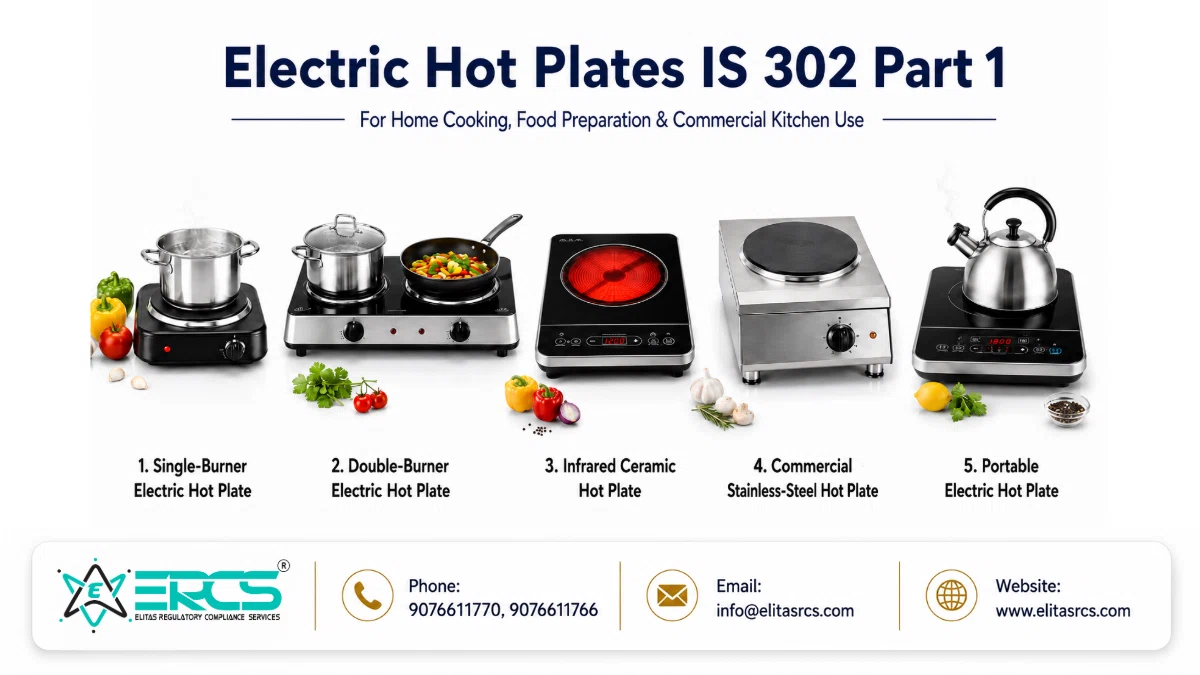
The BIS Certification under IS 302 Part 1: 2024/IEC 60335-1 is mandatory for the manufacture, import, or sale of Electric Hot Plates and warming plates in India. Products must pass rigorous safety tests and bear the ISI Mark, as enforced by Quality Control Orders. This IS defines the minimum safety requirements for user protection against Overheating, fire hazards, and unusual operating conditions, among other things. The Quality Control Order applies to equipment rated up to 250 V (single-phase) and 480 V (other, including DC/battery). It came into force on 19th March 2026, with extended dates for MSMEs.
Manufacturers of Electric Hot Plates can apply for BIS certification online, and application fees are paid before applying and receiving certification. Therefore, the BIS certification process establishes a clear, consistent standard for product quality and safety, facilitating both domestic and international BIS customs clearance for Electric Hot Plates.
What are Electric Hot Plates IS 302 Part 1: 2024/IEC 60335-1?
The electric hot plate is a portable cooking appliance that uses electricity as the heat source. It has one or more heating elements, such as a metallic heating element, a solid hot plate, or a ceramic heating surface, for placing your cooking utensils, such as pots, pans, and vessels. These appliances are widely used in houses, hostels, offices, kitchens, laboratories, and other places where a conventional cooking stove may not be needed. Some of the models have features such as temperature control systems, indicator lights, temperature regulation, and overheat protection.
Indian Standard IS 302 Part 1: 2024 / IEC 60335-1 is the compulsory Indian standard, in harmony with international standards, for portable or tabletop electric heating or warming plates. As per the Quality Control Orders (QCO) of the Bureau of Indian Standards (BIS), all electric hot plates marketed or available in India must pass this standard test to be marked with the compulsory ISI Mark.
Key Highlights for IS 302 (Part 1)/IEC 60335-1 for Electric Hot Plates
IS 302 (Part 1): 2024 / IEC 60335-1: 2020 is the central general safety standard laid down by the Bureau of Indian Standards for household and commercial electrical appliances such as electric slicers:
- Standard Version: Updated from the older 2008 revision to IS 302 (Part 1):2024, which harmonises with international IEC 60335-1:2020 guidelines.
- Enforcement Date: Compulsory compliance for electric hot plates and warming appliances falls under the Quality Control Order (QCO) with a strict enforcement deadline of October 1, 2026.
- Voltage Scope: Applies to single-phase appliances up to 250 V and other configurations up to 480 V.
- Shock & Live Parts Protection: Stringent checks to prevent user access to live internal components.
- Thermal Controls: Limits for maximum temperature rise during operation and rigorous testing against abnormal operation and overheating.
- Insulation & Leakage: Strict parameters for insulation resistance and low leakage current under normal and humid conditions.
- Mechanical Strength: Structural durability tests using impact and spring hammers to avoid mechanical hazards.
Key Benefits of ISI Mark Certification for Electric Hot Plates in India
The ISI Mark certification from the Bureau of Indian Standards (BIS) for electric hot plates in India is mandatory and essential to ensure the appliance's safety, quality, and marketability.
- Mandatory Legal Compliance: Certification enables the legal sale of the electric hot plate in India under the Quality Control Orders (QCO). There are no penalties for selling unmarked goods, and there is a risk of goods confiscation and litigation.
- Safety for Consumers: The product is tested for compliance with insulation resistance, temperature rise, and mechanical strength, in accordance with standards such as IS 302. Thus, the consumer is protected against shock, burn, and fire risks.
- Market Advantage: A certified product is more likely to compete in the market of poorly organised competitors.
- Facility in Importing: A BIS license is required to import electric cooking and heating appliances and clear Indian customs without complications.
- Brand Reputation Enhancement: The ISI certification mark with a license number gives consumers confidence about the appliance's ance quality.
List of Documents Required for ISI Mark Certification of Electric Hot Plates
To obtain ISI certification from the Bureau of Indian Standards (BIS) for electric hot plates under IS 302, one must provide a complete set of administrative, technical, and manufacturing data sheets.
- Business registration certificate of the manufacturer/company
- Factory License or manufacturing facility data
- Application for BIS in an application form, along with a declaration
- Technical specification sheet of the product
- Manufacturing process flow chart
- List of manufacturing equipment with their capacity
- Testing facilities data in-house
- Product test report in a BIS-recognized laboratory
- Quality control/Inspection procedure sheet
- Raw material and critical component details
- Letter of authorisation of signatory with identification proofs
- Company address proofs
Testing Parameters for Electric Hot Plates IS 302 (Part 1)/IEC 60335-1
Under IS 302 (Part 1)/IEC 60335-1, Electric Hot Plates are normally subjected to testing against the following testing parameters:
- Verification of Marking and instructions: This includes evaluating the product's labels, ratings, safety warnings and user instructions.
- Protection against electric shock: This test ensures that users cannot touch any part of the product that could cause electric shock during normal use.
- Power Input & Current test: This test verifies that the product can be operated safely as per its specified power and current ratings.
- Temperature rise: This test measures the temperature rise of externally accessible surfaces, internal components, and insulating materials while the appliance is heating.
- Leakage Current Test: This test verifies that the appliance's leakage current is within acceptable limits for safe operation.
- Electric Strength: This test is performed to ensure that the product can withstand the high-voltage dielectric withstand test applied per the standard without failure.
- Moisture Resistance Test: This test verifies that the appliance remains electrically safe after exposure to moisture.
BIS Certification Process for Electric Hot Plates in India
Bureau of Indian Standards (BIS) certification for Electric Hot Plates in India includes the following steps:
- The applicant should identify the relevant Indian standard and complete the application form.
- Ensure that all documents are complete and submit them to BIS through its website.
- BIS will carry out an inspection of the premises.
- The sample taken during the factory inspection is sealed by a BIS Inspector and then sent to the BIS-accredited laboratory.
- If BIS objects to any non-conformity, then the applicant should resolve it and notify BIS.
- The ISI mark is awarded to the applicant if all test parameters are satisfied.
- An applicant from abroad should have an AIR.
Both Indian and foreign manufacturers must follow the process to obtain BIS certification:
- ISI/BIS Certification Process for Indian Manufacturers
- BIS FMCS Certification Process for Foreign Manufacturers
BIS Certification Cost for Electric Hot Plates (2026)
Below, you can go through the table for the BIS Certification cost of Electric Hot Plates:
|
S No. |
Particular |
Amount (INR) |
Remarks |
|
1. |
Application Fee |
1000 |
To be paid directly to BIS |
|
2. |
Audit Fee |
7000 |
To be paid directly to BIS |
|
3. |
License Fee |
1000 |
To be paid directly to BIS |
|
4. |
Sample Testing Fee |
As Applicable |
To be paid directly to BIS (Testing charges vary by product and lab). |
|
5. |
Minimum Advance Marking Fee |
As per actual |
To be paid directly to BIS (Marking fee varies as per Indian Standard) |
|
6. |
Renewal Fee |
1000 |
To be paid directly to BIS |
|
7. |
Inclusion Fee |
5000 |
To be paid directly to BIS |
|
8. |
ERCS Pvt Ltd Service Fee |
Please contact info@elitasrcs.com |
|
Renewal of BIS Certification for Electric Hot Plates IS 302 Part 1:2024/IEC 60335-1
Renewal of a BIS certification for electric hot plates as per IS 302 (Part 1):2024 / IEC 60335-1 requires filing a renewal application along with updated test reports and fees for factory inspection before the expiry of your current license.
- Log in to the Portal: Use the official Bureau of Indian Standards online portal to log in using your credentials.
- Filing of Renewal Application: Complete the particular form (Form X or any other renewal application form) for your BIS Certification for Electric Hot Plates prior to the expiry of your license.
- Upload Supporting Documents: Include updated production details, calibration of test instruments, and evidence of payment of advance license/marking fees.
- Verification of Compliance: Ensure that your manufacturing facility complies with the revised general safety requirements of IS 302 (Part 1):2024 (Harmonised with IEC 60335-1:2020), which were made mandatory under the latest QCOS notifications.
- Payment of Fees: Pay the total renewal fees and annual minimum marking fees through the online portal.
- Extension of License: The license is extended for an additional term of validity (1 to 5 years) upon approval by the BIS officer.
Why Choose ERCS as Your BIS Certification Consultant for Electric Hot Plates?
ERCS provides end-to-end consultancy services for electric hot plate manufacturers seeking BIS Certification in India. Our team has extensive experience and a deep understanding of Indian laws governing the certification process, enabling customers to complete BIS certification efficiently while meeting all required industry standards.
- Comprehensive Knowledge Of The BIS Process: Professionals with experience and extensive knowledge of the procedures required for BIS Certification and all of the related standards are part of our team.
- Documentation Preparation Assistance: Preparing technical documentation, test reports, and compliance documentation for submission to BIS is done by ERCS personnel.
- Testing Support: Assisting in coordinating testing of products with the required BIS-accredited laboratories so that product testing can be completed in a timely and efficient manner.
- Regulatory Compliance: Providing the latest information on changes to BIS Regulations and revisions to standards; assisting in avoiding violations of BIS Regulations.
- Application & Liaison Services: Continual follow-up with the Bureau of Indian Standards for products, resolving any technical questions related to submitted applications for approval.
- Less Delays & Required Effort: Procedures developed to minimise delays and streamline the entire certification process.