BIS Certification for
Electric Food Processors
IS 302 (Part 1/IEC 60335-1)
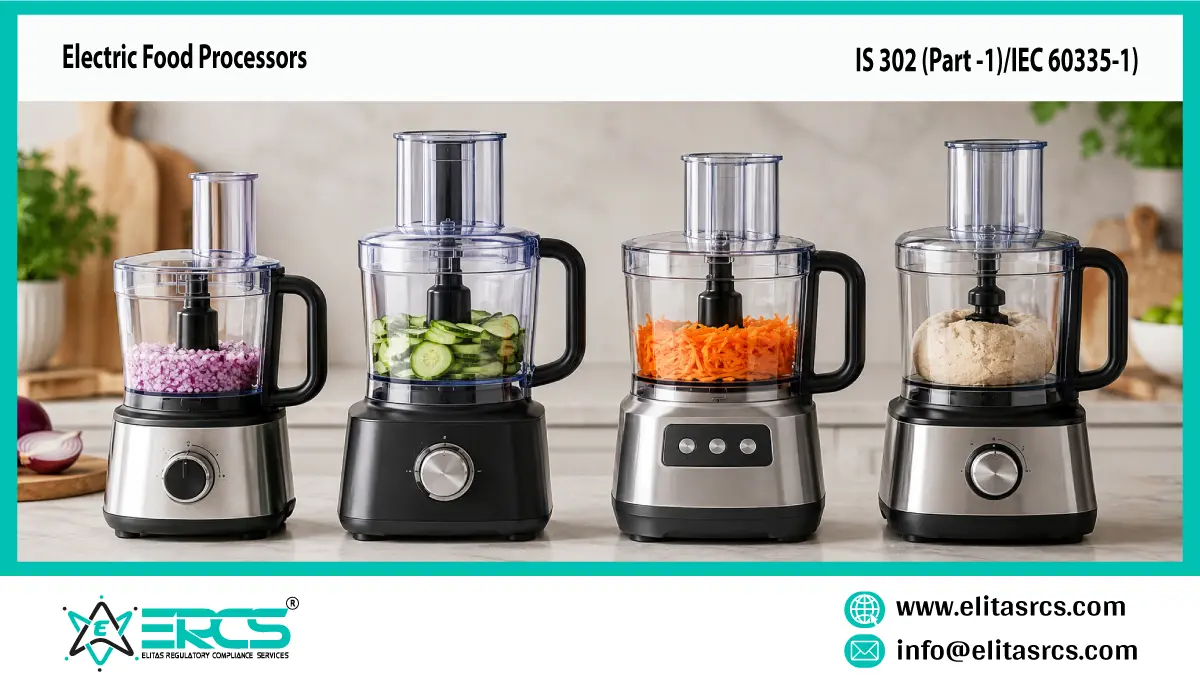
BIS certification for electric food processors is mandatory in India, as mandated by the Bureau of India under IS 302 Part 1. These products emphasise the importance of safety, performance, and reliability in these widely used kitchen appliances.
In today’s competitive market, maintaining a strong presence can be difficult. Manufacturers and importers aiming to sell their products in India must obtain a BIS, which is mandatory. Compliance with this standard not only enhances consumer trust but also helps manufacturers strengthen their brand reputation and market competitiveness as per the Safety of Household, Commercial and Similar Electrical Appliances (Quality Control) Order 2026. General manufacturers must comply by 1 October 2026. Small enterprises must comply by 1 January 2027. Micro enterprises must comply by 1 April 2027.
What are Electric Food Processors under IS 302 Part 1?
A food processor is a kitchen appliance used to facilitate repetitive tasks in food preparation. These appliances are powered by a motor that performs repetitive, time-consuming tasks such as chopping, slicing, and shredding. These kitchen appliances are used every day, often near water, heat, and children. As a result, the government makes BIS certification mandatory for many products.
IS 302 Part 1 states essential safety and performance guidelines that manufacturers must follow to ensure safe operation and consistent product quality. To secure BIS certification and ensure product quality, manufacturers must comply with the relevant Indian Standards prescribed by the Bureau of Indian Standards (BIS).
Key Highlights for IS 302 Part 1 2024 food processor
Electric food processor mandatory certification Key requirements as per IS 302 Part 1: IEC 60335-1, as per BIS Certification:
|
Key requirements |
Details |
|
Applicable Standard |
IS 302 (Part 1): 2024 aligned with IEC 60335-1: 2020 for electric food processors |
|
Power parameters |
Single-phase appliances up to 250 V, DC appliances, and battery-operated units |
|
Key Safety Test |
The Test includes: Input power and current limits Protection against electric shock Heating and temperature rise Leakage current test Mechanical strength |
|
Certification Scheme |
Scheme-I (ISI Mark Licensing) |
|
Mandatory mark |
Products must bear the BIS/ISI Standard Mark to be manufactured, imported, or sold legally in India. |
Why ISI Mark Certification Matters: Legal, Commercial & Safety
By following the strict safety regulations of IS 302 (part 1): IEC 60335-1, all manufacturers can meet requirements and help protect consumers and their companies from liability claims:
- The Indian government mandates ISI certification for over 450 product categories, including Food processors under various Quality Control Orders (QCOs).
- Obtaining BIS Certification allows manufacturers to legally produce and sell their goods across India without any restrictions.
- The ISI mark on the product provides a competitive edge for the business by ensuring compliance and helps consumers differentiate it from cheap, substandard alternatives.
- ISI-certified products are eligible to participate in government contracts and infrastructure projects.
- Selling or importing uncertified products for manufacture is illegal and can lead to heavy fines, seizure of products, and even imprisonment under the BIS Act, 2016.
Documents Required for BIS ISI Mark Certification of Electric Food Processors
The list of documents required for your BIS Certification:
- Business Registration Documents
- List of Manufacturing Machinery and Testing Equipment
Factory Layout Plan - Authorised Signatory ID and Authorisation Letter
- Quality Control Documents
- Trademark Certificates
- Manufacturing Unit Details and factory address proof
- Product Technical Specifications and design details
- Manufacturing Process Flow Chart
- Product Test Report from a BIS-recognised laboratory
Mandatory Safety Tests IS 302 (Part 1)/ IEC 60335-1
The safety tests are required to ensure the product is safe from accidental hazards. These specific parameters are used in evaluating the Safety of appliances:
- Mechanical Strength & Stability: This test ensures the product's body can withstand physical impacts, vibration during high-speed processing, and that no sharp, accessible edges pose mechanical hazards.
- Protection Against Electric Shock: Verifying that users cannot accidentally come into contact with any live part of an appliance, whether during normal use or cleaning.
- Moisture Resistance Testing: Determining if and how the spillage of liquids causes a short circuit or a failure of an appliance.
- Input Power & Current Testing: Confirming that the appliance functions properly and that its input power rating and output current level conform to manufacturer specifications.
- Insulation Resistance & Leakage Current: An effective electrical insulation material must demonstrate adequate durability and satisfactory performance.
- Marking & Durability: The product must confirm that warnings, wattage, voltage, and manufacturer details are permanently and clearly labelled on the device.
How to Get an ISI Mark License for Electric Food Processors in India: Step-by-Step Process
Let us know the process for obtaining a BIS Certificate. Here’s the list of procedures to follow:
- Submit the application on the BIS Online portal with complete information and the required documents.
- Prepare all required documents and submit them in the format specified by BIS, including a factory layout showing production, a quality management plan (including in-process testing for motors and electrical Safety), and manufacturing details.
- The BIS may conduct a factory inspection to verify and audit your manufacturing site to ensure compliance with quality control measures.
- Sent 3-5 samples of the products to get tested in a BIS-approved laboratory. The testing will be conducted in accordance with IS 302 Part 1: IEC 60335-1.
- BIS will certify your product only if it meets the IS standards criteria and allows you to use the ISI mark on your product.
For comprehensive guidance on the BIS ISI Certification process, please read.
- BIS Certificate Procedure for Domestic Manufacturers
- BIS Certificate Procedure for Foreign Manufacturers
BIS Certification Cost & Timeline for Electric Food Processors (2026)
As a manufacturer, if you want to obtain the ISI mark for Electric Citrusfruit Squeezers, you must know that the timeline for this is not fixed; it depends upon different variables:
- BIS Certification for Indian Manufacturers typically takes 35-50 days
- For Foreign manufacturers, it may take about 4 to 6 months
And the cost of ISI Mark certification depends on both the number of models manufactured and the lab testing fee for similar products. To better understand the cost and timeline, you can contact ERCS Private Limited directly.
Validity Period & How to Renew BIS License
Under Scheme-I (ISI Mark Scheme), the BIS license granted for Electric Food Processors is generally valid for 1 to 2 years initially, depending on the approval granted by BIS for your online renewal application for your Electric Food Processor. For the BIS certification renewal process, IEC 60335-1testing must be done at least 30 days before the expiration date. Manufacturers must ensure continuous conformity with IS 302 Part 1 during the entire validity period.
.
Why Choose ERCS Private Limited in India?
Working with a professional BIS consultant like ERCS makes the BIS certification easy. ERCS provides expert assistance throughout the certification process and helps ensure full compliance with BIS standards. The following are reasons to choose ERCS:
- ERCS offers strong expertise and guidance on the BIS Certification process for electric food processors.
- ERCS works efficiently to expedite the certification process and ensure timely product certification.
- ERCS provides continuous support to help manufacturers comply with BIS standards through routine audits and post-certification updates.
- ERCS ensures your product meets all necessary standards, providing a smooth certification process and access to international markets.
- We help both domestic and global manufacturers in obtaining their BIS licenses easily to comply with Indian Regulatory requirements.
- We assist with ISI Mark labelling, product standards, factory compliance, and the food processor's quality control requirements.
FAQs
Q1.What is the IEC 60335-1 standard for appliances?
Ans. IEC 60335-1 is a safety standard for electrical appliances used for household and similar purposes. It covers appliances with voltage ratings not more than 250 V for single-phase appliances and 480 V for other appliances.
Q2.Who requires a BIS Certificate?
Ans. The Bureau of Indian Standards (BIS) Certificate is required for manufacturers, importers, and foreign exporters whose goods are subject to mandatory government regulations in India.
Q3.How to check whether a BIS certificate is valid?
Ans. You can check the validity of a Bureau of Indian Standards (BIS) certificate by using either their official mobile app or the online web portal.
Q4.How long does certification take?
Ans. 35–50 days for Indian manufacturers; 4–6 months for foreign manufacturers
Q5. Is BIS Certification mandatory for Food Processors?
Ans. Yes, mandatory under the QCO 2026 as of 19 March 2026.