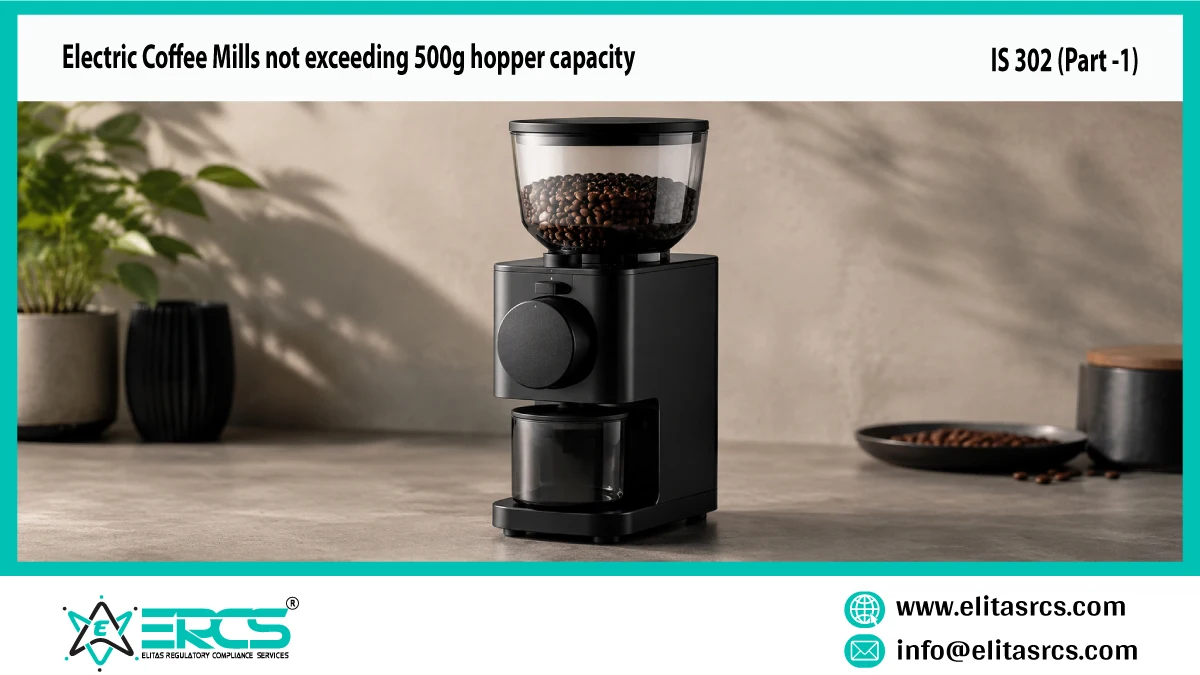
BIS Certification for
Electric Coffee Mills not exceeding 500g hopper capacity
IS 302 Part 1
The BIS Certification for Electric Coffee Mills with a hopper capacity of not more than 500g is mandatory for manufacturers under the Safety of Household, Commercial and Similar Electrical Appliances (Quality Control) Order, 2025. They must comply with IS 302 Part 1: IEC 60335-1 to legally sell the product in the Indian Market.
The IS 302 complies with the Safety requirements for household and similar electric appliances, so all certified goods should meet the quality and Safety guidelines. If the equipment does not comply with these requirements, penalties may apply. The requirements for certification are covered under Scheme I, as per the provisions under section 29 of the BIS Act, 2016, and may result in heavy fines, confiscation of goods, and a ban on sales.
What are Electric Coffee Mills (≤500g) as per IS 302 Part 1/IEC 60335-1
Electric Coffee Mills, also called coffee grinders, are motor-driven kitchen appliances used to grind coffee beans. Under Indian standards, units with a hopper capacity of up to 500g are classified as household appliances and must comply with IS 302 Part 1. As demand for freshly ground coffee rises rapidly, customers want assurance that their coffee mills meet stringent Safety and quality standards.
IS 302 Part 1: IEC 60335-1 is the standard that ensures the Safety of household and similar electrical appliances against accidents and electrical hazards. Manufacturers must demonstrate their compliance through mandatory certification for kitchen appliance safety.
Key Highlights for IS 302 Part 1 Certification
The specification mentioned under the IS 302 Part 1:IEC 60335-1 for ISI mark Electric Coffee Mills in India is mentioned below in the table:
|
Parameters |
Requirements |
|
Applicable Standards |
The applicable standard for Electric Coffee Mills with a hopper capacity of not more than 500g is IS 302 Part 1 |
|
Testing Parameters |
It ensures the appliances undergo Safety evaluations to protect against electric shock, ensure mechanical strength, and resist heat and moisture. |
|
Applicable Certification Scheme |
The appliance is covered by IEC 60335-1,2020(General Requirements) and by specific appliance parts. |
|
Voltage Current |
The appliance has a rated voltage of up to 250 V (single-phase) and DC-supplied appliances up to 480V |
|
Leakage Current & Insulation Resistance |
It ensures that electrical leakage remains within permissible limits and verifies the effectiveness of insulation against electrical faults. |
Key Benefits of BIS ISI Mark Certification Electric Coffee Mills (≤500g)
Here are the key benefits of getting ISI mark Certification for kitchen appliance safety India :
- The ISI mark ensures the appliance meets strict electrical Safety standards, protecting consumers from fire hazards and electric shock.
- Certified mills are mainly authorised for sale and distribution across India, helping manufacturers and retailers avoid heavy penalties for products.
- Consumers are more likely to purchase ISI-certified products, as they guarantee Safety and quality. This certification helps build trust and confidence among buyers.
- The reduction of the potential for product failures due to electrical malfunctioning, overheating, or other causes through compliance with applicable BIS standards.
- ISI Mark certification strengthens brand credibility and provides a competitive advantage in the Indian market.
Mandatory Safety Tests for Electric Coffee Mills under IS 302 (Part 1)
For electric coffee mills, the mandatory safety standard is IS 302 (Part 1), which is harmonised with the global IEC 60335-1 standard for household and similar electrical appliances. Non-compliance is a punishable offence under Section 29 of the BIS Act, 2016, and may result in heavy fines, confiscation of goods, and a ban on sales.
- Input Power & Current Testing: Confirming that the appliance functions properly and that its input power rating and output current level conform to manufacturer specifications.
- Protection Against Access to Live Parts: Verifying that users cannot accidentally come into contact with any live part of an appliance, whether during normal use or cleaning.
- Insulation Resistance & Electric Strength: Coffee grinders produce fine coffee dust that can enter the motor housing and compromise the electrical insulation. The standard tests insulation resistance and protection against dust ingress.
- Leakage Current Testing: Testing for any potential hazards due to the leakage of currents when the appliance is used under its normal operating conditions.
- Moisture Resistance Testing: Determining if and how the spillage of liquids or internal coffee will cause a short circuit or a failure of an appliance.
- Motor overload and burnout: Coffee mills often run continuously or with heavy loads (too many beans). The standard requires thermal overload protection to prevent the motor from overheating and causing a fire.
Documents Required for BIS Certification of Electric Coffee Mills (≤500g)
The list of documents required for obtaining BIS certification for Electric Coffee mills is given below:
- Company registration certificate and address proof
- Product technical specification
- Factory layout plan
- List of raw material
- Appointment from the Authorised Indian Representative (AIR) only for foreign manufacturers
- Test reports from a BIS-approved laboratory
- Trade mark certificate
- ID Proof of authorised signatory
How to get a BIS license for Electric Coffee Mills?
The BIS certification process for electric coffee mills follows Scheme-I of the BIS (Conformity Assessment) Regulations, 2018.
- Application Submission: Manufacturers must submit a complete application form on the BIS online portal along with all required documentation.
- Document preparation: Prepare all required documents and submit them in the format specified by BIS, including a factory layout showing production, a quality management plan (including in-process testing for motors and electrical Safety), and manufacturing details.
- BIS factory inspection: BIS officials visit your manufacturing units to verify that you have the necessary production infrastructure, in-house testing equipment (especially for motor and electrical Safety tests), and quality control systems.
- Testing at a BIS-approved laboratory: Send 3-5 samples to a BIS-approved laboratory for testing. Testing will be conducted in accordance with IS 302 Part 1: IEC 60335-1.
- Grant of BIS ISI Mark license: Once the documents are verified and the factory inspection is done, BIS grants the certification mark license.
BIS Certification Cost and Timeline for Electric Coffee Mills (≤500g) India
The Electric Coffee mills, with hopper capacity up to 500g, cost depends on the following criteria:
|
S No. |
Particular |
Amount (INR) |
Remarks |
|
1. |
Application Fee |
1000 |
To be paid directly to BIS |
|
2. |
Audit Fee |
7000 |
To be paid directly to BIS |
|
3. |
License Fee |
1000 |
To be paid directly to BIS |
|
4. |
Sample Testing Fee |
As Applicable |
To be paid directly to BIS (Testing charges vary from product to product and lab to lab.) |
|
5. |
Minimum Advance Marking Fee |
As per actual |
To be paid directly to BIS (Marking fee varies as per Indian Standard) |
|
6. |
Renewal Fee |
1000 |
To be paid directly to BIS |
|
7. |
Inclusion Fee |
5000 |
To be paid directly to BIS |
|
8. |
ERCS Pvt Ltd Service Fee |
Please contact info@elitasrcs.com |
|
As a manufacturer, if you want to obtain BIS Certification for Electric Coffee mills, you must know that the timeline for this is not fixed; it depends upon different variables:
- BIS Certification for Indian Manufacturers typically takes 35-50 days, document-dependent
- For Foreign manufacturers, it may take about 180 days, including the appointment of AIR
BIS Certification Validity and Renewal Period
To initiate an online renewal application for your Electric Coffee mill with a hopper capacity of up to 500g, BIS Certification (IS 302 Part 1: IEC 60335-1), manufacturers must process the application 30 days before the expiration period. The renewal will give you 1 to 5 years of validity, depending on the fee schedule and the outcome of the annual inspection.
Why choose ERCS Private Limited for BIS Certification of Electric Coffee Mills with a hopper capacity of up to 500g?
ERCS tells you exactly which Indian Standard applies and whether your product falls under IS 302 Part 1: IEC 60335-1. We work with BIS-approved, NABL-accredited laboratories that specialise in testing motor-operated kitchen appliances. We book testing slots in advance and review all test reports before submission to BIS.
- ERCS agents will complete your application through the BIS ManakOnline portal and handle all queries from BIS officers
- We follow up with BIS daily until your licence is granted. You are never left wondering about the status of your application.
- We help foreign manufacturers with BIS registration and Authorised Indian Representative (AIR) services.
- With years of BIS certification expertise and 1,500+ certification projects with 100% customer satisfaction, ERCS Private Limited is a BIS-authorised consultant based in India that helps manufacturers of electrical appliances secure certification on time and without avoidable complications.
- Get in touch for a free compliance assessment for your coffee mills (≤500g).
FAQs
Q1.Is BIS certification mandatory for Electric Coffee Mills?
Ans: Yes. BIS certification is mandatory under the Safety of Household, Commercial and Similar Electrical Appliances (Quality Control) Order, 2025. Selling, manufacturing, or importing uncertified electric coffee mills in India is a punishable offence under Section 29 of the BIS Act, 2016
Q2. Which standard applies to electric coffee mills for BIS certification?
Ans: Electric coffee mills with a hopper capacity not exceeding 500g must comply with IS 302 Part 1: IEC 60335-1 Safety of Household and Similar Electrical Appliances (General Requirements).
Q3.Are battery-operated or USB-powered coffee grinders covered?
Ans: Yes. The QCO 2025 explicitly covers DC-supplied and battery-operated appliances. Even a small, portable USB coffee grinder with a 50g hopper is covered and must be BIS-certified.
Q4.What happens if a coffee mill is imported without BIS certification?
Ans: Importing, manufacturing, or selling uncertified coffee mills in the Indian market is illegal. Non-compliance can result in heavy fines, confiscation of goods, and a ban on sales.
Q5.How to renew the BIS ISI mark licence for an electric coffee mill?
Ans: To renew a BIS ISI mark licence, manufacturers must submit an online application through the ManakOnline portal at least 30 days before the licence expiry date. The renewed licence is valid for 1 to 5 years, depending on the application renewal fee.