BIS Certification for
Fasteners – Cross Recessed Drilling Screws with Tapping Screw Thread Part 2 Countersunk Head
IS 18471 Part-2
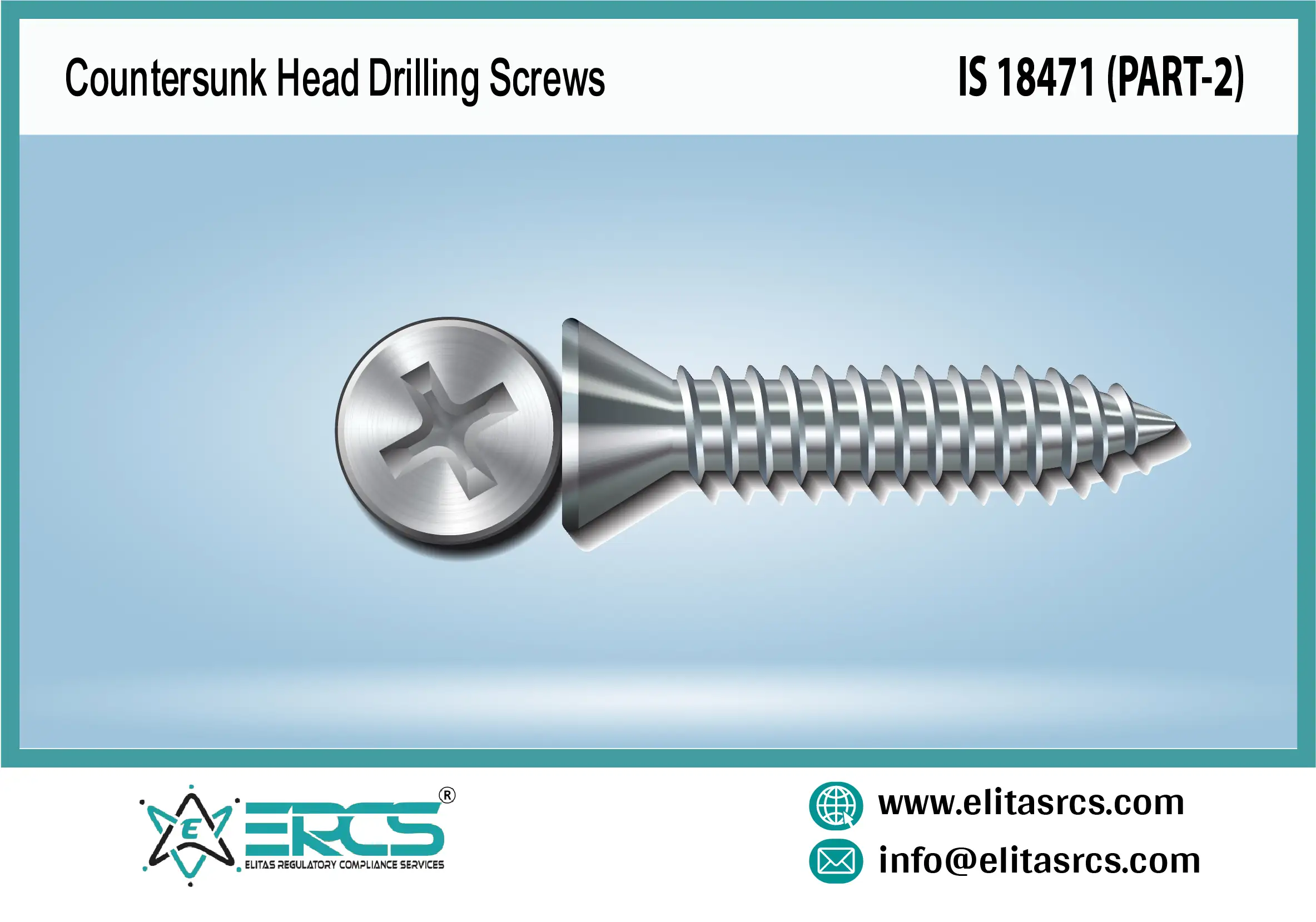
BIS certification of Cross Recessed Drilling Screws with Tapping Screw Thread (Part 2: Countersunk Head) as per IS 18471 (Part 2) is mandatory as it provides quality and performance standards to customers. This Indian Standard (IS) ensures that products meet reliability, durability, and safety standards. Cross-recessed drilling screws are valuable in furthering the tasks. To ensure the structural integrity and ease of use. Let’s delve deeper to know more about the Bureau of Indian Standards scheme and the role of ERCS in the certification of the product.
Tapping Screw Thread Part 2 Countersunk Head IS 18471 Part-2 Specification: An Overview
The key specifications of countersunk head cross-recessed drilling screws with tapping screw thread IS 18471 Part 2 are as follows:
- The drilling point of the screw is designed to create a hole as it is driven into the material, eliminating the need for a pre-drilled hole.
- The screw features a specialized tapping thread that enables it to form threads in materials such as plastic, wood, or thin metal, driven in to create a thin and secure fit.
- Screws are made up of high-quality carbon steel, stainless steel, or other materials that provide durability and resistance to corrosion.
- The standard includes guidelines for coating, such as zinc plating. It includes other finishes that increase corrosion resistance for industrial or outdoor environments.
- The standard provides complete information regarding the size, thread specification, and length of the screw. These dimensions are crucial for compatibility with materials and tools. This includes head diameter, shank length, and thread pitch.
- Screws feature a tapping thread profile; this includes a sharp edge to ensure clean and precise cutting threads in materials. The geometry is designed to be robust and durable, providing long-term reliability in applications that require assembly and disassembly.
- The screws are tested to ensure that they meet the certain strength and tensile requirements. The standard ensures that the screw will not fail under normal use conditions, providing reliability and safety while using.
- Manufacturers have to follow the exact tolerances and processes specified under IS 18471 (Part 2), which include heat treatment, coating, and threading processes.
- Screws undergo many tests, like thread engagement, pull-out strength, and corrosion resistance.
Procedure for Granting BIS License for Countersunk Head
Check the Obtaining the ISI Mark Process for Countersunk Head Certification in India:
- Application Submission: The manufacturer or applicant must apply for a BIS license to a BIS regional office or through the BIS portal. The application process requires a few important documents, such as company details, product details, manufacturing details, QCO details, and more.
- Documentation & Product Testing: The applicant must provide product samples that comply with IS 18471 (Part 2) standards. They are required to submit the documents that verify the product’s compliance with relevant BIS standards.
- Factory Inspection: A BIS inspector will visit the manufacturing facility to inspect the production process, correct application of standards, and the quality control system.
- Product Testing by BIS-Approved Labs: BIS will send sample products to approved labs for testing according to IS 18471 (Part 2) standard.
- Obtaining a BIS License: After viewing the factory inspection result and test report, BIS will grant the BIS license for the product.
IS 18471 (Part 2) Quality Control Order
The ‘Cross Recessed Screws (Quality Control) Order’ mandates that cross recessed screws, IS 18471 Part 2, must adhere to Indian Standard and bear the Standard Mark and certification by BIS. The DPIIT, Ministry of Commerce & Industry, Govt. of India issued a draft for a Quality Control Order; this mandates the BIS certification of cross-recessed screws. Manufacturers in India or importers from foreign countries must carry FMCS certification from the Bureau of Indian Standards under a valid BIS license.
BIS Certification Timeline for Cross Recessed Drilling Screws Countersunk Head IS 18471 (Part 2)
In India, there are various BIS certifications for various products. For Indian manufacturers, the BIS certification generally takes about 30 days. For foreign manufacturers, the inspection time usually takes around 180 days.
The timeline for implementing the Cross Recessed Screws (Quality Control) Order, 2024, which applies to fasteners like the drilling screws with tapping screw thread (IS 18471 Part 2), will have a staggered applicability based on the size of the enterprise as follows: six months for general enterprises, nine months for small enterprises, and twelve months for micro enterprises from the date of publication of the Quality Control Order (QCO).
Eligibility Criteria of BIS Certification for Countersunk Head Certification
Below, you can go through the eligibility criteria for countersunk head BIS licensing in India:
- The applicant must follow the requirements of IS 18471, which provides the detailed specification for the product.
- The manufacturer must implement a Quality Control System (QCS) to ensure that products meet the standard’s quality parameters.
- Regular testing of products is a must to ensure their strength, workability, and durability.
- Detailed records of raw materials and compliance with standards must be maintained.
- At the end, BIS will conduct a factory inspection to verify that the manufacturing process, quality control procedure, and facilities meet the requirements of the standard.
BIS Certification Fee for Fasteners Cross Recessed Drilling Screws
A comprehensive assessment of the expenses related to ISI certification for Indian Standard 18471 is provided below:
|
S No. |
Particular |
Amount (INR) |
Remarks |
|
1. |
Application Fee |
1000 |
To be paid directly to BIS |
|
2. |
Audit Fee |
7000 |
To be paid directly to BIS |
|
3. |
License Fee |
1000 |
To be paid directly to BIS |
|
4. |
Sample Testing Fee |
As Applicable |
This will be paid directly to BIS (testing charges vary from product to product and lab to lab). |
|
5. |
Minimum Advance Marking Fee |
As per actual |
To be paid directly to BIS (Marking fee varies as per Indian Standard.) |
|
6. |
Renewal Fee |
1000 |
To be paid directly to BIS |
|
7. |
Inclusion Fee |
5000 |
To be paid directly to BIS |
|
8. |
ERCS Pvt Ltd Service Fee |
Please contact info@elitasrcs.com |
|
Why Choose ERCS for BIS Certification?
As the best BIS consultant, ERCS guarantees that your product is compliant with the necessary IS requirements. The team guarantees that the product documentation adheres to BIS criteria through their extensive understanding of Indian Standard Specifications and BIS suggestions. These requirements have been interpreted for quality control personnel by team members who have completed more than 100 projects.
ERCS is a fully covered inspection procedure provided by BIS that lays out what you need to bring to the inspection. For the audit to be successful, the team makes sure that proper documentation and protocols are present. The team performs an initial inspection of your factory to identify and address any possible nonconformities. This provides a higher degree of overall effectiveness to the BIS inspection process, leading to success.