BIS Certification for
Countersunk flat head screws (Common Head Style) with type H or Type Z Cross Recess – Product Grade A part 2 Steel Screws of Property Class 8.8, Stainless Steel Screws and Non – Ferrous Metal Screws
IS 7485 (Part 2)
ISI Certification in India is important because it guarantees the quality, safety, and reliability of products sold in India. The Central Government Ministry of Commerce and Industry (Department for Promotion of Industry & Internal Trade) has made BIS certification of Cross Recessed Screws mandatory, in consultation with the Bureau of Indian Standards (Govt. of India).
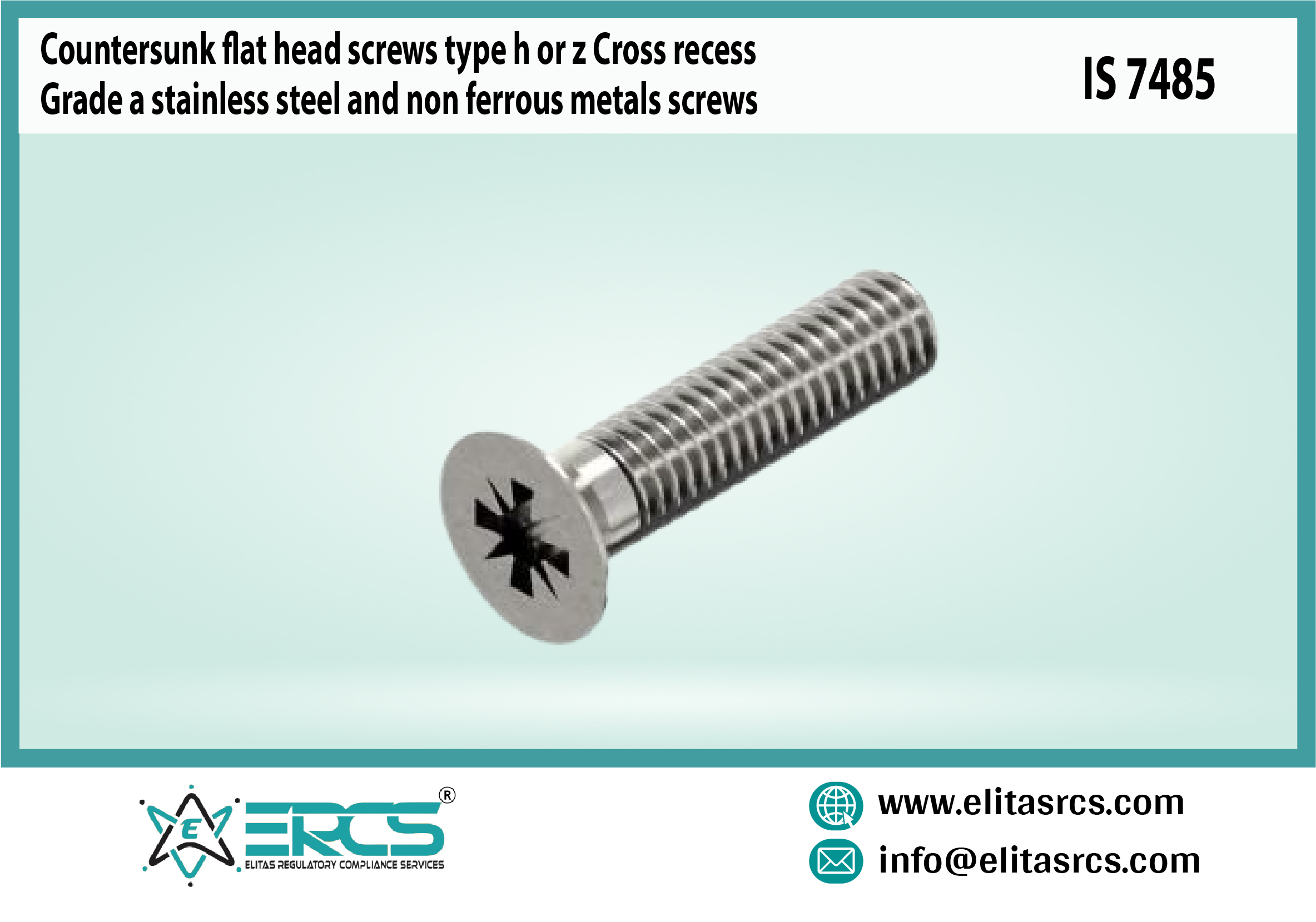
Countersunk flat head screws with the Cross Recess Type H and Type Z configurations are common components found within a broad range of industries (automotive, construction, electronics, etc.). The mechanical properties, dimension sequences and tolerances along with surface integrity for these screws are contained in the Indian Standard IS 7485 (Part 2).
Overview of Countersunk flat head screws (Common Head Style) with type H or Type Z Cross Recess
Countersunk Flat Head Screws (Standard Head Type) with Type H or Type Z Cross Recess - Product Grade A Part 2 Steel Screws of Property Class 8.8, Stainless Steel Screws, and Non-Ferrous Metal Screws are high-quality fasteners that can be used for the most demanding applications. These screws are considered "flat head" screws with a "countersunk" design for a flush finish on the surface.
Therefore, they can be useful for aesthetic applications with the requirement for a flush surface finish. They are available in property class 8.8 for steel screws, in addition to stainless steel and non-ferrous metals. Countersunk flat head screws are very strong, resistant to corrosion, durable, and can be used in construction, automotive, and machinery applications.
Scope of ISI Mark for Countersunk flat head screws
This section of ISO 7046 describes the characteristics of countersunk flat head recessed screws with threads ranging from M2 to and including M10, and meets the standard of Grade A and property class 8.8 for steel, A2-70 for stainless steel, and CU2 and CU3 for nonferrous metals.
If there are reasons to use specifications other than those given in this International Standard, refer to the current International Standards, for example ISO 261, ISO 888, ISO 898-1, ISO 965-2, ISO 3506, ISO 4759-1, and ISO 8839.
Key Highlights of IS 7485 (Part 2)
Below, we have mentioned some of the key highlights of IS 7485 (Part 2). Go through them to get complete details about IS 7485:
- IS 7485(Part 2) Countersunk Flat Head Screws with Type H or Type Z cross recess, for steels of property class 8.8, stainless steels, and nonferrous metals.
- The standard classifies screws from M2 to M10 thread sizes and evaluates two main concepts: Mechanical Strength and Tolerance.
- The screws classified in the standard must achieve the mechanical strengths needed to achieve a minimum level of tensile strength and resistance to operational demands.
- The depth of the cross recess can both contribute to the strength of the head, while also impacting the wrenchability of a screw.
- There are also two different series of recess types: Series 1 ( deeper Penetration for better wrenchability)- Series 2 ( shallower penetration for better Head Strength).
- This covers a range of thread sizes and establishes mechanical strength and tolerance criteria.
- The standard is aligned with and consistent with ISO 7046 to ensure a variable capacity for minimum actual tensile strength and stress resistance.
Updated BIS Quality Control Order for Countersunk flat head screws
The government of India has issued a Quality Control Order which mandates Countersunk Flat Head Screws (Common Head Style) with either a type H or Type Z Cross Recess. This requirement applies to both products manufactured in India and those imported into the country. As a result, these screws must bear the ISI Mark under a valid Bureau of Indian Stanadards (BIS) license.
This order aims to ensure that all countersunk flat head screws-specially, type h or type z cross recess screws, Product Grade A part 2 steel screws of Property Class 8.8, stainless steel screws, and non-ferrous metal screws-produced, imported, or sold in India meet stringent quality standards. This initiative is designed to enhance safety and ensure compliance with Indian regulations.
Click Here to know latest update on BIS QCO for cross recessed screws
Procedure of BIS Licensing for Countersunk flat head screws Type H or Type Z (Part 2)
The steps listed below outline how to become certified as a BIS professional:
- Confirm Relevance: If the product is an IS 2083-designated product, submit a BIS license application using IS 2083.
- Online Application: The BIS license application should be submitted online.
- Factory Inspection: When BIS inspectors come to your Production Facility, they will review: Production processes and equipment devices are tested for quality assurance.
- Testing sample: Product samples are sent to a BIS-accredited facility for testing. The IS 2083:2024 standard examines a sample for tensile strength, elongation, and chemical resistance.
- Compliance check: BIS will review the test and inspection reports to ensure compliance with the standard.
You can go through the BIS process to obtain certification for your product for both Indian and foreign manufacturers:
ISI Mark Certification Process for Indian Manufacturers
ISI Mark Certification for Process for Foreign Manufacturers
How Does ERCS Help In Obtaining BIS Certification?
Finding the right BIS Consultant in India can provide numerous advantages, making it a great option for companies wishing to get certified. You can choose ERCS to get the best consulting services. We give you the experience and knowledge of standards and certification processes.
It helps to ease the certification processes, making it a more direct and efficient process for companies. Provides services from beginning to end, which may include consulting, documentation, training, and compliance assessments as full services, so you will have complete support during the entire certification process.