BIS Certification for
Commercial Dispensing Appliances and Vending Machines
IS 302 (Part 2/Sec 75)
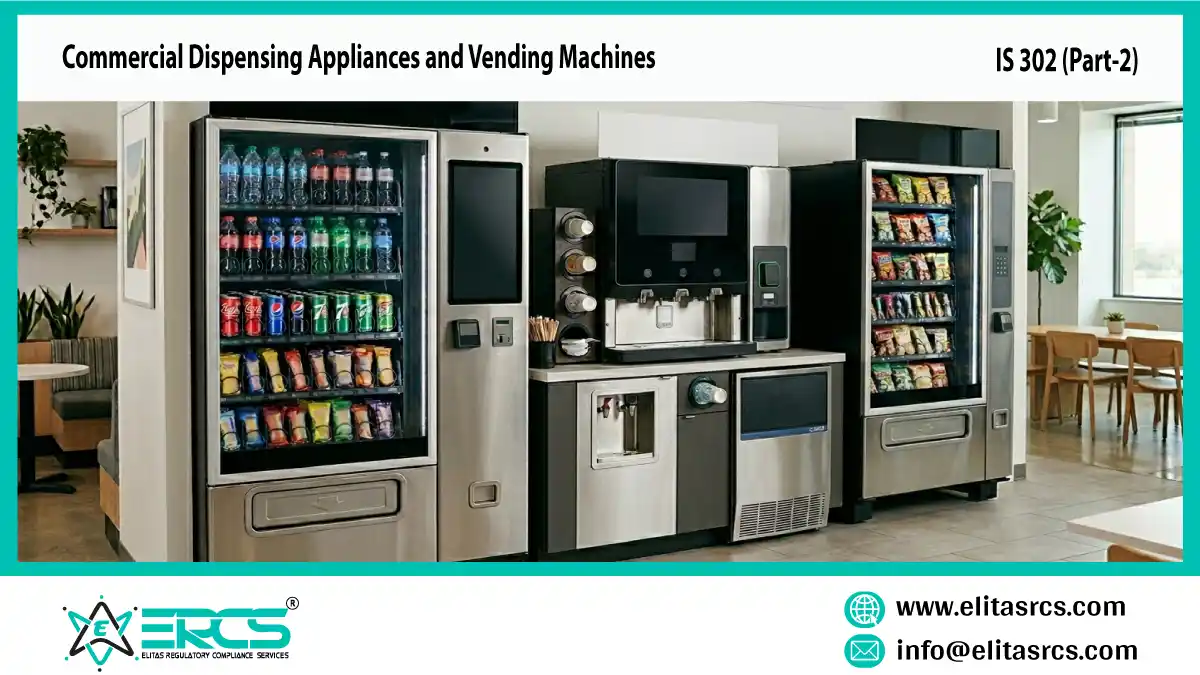
As a manufacturer or importer of Commercial Dispensing Appliances and Vending Machines, you must have heard about the ISI Mark. The BIS Certification of Commercial Dispensing machines is mandatory under the Electrical Appliances (Quality Control Order), 2025. The ISI/BIS Certification will help promote the safe, hygienic, and reliable operation of electrical appliances (i.e., coffee makers, vending machines, ice dispensers, etc). Manufacturers of Electrical Appliances for Commercial Dispensing and Vending are responsible for ensuring their products are safe for public use.
IS 302 (Part 2/Sec 75) contains the complete specifications and standards needed to ensure the quality and reliability of the product. To expedite customs clearance of your products entering India, it is important to understand the BIS Regulations, the requirements of the QCO, and the applicable fees associated with licensing.
Overview of Commercial Dispensing Appliances and Vending Machines Under BIS Scheme - I.
Vending machines come in various shapes, sizes, and styles with both traditional and modern designs. Food and drink vending machines are also found in vending machines that dispense tickets for all different kinds of transportation, and will also dispense items for medical purposes and hygiene/cleaning products.
Every machine that has obtained the ISI mark from the Bureau of Indian Standards is manufactured to meet specific criteria, as set by the Bureau, regarding stability, reliability, and safety. All electrical products must have obtained BIS certification to establish their reliability and safety; therefore, machines proven to be unsafe by demonstrating unsafe conditions to the Bureau will receive a certified used machine price of 20% below their original cost, and any subsequent safety incidents occurring in an already certified machine will nullify their initial warranty.
Key Highlights for IS 302 (Part 2/Sec 75)
Here are the basic specifications for vending and other commercial dispensing machines as per the IS 302 (Part 2/Sec 75) standard:
- Mandatory Requirement: Before being manufactured or imported, all commercial vending machines sold in India must be certified with the ISI mark.
- Safety Consideration: The IS 302 (Part 2/Sec 75) standard only applies to machines intended for commercial use (e.g., not for home or private use).
- Products Covered: Commercial dispensing machines dispense hot/cold beverages (coffee/tea), ice cream, whipped cream, hot water, and bulk coffee/tea.
- Grouping of a Manufacturer's Products: A manufacturer may group similar devices into similar types to reduce the number of tests needed. However, all devices must be tested according to the requirements of the Bureau of Indian Standards in order to receive certification.
- Importing/Research and Development Exemption: The Importing/Research and Development Exemption allows up to 50 devices of any one type to be imported before certification.
Benefits of ISI Mark for Commercial Dispensing Appliances and Vending Machines
Some of the key benefits of obtaining ISI Mark on Commercial Dispensing Appliances & Vending Machines include:
- Legal Compliance/Market Access: The BIS certifies that your products meet legal standards in order for you to sell them in India. This means you avoid any fines or penalties. This allows for smooth product distribution into the market.
- Safety/Quality: Certification is a way to ensure that your vending machine has been tested for safety and quality of performance (i.e., by being tested to ensure it doesn't create an electric shock or overheating condition), thus providing a safe and reliable solution for public use.
- Trust/Credibility in Brand: The ISI Mark shows to the end-users that these are high-quality, reliable, and safe to use.
- Competitive Advantage: As a general rule, institutions in India will only buy products that are certified. Therefore, certifying your product creates a competitive advantage for your company in India.
- International Compatibility: The IS 302 (Part 2/Sec 75) standard for vending machines established by the BIS is compatible with the IEC international standard; therefore, no extra steps need to be taken to meet international quality standards.
Documents required for Obtaining ISI Mark on IS 302 (Part 2/Sec 75)
The list of important documents for obtaining BIS Certification is given below:
- Application Form
- Factory Registration (KYC) Documents
- Manufacturing Process Flowchart
- List of Required Testing Equipment with Valid Calibration (In-house Testing Facilities)
- Details of Raw Materials and Their Test Certificates
- Authorized Signatory and Quality Control Inspector (QCI) Details
- Factory Test Report
- Plant Layout and Other Related Documents
Applicable Test Parameters for Commercial Dispensing Appliances and Vending Machines
Important test parameters as per IS 302 (Part 2/Sec 75) standards are:
- Markings & Instructions: Enough markings & clear instructions to allow users to operate the equipment safely.
- Protection from Live Parts: Tests using various probes to ensure that users will not have access to live parts.
- Power Input & Current: Ensuring that the machine is trained according to its requirements, e.g., measuring the power of the machine in watts and its current.
- Temperature Rise Test: Tests to evaluate how the appliance will react to increased ambient temperature, both for normal service and for extreme conditions.
- Leakage Current & Electrical Strength: Ensuring that users are protected from electric shock and that the appliance does not have unwanted faults.
- Mechanical Hazards / Strength: Ensuring that the overall assembly of the appliance's structure will be stable and not be damaged from a solid impact.
- Internal Wiring and Components: Testing of the electrical components and connections to ensure that they are properly connected.
BIS Certification Benefits for Dispensing Appliances IS 302 (Part 2/Sec 75)
Below are the steps involved in receiving BIS Certification for your product:
- Application: The first step is for the manufacturer to first register on the BIS Portal. After registering, the second step is to submit an application for a BIS licence to produce goods.
- Documents: Before applying for a BIS licence, the manufacturer must have the following documents: a Factory Licence and evidence that the producer is using Quality Control measures.
- Testing: The manufacturer sends a product sample to a BIS-accredited testing laboratory for chemical analysis of its components.
- Inspection: An authorized representative from BIS will conduct an on-site inspection of all aspects of the product's manufacturing, including documentation of process control and quality control, and the overall layout of the manufacturing facility.
- Issuance of Licence: After the manufacturer has passed the BIS inspection and all testing has been completed, the manufacturer will receive a BIS licence, which permits the application of the BIS Mark on each of the goods.
Indian and foreign manufacturers must follow the same requirements when applying for BIS certification:
BIS Certification Process for Indian Manufacturers
BIS Certification Process for Foreign Manufacturers
Checklist of Points for Obtaining ISI Mark on IS 302 (Part 2/Sec 75)
The following is a guideline for acquiring an ISI marking for your product from the Bureau of Indian Standards:
- Confirm if your product meets the requirements of IS 302 (Part 2/Sec 75)
- Only fully operational manufacturing facilities can apply for a Manufacturing Unit License from BIS.
- To conduct testing on an in-house basis, you must establish an in-house testing laboratory with all of the necessary equipment for the tests needed to meet Indian Standards.
- A copy of current calibration certificates (from NABL-accredited labs) must be available for every piece of in-house testing equipment.
- Have adequately trained Technical Representatives to supervise and control your Quality Control processes.
- Create accurate flow charts for every stage of your Manufacturing process, from receipt of your raw material to shipment of your finished product.
BIS License Fees in India for IS 302 (Part 2/Sec 75)
Go through the table to know the cost of BIS Certification India for IS 302 (Part 2/Sec 75):
|
S No. |
Particular |
Amount (INR) |
Remarks |
|
1. |
Application Fee |
1000 |
To be paid directly to BIS |
|
2. |
Audit Fee |
7000 |
To be paid directly to BIS |
|
3. |
License Fee |
1000 |
To be paid directly to BIS |
|
4. |
Sample Testing Fee |
As Applicable |
To be paid directly to BIS (Testing charges vary from product to product and lab to lab.) |
|
5. |
Minimum Advance Marking Fee |
As per the actual |
To be paid directly to BIS (Marking fee varies as per Indian Standard) |
|
6. |
Renewal Fee |
1000 |
To be paid directly to BIS |
|
7. |
Inclusion Fee |
5000 |
To be paid directly to BIS |
|
8. |
ERCS Pvt Ltd Service Fee |
Please contact info@elitasrcs.com |
|
|
Remarks |
Including all the taxes |
||
Why Choose ERCS Private Limited for ISI/BIS Certification?
ERCS Private Limited is the Top BIS Consultant in India, with specific expertise in certifying commercial vending and dispensing machines (also known as VDMs) for the Bureau of Indian Standards (BIS).
- Complete support: ERCS will manage all aspects of obtaining a BIS Certificate for VDMs. This service includes preparing all necessary documentation, coordinating with an independent testing laboratory for product testing/certification, and filing an application for a BIS Certificate.
- Regulatory Compliance and Risk Mitigation: To ensure its clients comply with the Electrical Appliances (Quality Control) Order, ERCS will work with clients to produce, test, and certify the VDMs to ensure compliance with safety regulations.
- Cost and Time Efficient: ERCS offers fast and affordable services that allow clients to quickly obtain the necessary product certifications to market their products in India.
- Full Service: In addition to BIS Certification, ERCS also assists with renewal and more certification opinions in the Indian Market.