BIS Certification for
Appliances for Skin Exposure to Optical Radiation
IS 302 Part 1:2024/IEC 60335-1
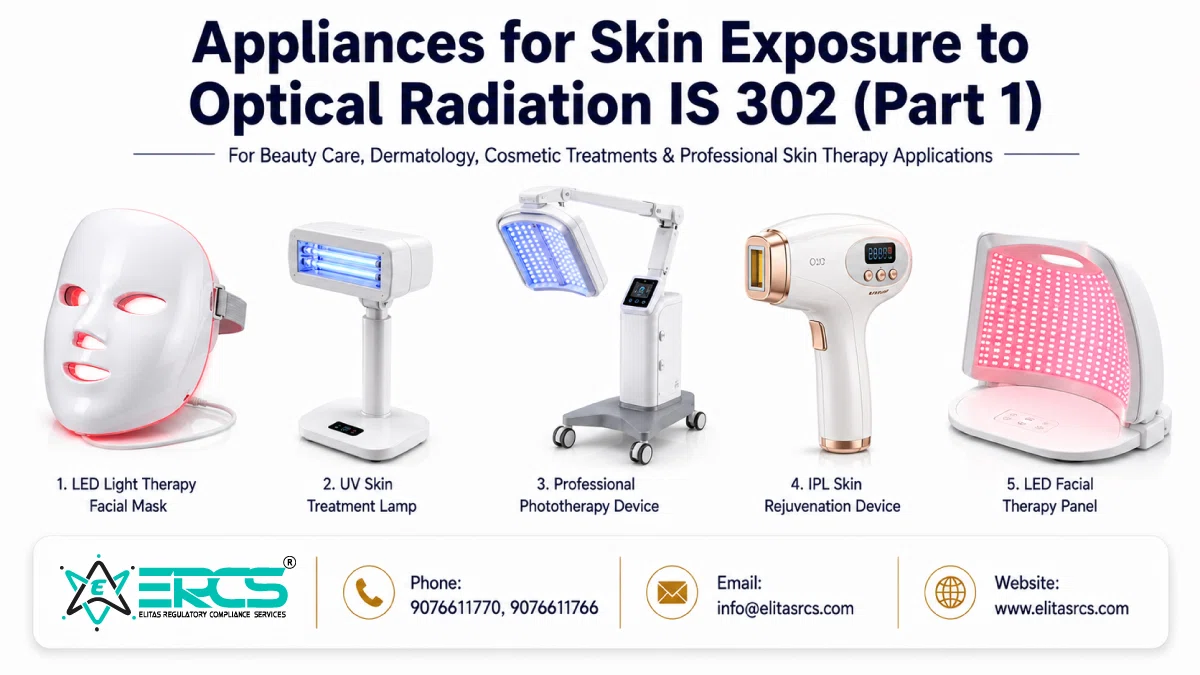
BIS certification for appliances that expose human skin to optical radiation, as per IS 302 Part 1:2024/IEC 60335-1, is mandatory for manufacturers and importers before selling these products in the Indian market. These appliances have gained popularity in India’s wellness and healthcare industry in recent years. Given their potential hazards, such as radiation and electrical risks, they are heavily regulated by the Bureau of Indian Standards to ensure the products meet safety standards.
In today’s quality-conscious market, regulatory compliance is crucial for building consumer trust and maintaining uninterrupted market access. Because these appliances come into direct contact with human skin, improper use or substandard design can cause burns, skin pigmentation, or even eye damage if safety measures are not followed.
Obtaining BIS certification is important to ensure that your product meets the prescribed Indian Standards for safety, quality, and performance. IS 302 (Part 1):2024 IEC 60335-1 General requirements that set out the safety and performance standards for household, commercial and similar electrical appliances that expose the skin to optical radiation (UV/IR).
What is Skin Exposure to Optical Radiation under IS 302 Part 1: 2024/IEC 60335-1?
Skin Exposure to Optical Radiation is the interaction between human skin and light waves in the optical spectrum. The optical spectrum encompasses wavelengths from 100 nanometers to 1 millimetre and includes UV, visible, and IR radiation. Skin exposure to optical radiation, as per IS 302 (Part 1): 2024 (harmonised with international standard IEC 60335-1:2020), refers to the rules governing the safety and performance of electrical equipment that emits, conducts, or reflects optical radiation, such as UV, IR, lasers, or intense pulsed light, on human skin.
Key Highlights for IS 302 (Part 1) for Skin Exposure to Optical Radiation
|
Key Particular |
Important Details |
|
Applicable Standard |
IS 302 (Part 1) |
|
Product/Equipment Scope |
Electrical appliances that may expose the skin to optical radiation |
|
Safety Focus |
Protection of users against the harmful effects of optical radiation |
|
Optical Radiation |
Includes radiation such as ultraviolet (UV), visible light, and infrared (IR) |
|
User Protection |
Appliances should be designed to minimise risks from excessive optical radiation exposure |
|
Testing Requirement |
Applicable safety requirements and tests must be completed as specified under the relevant standard |
|
Risk Prevention |
Helps reduce the possibility of skin damage or other health risks caused by excessive optical radiation |
Key Benefits of ISI Mark Certification for Skin Exposure to Optical Radiation in India
The ISI mark certification under IS 302 (Part 2 / Sec 27) states that the product conforms to the safety and performance standards prescribed by the Bureau of Indian Standards before being sold in salons, wellness centres, or households. The importance of the ISI Mark certification for producers and importers extends beyond mere regulation, offering practical business benefits.
- Improved Safety: Assists in meeting safety requirements related to optical radiation.
- Quality Assurance: Assists in conducting conformity assessments and product testing.
- Legal Compliance: Assists in ensuring legal conformity with Indian Standards and BIS requirements.
- Protection of Consumers' Interests: Gives consumers additional confidence in product safety and quality.
- Market Access: Enables producers and importers to meet the requirements to sell covered products in the Indian market.
List of Documents Required for ISI Mark Certification of Skin Exposure to Optical Radiation
For the ISI certification of Skin Exposure to Optical Radiation under IS 302 by the Bureau of Indian Standards (BIS), it is necessary to submit complete documentation, including administrative, technical, and manufacturing data sheets.
- BIS application form
- Technical details of the product
- Manufacturing process chart
- Information about the manufacturing unit
- Raw material/component list
- Testing report of a recognised BIS laboratory
- Factory layout plan
- List of testing equipment
- Calibration certificates of testing equipment
- Quality control information
- Product design/drawings
- Trademark/Brand ownership information
- Authorisation letter, if any
- Undertaking/Declaration, if any
- Previous BIS license/certification information, if any
Testing Parameters of Appliances for Skin Exposure to Optical Radiation IS 302 (Part 1):2024/IEC 60335-1
The list of tests evaluated for Skin Exposure to Optical Radiation under IS 302 Part 1/IEC 60335-1, as mandated by the Bureau of Indian Standards, for protecting its users from certain accidental hazards:
- Harmful Optical Radiation: It is important to test devices to ensure compliance with requirements limiting UV, IR, and visible radiation emissions to prevent skin burns and eye injuries.
- Temperature Increase: Verification of surface and heating-element temperatures during continuous use to prevent device overheating.
- Electrical Safety: Verification of tests for dielectric strength, leakage current, earth continuity, and insulation resistance to ensure safe appliance use.
- Resistance to Moisture and Dust: It is necessary to verify the IP rating test results to ensure that exposure to liquids, gels, or dust (common materials used with skin-contact appliances) does not compromise the safety of the internal electrical components.
- Mechanical Safety: Verification of the enclosure's durability and safety.
BIS ISI Certification Process of Appliances for Skin Exposure to Optical Radiation in India
The procedure for Bureau of Indian Standards (BIS) Certification of Skin Exposure to Optical Radiation in India involves the following process:
- The applicant must determine the Indian standard and fill in the application form.
- Check that all documents are complete and submit them to BIS through its website.
- BIS shall conduct an inspection of the facility.
- The sample collected during factory inspection is sealed by the BIS Inspector and dispatched to the BIS-approved laboratory.
- If BIS raises any objection due to non-conformity, the applicant must rectify it and inform BIS.
- ISI Mark shall be awarded to the applicant if all test parameters are fulfilled.
- Foreign applicants must have an AIR.
The process of obtaining BIS Certification can be complex, especially for those seeking to understand the step-by-step process that both domestic and foreign manufacturers must follow. The details are below:
- ISI/BIS Certification Procedure for Domestic Manufacturers
- BIS FMCS Certification Procedure for Foreign Manufacturers
BIS Certification Cost for Skin Exposure Optical Radiation Appliances (2026)
Government fees are indicative and subject to change as per BIS notifications. Below, you can refer to the table for the BIS Certification cost of the following:
|
S No. |
Particular |
Amount (INR) |
Remarks |
|
1. |
Application Fee |
1000 |
To be paid directly to BIS |
|
2. |
Audit Fee |
7000 |
To be paid directly to BIS |
|
3. |
License Fee |
1000 |
To be paid directly to BIS |
|
4. |
Sample Testing Fee |
As Applicable |
To be paid directly to BIS (Testing charges vary by product and lab). |
|
5. |
Minimum Advance Marking Fee |
As per the actual |
To be paid directly to BIS (Marking fee varies as per Indian Standard) |
|
6. |
Renewal Fee |
1000 |
To be paid directly to BIS |
|
7. |
Inclusion Fee |
5000 |
To be paid directly to BIS |
|
8. |
ERCS Pvt Ltd Service Fee |
Please contact info@elitasrcs.com |
|
Renewal of BIS Certification for Skin Exposure to Optical Radiation IS 302 Part 1:2024/IEC 60335-1
BIS Certification renewal for products designed for optical radiation exposure to skin is important to ensure the manufacturer's continued compliance with IS 302 (Part 1):2024/IEC 60335-1 and all other BIS Standards.
- Submit your application before expiry: Apply for BIS Certification Renewal on BIS ManakOnline in time.
- Change to IS 302 (Part 1):2024/IEC 60335-1:2020: Ensure that the latest edition is being followed.
- New test results: Conduct new tests on radiation levels, insulation, grounding, and heat.
- Facility inspection: Conduct a BIS Inspection of manufacturing and quality control processes.
- Notify about changes: Inform about any changes to the emitter and circuits.
- Submit new documentation: Provide updated factory, quality control and test documentation.
- Payment of Renewal Fees: This is part of the BIS Certification Renewal process.
- License Number does not change: There is no need to submit a new application for the license number.
- Consequences of non-renewal: Deprivation of ISI mark privileges and penalties.
ERCS: Trusted BIS Certification Consultant of Skin Exposure to Optical Radiation
ERCS Private Limited simplifies the complex process of obtaining BIS ISI Mark Certification from a top BIS Consultant in India because we assist you in areas like:
- BIS Expertise: ERCS has strong knowledge of BIS rules, Indian Standards, testing, and inspections, which helps manufacturers to avoid mistakes.
- End-to-End Support: From selecting the right IS standard to testing, application filing, inspections, and renewals, ERCS manages the full process.
- Experienced Team: A skilled team of engineers and compliance experts ensures faster approval with fewer errors.
- Practical Compliance Guidance: ERCS helps you understand and meet BIS requirements, not just complete paperwork.
- Regulatory Updates: Keep you informed about BIS rule changes and Quality Control Orders.
- Global Support: Assists foreign manufacturers in entering the Indian market smoothly and helps them understand Indian standards.