BIS Certification for
Aluminium Alloy Redraw Rods for Electrical Purposes
IS 9997
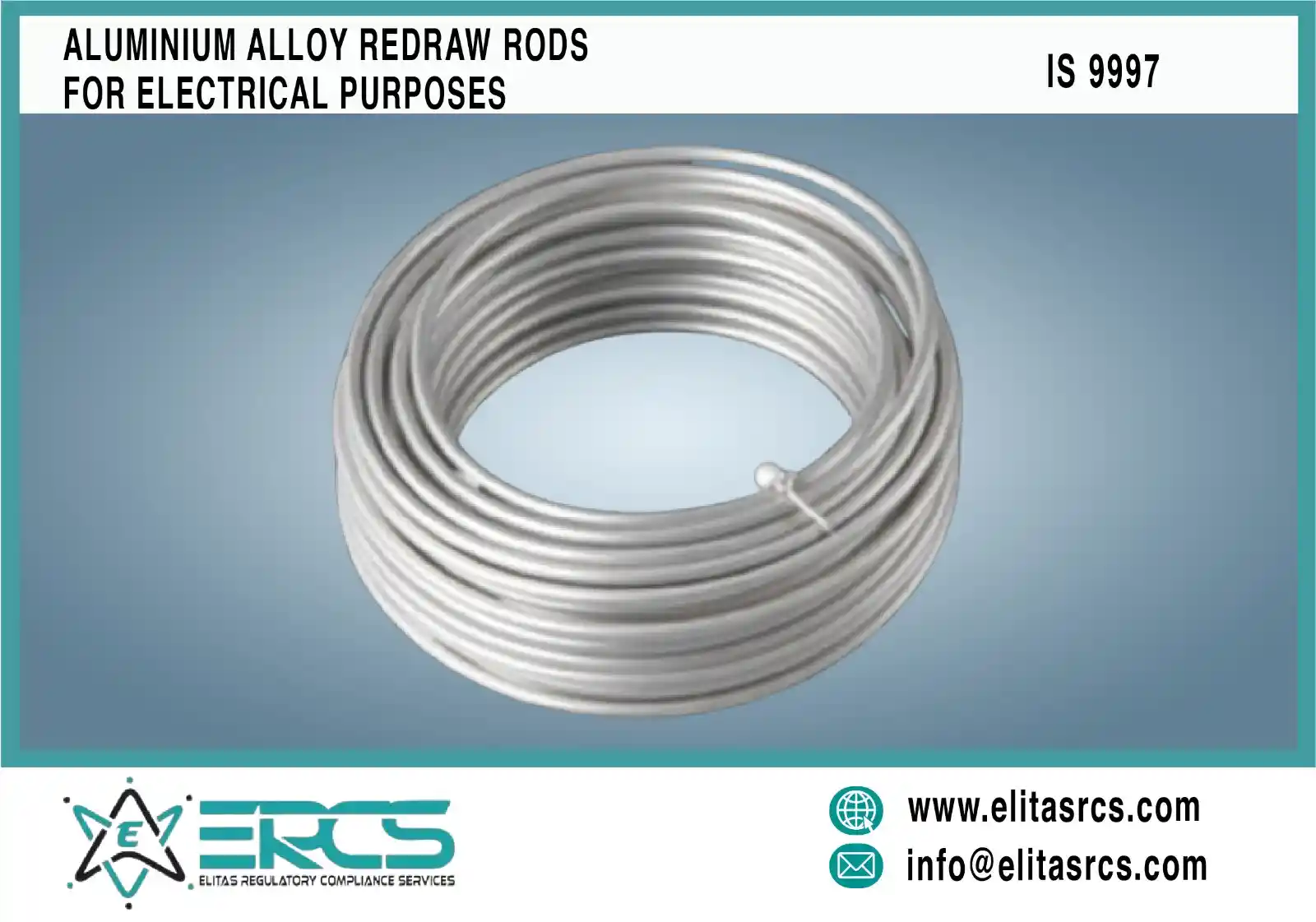
Getting BIS Certification for Aluminium Alloy Redraw Rods for Electrical Purposes will soon become mandatory. The Bureau of Indian Standards (BIS) sets the rules to ensure the quality and safety of products in India.
This product falls under Indian Standard IS 9997, and having the ISI Mark will be compulsory. The mark shows that the product meets safety and quality standards, which is important for selling in the Indian market. The official Quality Control Order (QCO) has not yet been issued by the Ministry of Commerce & Industry, but it is expected to be announced soon on the BIS website. For companies in this sector, following these rules will be necessary to stay compliant, keep market access, and remain competitive in India’s growing electrical and power industry.
Overview of BIS License for IS 9997
BIS Licensing is a necessary compliance to obtain in India if manufacturers and importers want to access the marketplace. Product quality and performance are crucial in electrical appliances. The Indian Standard applicable to this rod is IS 9997. This shows the chemical composition requirements, mechanical properties, dimensions, and surface finish.
The Quality Control Order (QCO) under IS 9997 is still in draft and has not come into effect yet, but is likely to be enforced soon. Regarding enforcement, the certification will become mandatory, and all manufacturers, importers, and traders of Aluminium Alloy Redraw Rods for electrical purposes must comply with the certification standards.
Key Specification of IS 9997
Here's a breakdown of the key aspects:
1. Material: The standard specifies Aluminum alloy redraw rods for electrical purposes.
2. Diameter: The standard is mainly for rods with a nominal diameter of 9.5 mm, but may be applied for other diameters if agreed upon by manufacturer and purchaser.
3. Chemical Composition: It gives the allowable ranges for the different elements in the alloy, including silicon, magnesium, iron, copper, manganese, chromium, zinc, and boron.
4. Mechanical Properties: The minimum requirements for tensile strength and elongation are specified by this standard. These requirements vary from one temper to another on the rod (for example, O, F, T4).
5. Electrical Properties: It also limits the maximum electrical resistivity of the rods.
6. Dimensions and Tolerances: Permissible variations in diameter are also specified by this standard.
7. Manufacturing Process: It specifies continuous casting and rolling for the manufacture of the rods.
8. Testing and Inspection: Testing procedures are specified by IS 9997 for determining acceptance or rejection of the rods as per tensile, elongation, and resistivity tests.
9. Packaging and Marking: The standard has specifications for the packaging and marking of the rods.
10. Compliance: Products that conform to IS 9997 will be eligible for ISI Certification. BIS ISI mark indicates compliance with a quality standard designated by the Bureau of Indian Standards (BIS).
BIS Requirement for Aluminium Alloy Redraw Rods Certification in India
The following are the basic requirements of BIS. Manufacturers must know. Let's go through it:
1. Legally Operative Manufacturing Unit
- The manufacturer must be a legally registered manufacturing unit.
- BIS certification is granted factory-wise, so each location of manufacture will require a separate certification.
2. In-House Testing Facilities
- The factory must have all the testing equipment available to perform testing according to IS 9997.
- Equipment should be available to test:
- Chemical composition (spectrometer)
- Mechanical properties (ultimate tensile strength and elongation)
- Electrical properties (conductive or non-conductive)
- Dimensions and surface finish
3. Technical Staff
- Manufacturers must have technical staff who are qualified to operate the machinery, execute the in-house tests and take quality control decisions.
4. Quality Control System (QCS)
- Manufacturers must have a Quality Control System that meets business requirements to consistently manufacture quality raw material and products.
5. Repeatability of Product
- Manufacturers must have a repeatable manufacturing process to ensure a similar quality product across the many batches of products.
- Maintain product consistency to meet the specifications of IS 9997 and be adverse to varying levels of mechanical, electrical, chemical, and cosmetic quality in products.
6. Batch Identification and Traceability
- Batch or lot identification and traceability must be clear, with the ability to identify the product.
7. BIS Inspection Readiness
- The organisation must be ready for a factory inspection from BIS. The factory inspection will include an inspection on the production process, take a look at laboratory testing facilities and will pick samples from the production for independent testing.
8. IS 9997 Compliance
The products must be in total compliance with the laid down parameters surrounding IS 9997, including:
- Chemical composition standards
- Mechanical strength standards
- Electrical conductivity values
ISI Certification Process for IS 9997
To obtain the BIS certificate for your product, please follow the steps below:
- Lodging of Application: First, the manufacturers must register on the BIS portal and then apply for a license by completing an application form.
- Preparation of Documents: This involves getting all of your documents such as factory licenses, quality control plans, specifications of raw materials etc.
- Laboratory Tests: The samples need to be sent to a laboratory that is registered with the BIS for chemical composition tests.
- Inspection of Factory: The BIS officers will inspect the extraction of the quality control document and factory layout.
- Approval of License: Upon the satisfactory Inspection of the license, and examination and verification of test reports, the BIS grants the license to use the Standard mark, to indicate that the tin ingots comply with the respective Indian Standards.
To Check the Procedure in Detail, Please Visit:
Process of ISI Certification for Indian Manufacturers (BIS Certification India)
Process of ISI Certification for Foreign Manufacturers (FMCS License)
Timeline for BIS License of IS 9997
In India, there are various timelines for BIS Certification of different products for Indian Manufacturers; it is for 30 days, whereas for Foreign Manufacturers, it is provided within 180 days.
Documents Required for BIS Certification of IS 9997
Below is the list of mandatory documents required for the ISI Mark Scheme for IS 9997:
1. Application Form
- Filled Form VI (Application for grant of license) submitted to the Manakonline BIS Portal.
2. Manufacturing Unit Registration Proof
- Company registration certificate or manufacturing license.
- GST registration certificate (for Indian manufacturers).
- Factory license or trade license.
3. Product Information
- The detailed product specification sheet should include:
- Material grade
- Design and capacity of milk cans
- Drawing/diagram with dimensions
4. Quality Control Documents
- List of in-house testing equipment meeting IS 9997 requirements.
- Calibration certificates of all testing instruments.
- Internal test reports for chemical composition, hardness, capacity and mechanical strength.
- Details of quality control employees.
5. Process Flow Chart
- Quality checkpoints are added at the end of each step of the Manufacturing Process Flow Chart. Detailed Manufacturing process, process flow steps, formed openings and parts used to check the National Board of Boiler and Pressure Vessel Inspectors.
6. Test Report
- In-house / third-party test reports indicating that the parameters of IS 9997 have been fulfilled:
- Chemical composition
- Tensile strength
- Capacity accuracy
- Leakage and durability tests
- Location Plan of Factory
- Testing lab
- Storage areas
- Production units
7. Authorisation Documents
- Letter of authorisation (If authorised signatory or consultant applies).
Cost of Product Certification for Aluminium Alloy Redraw Rods for Electrical Purposes
Go through the table to know the BIS License Cost for IS 9997:
|
S No. |
Particular |
Amount (INR) |
Remarks |
|
1. |
Application Fee |
1000 |
To be paid directly to BIS |
|
2. |
Audit Fee |
7000 |
To be paid directly to BIS |
|
3. |
License Fee |
1000 |
To be paid directly to BIS |
|
4. |
Sample Testing Fee |
As Applicable |
To be paid directly to BIS (Testing charges vary from product to product and lab to lab.) |
|
5. |
Minimum Advance Marking Fee |
As per actual |
To be paid directly to BIS (Marking fee varies as per Indian Standard) |
|
6. |
Renewal Fee |
1000 |
To be paid directly to BIS |
|
7. |
Inclusion Fee |
5000 |
To be paid directly to BIS |
|
8. |
ERCS Pvt Ltd Service Fee |
Please contact info@elitasrcs.com |
|
|
Remarks |
Including all the taxes |
||
Why Choose ERCS for Aluminium Alloy Redraw Rods Certification?
By selecting ERCS as your BIS Certification Consultant, you have ensured that you have a fast, efficient, and completely compliant procedure from start to finish. BIS experts of ERCS are equipped with proper knowledge and understanding of Indian Standards, Quality Control Orders (QCOs), and the processes and regulations of BIS Conformity Assessment Regulations.
Whether you are a domestic manufacturer or an international company entering the Indian market, ERCS offers complete end-to-end support. We handle documentation, file applications, coordinate inspections, and manage post-certification activities.
Over the years, we have served clients worldwide and earned a reputation for transparency, technical accuracy, and customer awareness. Today, we continue to support hundreds of manufacturers. With ERCS, you can expect a smooth, reliable, and hassle-free BIS certification process.