BIS Certification for
Aluminium Alloy Milk Can
IS 1825
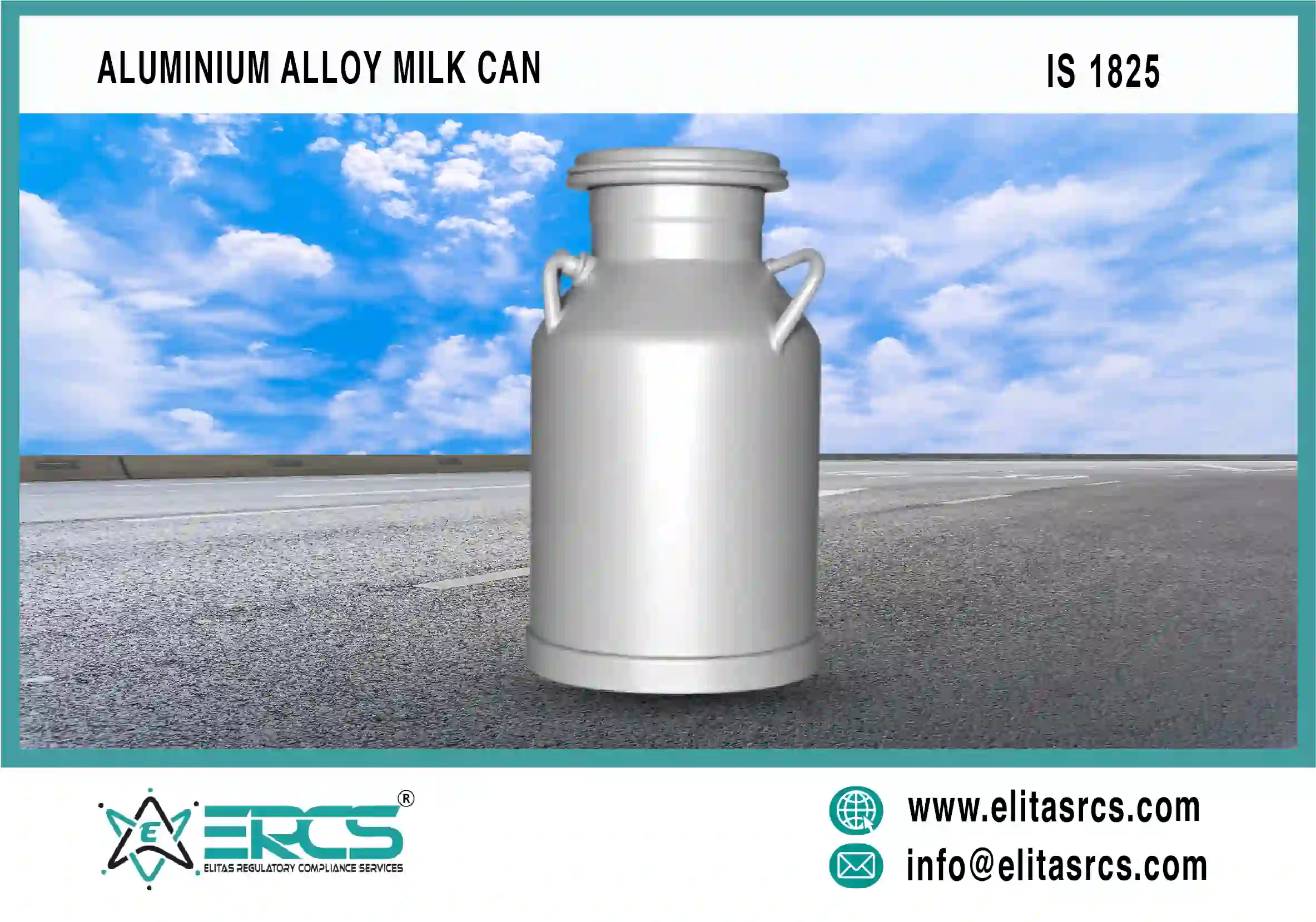
Aluminium alloy milk cans are a crucial component in India for the dairy supply. To ensure the quality, durability, consistency, and safety of the product, the BIS Certification is compulsory. IS 1825 in the Indian Standard specifies the requirements for aluminium alloy milk cans that are used for collecting and distributing fluid milk. The ISI Mark is often required for the cans to be legally manufactured and sold in the Indian market. The standard is already established. Although the QCO has not yet been officially announced, it is anticipated that it will soon be published on the BIS website. Stakeholders are encouraged to begin their preparations now to ensure timely compliance once the order takes effect.
|
Note: The product is drafted, but QCO has not been published yet. The official BIS website can publish the QCO soon. |
Overview of Aluminium Alloy Milk Can Certification
The Indian market is featured under IS 1825 for the aluminium alloy milk cans, which specifies the requirement for product Certification under the BIS Scheme-I. The standard also requires quality and suitability aspects of the cans as they pertain to storage and transitory events. Aluminium alloy milk cans are widely used in the dairy industry for storing, collecting, and transporting milk. They are preferred to be lightweight, durable, and resistant to corrosion, making them a superior choice compared to traditional materials like steel or plastic. It is essential to maintain hygiene and quality of milk during long-distance transportation in varying climatic conditions.
BIS Certification of cans typically involves a few specifications that entail specific physical material, construction, and performance properties, including hardness, workmanship & finish, leakage test, and drop test.
Key Specification of IS 1825
IS 1825 is an Indian Standard that specifies the requirements for aluminium alloy milk cans with a rated capacity of 20 litres for delivery cans and a rated capacity of 20, 30, 40, and 50 litres for transport cans. This covers the following aspects, among others: the can shape, dimensions, part thickness, the mode of shaping, hardness, and mass, plus some of the performance from this standard, including pneumatic, drop, and leakage tests.
- Material: Alloy 3004 aluminium um (Refer Clause of IS 1825).
- Contents: 20, 30, 40, and 50 liters.
- Shape and Dimensions: These are individually specified for design and dimensions for each capacity.
- Plate Thickness: Derived from the design, the standard specified the necessary thickness for the parts of the can.
- The method of formation: Orientation on the formation of the can is included.
- Hardness: Hardness requirements were included in the standard, and hardness is linked to the required strength of the can.
- Mass: The standard stated the permissible mass for the 50-liter can; the permissible mass of the can was revised to 7.1 kg.
- Test: To demonstrate the integrity and appropriateness of the can for the transport and storage of milk, tests that include pneumatic, drop, and leakage tests will be required.
- Lid designs: Specifications for lids were included, which included various cap designs to include pull-type or lockable types.
Basic Requirements for Obtaining BIS Certification for IS 1825
Let’s break down the basic requirements for BIS Certification in India of IS 1825:
1. Manufacturing Set up
- Adequate manufacturing facilities to manufacture cans based on IS 1825.
- Adequate quality control (QC) equipment for testing mechanical, chemical, and physical properties.
- An in-house laboratory or arrangement with a BIS-recognized laboratory.
2. In-house, as a minimum, testing facilities (Equipment) (Refer to Annex-A of the product manual of IS 1825):
- Vernier caliper/ Micrometer
- Weighing balance
- Hardness tester
- Chemical analysis kit/ Spectrometer
- Leak Test equipment
- Tensile testing machine
3. Quality Control Procedures
4. Have Standard Operating Procedures (SOPs) for the following:
a. Raw material inspection
b. In-process inspection
c. Final (product) inspection
5. Factory Inspection by BIS
- A BIS officer will visit the factory for a pre-certification inspection.
- Samples will be taken for independent third-party testing.
6. Marking/ Labelling of Product
- BIS Standard mark (ISI Certification) once certified.
- Marking details as per the standard: name of manufacturer, size/capacity of can, month/year of manufacture, etc.
Steps to Follow To Obtain BIS Certification for IS 1825
To secure the BIS certificate for your product, please follow the procedure outlined below:
- Filling of the Application: Manufacturers must first register on the BIS portal and then apply for a license by filling out the application form.
- Documentation Preparation: This involves getting all documents such as factory licenses, quality control plans, specifications of raw materials, etc.
- Laboratory Testing: Milk can samples need to be sent to a laboratory registered with the BIS for chemical composition analysis.
- Inspection of Factory: The BIS officers will inspect the extraction process, quality control system, and layout of the Factory.
- Questioning the License: On the completion of license inspection, examination, and verification of test reports, the BIS grants the license to use the Standard Mark to signify that the tin ingots conform to IS 1825.
The process can be obtained and certified for the Indian manufacturer and the foreign manufacturers as well:
- BIS Mark Certification Process for Indian Manufacturers
- BIS Mark Certification Process for Foreign Manufacturers
What are the timelines for Tin Ingot BIS Certification?
India offers several BIS certification periods for different types of producers. They include BIS Certifications to Indian Manufacturers, issued in the general case within 30 days, and BIS Certifications for Foreign Manufacturers, released within 180 days.
Documents Required Under BIS Certification of Aluminium Alloy Milk Can IS 1825
Below, we have mentioned the list of important documents required for the Indian BIS Certification of Milk Can:
- Company Registration Certificate
- Manufacturing Process Flowchart
- List of Manufacturing and Testing Equipment
- Quality Control Plan
- Raw Material Specifications and Supplier Details
- Test Reports (In-house or Third-party)
- Layout of the Factory
- Calibration Certificates for Testing Instruments
- Details of Key Personnel and Authorized Signatory
- Trademark Certificate (if applicable)
- Technical Drawings of the Forged Products
- Lease or Ownership Documents of the Premises
- Copy of Any Previous BIS License (if applicable)
Cost of Product Certification for Aluminium Alloy Milk Can
Go through the table to know the BIS Certification Cost for IS 1825:
|
S No. |
Particular |
Amount (INR) |
Remarks |
|
1. |
Application Fee |
1000 |
To be paid directly to BIS |
|
2. |
Audit Fee |
7000 |
To be paid directly to BIS |
|
3. |
License Fee |
1000 |
To be paid directly to BIS |
|
4. |
Sample Testing Fee |
As Applicable |
To be paid directly to BIS (Testing charges vary from product to product and lab to lab.) |
|
5. |
Minimum Advance Marking Fee |
As per actual |
To be paid directly to BIS (Marking fee varies as per Indian Standard) |
|
6. |
Renewal Fee |
1000 |
To be paid directly to BIS |
|
7. |
Inclusion Fee |
5000 |
To be paid directly to BIS |
|
8. |
ERCS Pvt Ltd Service Fee |
Please contact info@elitasrcs.com |
|
|
Remarks |
Including all the taxes |
||
How ERCS Can Help You In Obtaining BIS Certification For Aluminium Alloy Milk Can?
As the BIS Standard for IS 1825 has been published and the QCO notification is expected to be released shortly, the manufacturers and importers of aluminium alloy milk cans must get themselves ahead of the certification process. Meeting the requirements of BIS is considered to guarantee an assurance of safety and quality on behalf of a product, and hence, it is essential for smooth market entry and legal manufacturing.
ERCS, as a BIS agent, offers comprehensive assistance in acquiring BIS Certification. Our professional team will take care of everything for you - documentation, application, communication with BIS authorities, and test laboratories. Engaging in a partnership with ERCS means that you will be fully prepared to comply at the time the QCO is officially notified, hence avoiding any delays or risks and getting the certification as quickly as possible.