BEE Registration for
Tyres/Tires
IS 15633
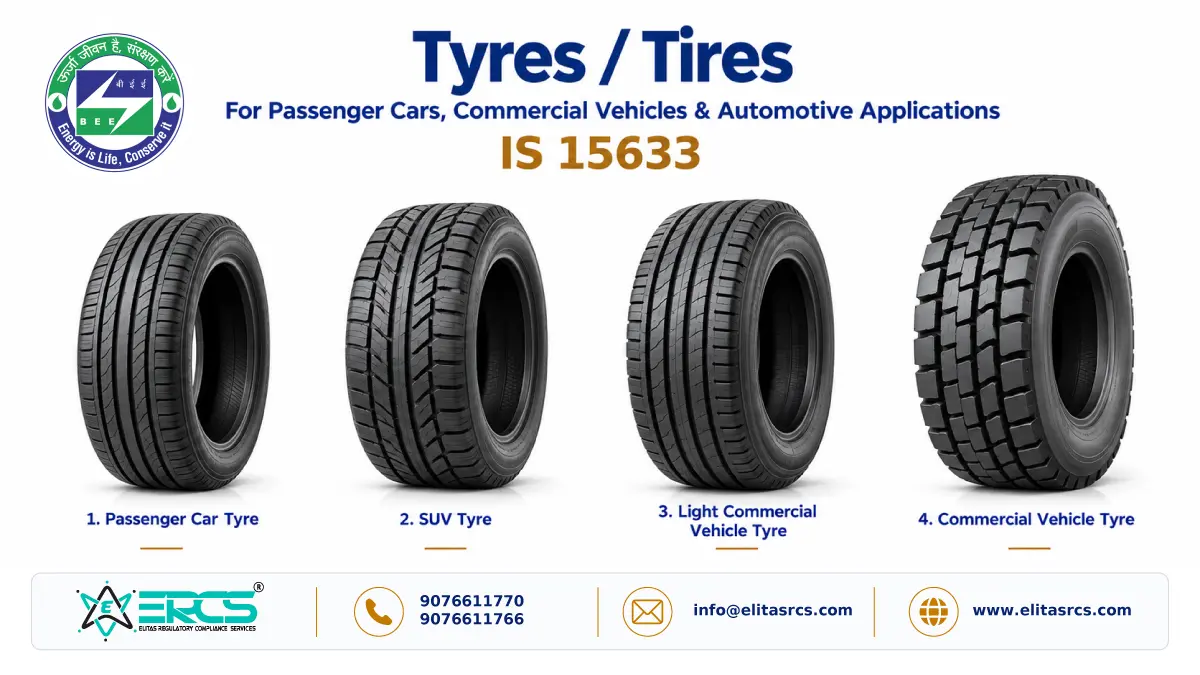
BEE (Bureau of Energy Efficiency) Registration for Tyres/Tires falls under the BEE Standards & Labelling Programme, which aims to promote energy efficiency by disseminating product performance information. Under Schedule 30 Tyres, the following tyres are subject to energy labelling: C1, C2, and C3. For C1 tyres, the Indian Standard in the BEE schedule is IS 15633, whereas C2 and C3 are tied to the standards listed in the schedule.
For tyres covered by IS 15633, the BEE energy labelling process primarily focuses on rolling resistance and wet grip performance. The star rating system is pegged to the Rolling Resistance Coefficient (RRC). This is the resistance that a tyre experiences during rolling. The performance parameters that apply to the laboratory requirements of BEE in tyre energy labelling include rolling resistance, RRC and wet grip index.
Key Highlights of BEE Registration for Tyres
The BEE categorises Tyres under Schedule 30 and includes C1 tyres as referred to in IS 15633, with rolling resistance as the rating criterion. Some of the laboratory requirements from BEE include rolling resistance, RRC, and wet grip index.
|
Key Particular |
Details |
|
Regulatory Authority |
Bureau of Energy Efficiency (BEE) |
|
Applicable Schedule |
Schedule 30 – Tyres/Tires |
|
Product Coverage |
C1-Passenger cars C2-Light-duty commercial vehicles and C3-Heavy-duty commercial vehicles Replacement tyres covered under AIS 142 |
|
Applicable Standard for C1 Tyres |
IS 15633 |
|
Applicable Standard for C2 & C3 Tyres |
IS 15636, as applicable |
|
Testing Reference |
AIS 142 |
|
Main Performance Focus |
Rolling Resistance Coefficient (RRC) and Wet Grip Index |
|
Star Rating Basis |
Primarily based on the Rolling Resistance Coefficient (RRC) |
|
Labelling Scope |
Applicable base models, batches and variant models |
|
Programme Objective |
To communicate tyre energy-efficiency performance and help consumers make informed choices |
|
Testing Laboratory |
Testing through laboratories meeting the applicable BEE accreditation/recognition requirements |
Tyres Testing Requirements and NABL Lab under IS 15633
Indian Class C1 passenger car tyres must pass the test as per IS 15633 to earn BEE approval under Schedule 30. It is required when the manufacturer would like to display labels indicating fuel efficiency and safety. The following tests are performed:
- Rolling resistance coefficient (RRC): Measures the energy loss due to tyre rolling resistance, which affects fuel efficiency and carbon dioxide emissions.
- Wet grip index (WGI): Measures braking traction and safety in wet conditions.
- External rolling noise: Measured in decibels, the noise caused by the tyre rolling on the road.
- Star Rating Assessment: The BEE star-rating bands are primarily based on the RRC value.
Documents Required for BEE Registration of Tyres
The list of documents required to get BEE registration in India for a tyres/tires:
- Manufacturing address and factory license copy
- BIS License with validity date, covering the relevant product scope and listing all models
- Brand registration form and Trade Mark certificate
- MSME certificate (Indian OEMs only)
- ISO 9001 Quality Management certificate
- Authorised signatory letter
- Technical/model details as required by BEE
- Covering letter in prescribed format
- Model registration payment receipt (per model)
- Completed mandatory form and Annexure
- Test report and specimen BEE label
Step-by-Step BEE Registration Process for Tyres
The process for BEE Registration for Tyres is done in a step-by-step manner and includes Company Registration, NABL Laboratory Testing for Tyres and final BEE Star Rating India:
- Verify Applicability of the Product: The manufacturer/applicant shall confirm that the product is applicable under BEE Schedule 30
- List relevant standards: Test and energy performance evaluations shall be conducted in accordance with IS 15633 for C1 and IS 15636 for C2/C3.
- Product Testing: The model shall be tested to determine its parameters, including the Tyres.
- Get the Test Report: Upon successful completion of the testing process, the applicant will receive the test report from an NABL-certified lab or another authorised lab, as required.
- Preparation of the Application and Relevant Documents: The application document and other relevant documents related to BEE S&L will be prepared by the applicant.
- BEE Application Process: BEE application shall be made through the respective BEE Standards & Labelling registration process along with other relevant documents and applicable charges.
- Scrutiny and Verification by BEE: The BEE shall undertake scrutiny and verification of the application along with other relevant test documents. Any discrepancies must be resolved before approval.
- BEE Approval and Star Rating: Upon acceptance of the application, BEE shall grant the product approval/registration and assign an energy-efficiency rating. The BEE S&L program rates the products on a 1-to-5-star scale; the higher the star rating, the higher the energy efficiency.
Validity, Renewal & Timeline of BEE Registration for Tyres
The BEE registration process for Testing and approval generally takes 4 to 8 weeks, including roughly 20 to 25 working days for the BEE's review of high tyre/tires once the application and test report are submitted.
Renewal of BEE Registration
- When to apply: Apply well ahead of expiry, per BEE's renewal notice
- Product Testing: Fresh product testing is required whenever product specifications or BEE standards change.
- Re-Registration Application: Complete the re-registration application form and submit it with the test report.
- Fees for Re-Registration: Re-registration fees and other fees.
- Approval of Registration: Re-approval of registration by BEE.
How ERCS Private Limited Helps with BEE Registration for Tyres
ERCS Private Limited is a provider of complete solutions for BEE certification for Tyres in accordance with the pertinent Standards & Labelling provisions. As per BEE, Tyres currently fall under Schedule 30, and the program involves the C1, C2, and C3 categories of tyres.
- Product Assessment: Assistance for identifying the appropriate tyre category and its BEE requirements.
- Standard Identification: Guidance on identifying the appropriate standard, which may be IS 15633, IS 15636, or AIS 142, as applicable.
- Testing Coordination: Assistance with testing aspects such as Rolling Resistance, RRC, and Wet Grip Index.
- Documentation: Assistance in the preparation and checking of technical and application documents.
- Application Filing: Assistance in making the BEE application and submitting information.
- Query Handling: Assistance in resolving any queries or deficiencies raised by BEE while processing the application.
- Labelling: Assistance in meeting BEE star labelling provisions after registration.