BEE Registration for
Solar Photovoltaic
Schedule 35
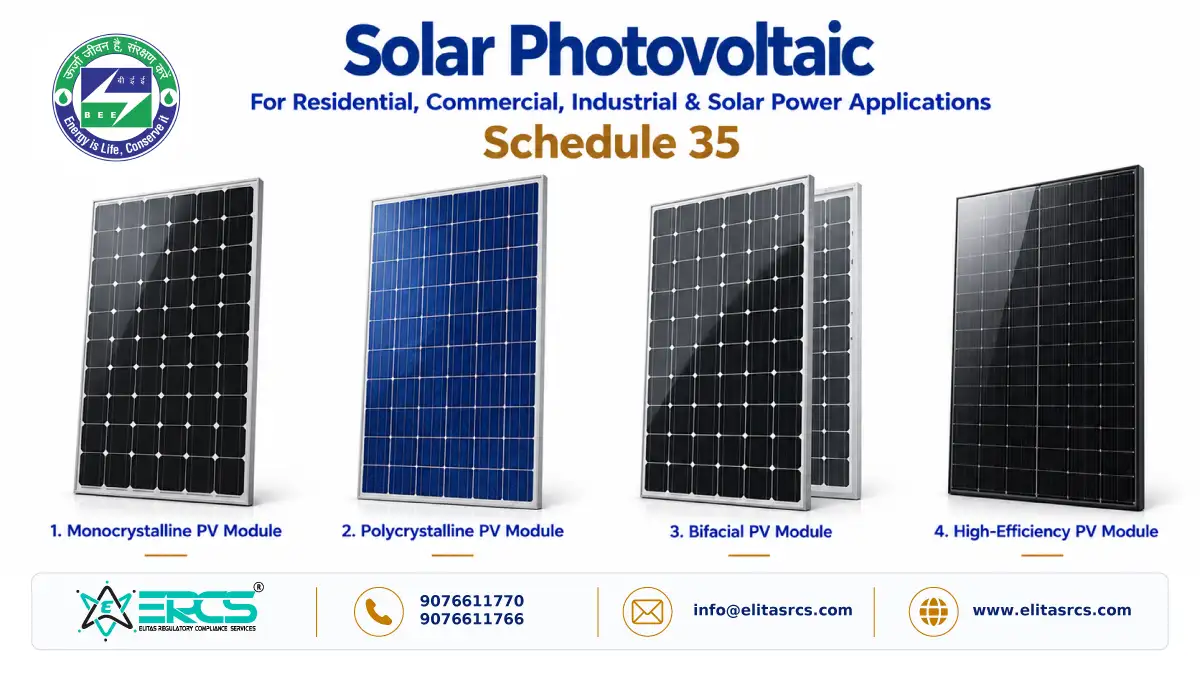
BEE Registration for Solar Photovoltaic (SPV) Modules is the process of registering crystalline silicon and thin-film PV modules under Schedule 35 of the BEE Standards & Labelling Programme to evaluate their energy performance and provide consumers with star-rating information. The relevant standard and test requirements are specific to the particular SPV product under the BEE Programme.
Solar Photovoltaic modules use sunlight to generate electricity and are tested and star-rated as crystalline silicon or thin-film modules under Schedule 35. The BEE Standards & Labelling criteria depend on the category of the SPV products; therefore, the concerned company must check the BEE schedule, which shows the energy-efficiency performance of its products.
Key Highlights for Solar PV Modules under BEE Schedule 35
|
Key Particular |
Details |
|
Product Category |
Solar Photovoltaic (SPV) Products |
|
Applicable Standard for Solar PV Modules |
1. IS 14286:2010 – Crystalline Silicon terrestrial photovoltaic (PV) modules-Design qualification and type approval 2. IS 16077:2013 Thin film terrestrial photovoltaic (PV)-Design qualification and type approval 3. IEC 61853-3:2018 Photovoltaic (PV) module performance testing and energy rating - Part 3: Energy rating of PV module. 4. IS 12834: 2013 Photovoltaic Energy Systems – Terms, Definitions and Symbols 5. IEC 62804 (Part 1):2022 Photovoltaic (PV) modules - Test methods for the detection of Potential-induced degradation Part 1 crystalline silicon |
|
Key Performance Parameter |
Energy efficiency/overall efficiency, as applicable to the specific SPV product |
|
Testing Laboratory |
Testing should be conducted through a laboratory having the applicable testing scope and accreditation |
|
BEE Relevance |
The applicable BEE Standards & Labelling requirements depend on the specific Solar PV product category |
|
BEE Star Label |
The BEE S&L programme uses a 1-to-5 star rating system, with a higher star rating indicating better energy efficiency |
BEE Certification Testing Requirements for Solar Photovoltaic
Testing for solar photovoltaics requires NABL-accredited laboratory facilities that comply with applicable standards to support Bureau of Energy Efficiency (BEE) star ratings and regulatory approvals.
- Design Qualification & Type Approval: Tests whether the solar PV module's design qualification meets the requirements of the relevant standard. Normally, this requirement is verified before BEE registration.
- Power Rating / I-V Characteristics: Determines the module's maximum power rating, voltage, and current under standardised testing conditions. It is conducted to ascertain the module's true electrical performance.
- Energy Rating: Measures the solar module's electrical energy generation capacity over a year under various climatic conditions.
- Module Efficiency: Determines how effectively the module converts light energy into electrical energy. Efficiency is determined by the module's power and surface area and is used to assess the module's relevant BEE Star Rating.
- Potential-Induced Degradation (PID) Test: Tests whether the module's performance degrades under electrical voltage stress. The test is conducted to verify the module's performance. For qualifying crystalline silicon modules, the power degradation after the test should not exceed the prescribed limit.
Documents for a BEE Certificate for Solar Photovoltaic
The list of documents required to get Bureau of Energy Efficiency (BEE) registration for a solar Photovoltaic:
- Manufacturing address.
- Copy of factory license for the relevant product scope.
- Copy of the BIS License with the validity date and a list of all models.
- Brand registration form.
- Brand / Trade Mark Certificate.
- MSME certificate (for Indian OEM only).
- ISO 9001 Quality Management certificate.
- Authorised signatory letter.
- IEC 61730-1 and 61730-2 test/safety reports (BIS CRS).
- Documents/technical details required by BEE for model registration.
- Covering letter in the prescribed format.
- Model registration payment receipt (each model).
- Print out the mandatory form and its Annexure form.
- Test report and specimen of BEE label.
Step-by-Step BEE Star Rating Process for Solar Photovoltaic
The steps required to obtain BEE registration India for Solar Photovoltaic are as follows:
- Verify Applicability of the Product: The manufacturer/applicant shall confirm that the product is applicable under the BEE Schedule 35.
- List relevant standards: Test and energy performance evaluations shall be conducted in accordance with the applicable standards.
- Product Testing: The PV module shall be tested at an NABL-accredited laboratory to determine its power rating, energy rating, module efficiency and PID resistance.
- Get the Test Report: Upon successful completion of the testing process, the applicant will receive the test report from an NABL-certified lab or another authorised lab, as required.
- Preparation of the Application and Relevant Documents: The application document and other relevant documents related to BEE S&L will be prepared by the applicant.
- BEE Application Process: The BEE application shall be submitted through the respective BEE Standards & Labelling registration process, along with other relevant documents and applicable charges.
- Scrutiny and Verification by BEE: The BEE shall undertake scrutiny and verification of the application along with other relevant test documents. Any discrepancies must be resolved before approval.
- BEE Approval and Star Rating: Upon acceptance of the application, BEE shall grant the product approval/registration and assign an energy-efficiency rating. The BEE S&L program rates the products on a 1-to-5-star scale; the higher the star rating, the higher the energy efficiency.
BEE Registration Timeline, Validity & Renewal for Solar Photovoltaic
The BEE Star Rating for Solar PV Modules Schedule 35 is valid till December 31, 2026. This can be reviewed and updated by BEE from time to time; therefore, manufacturers must check its applicability before proceeding.
If there are any changes to the standards and star rating bands, the manufacturer must test the product and register it under the new standards. If registration renewal is required, manufacturers must apply at least one month before the existing table or registration expires.
Renewal of BEE Registration
- When to apply: Apply well ahead of expiry, per BEE's renewal notice
- Product Testing: Fresh product testing is required whenever product specifications or BEE standards change.
- Re-Registration Application: Complete the re-registration application form and submit it with the test report.
- Fees for Re-Registration: Re-registration fees and other fees.
- Approval of Registration: Re-approval of registration by BEE.
Why Choose ERCS Private Limited for BEE Registration of a Solar Photovoltaic System?
ERCS consultants provide End-to-End Regulatory Support, Accurate Coordination for NABL testing, and Smooth Portal Processing for BEE Registration of Solar Photovoltaics.
Completely compliant with the latest 2026 energy labelling standards & norms.
BEE Schedule 35 is monitored periodically by ERCS and includes an extension of the current PV module star-rating table until December 31, 2026, to ensure that you use the latest criteria in your application.
- Specialised Expertise in Energy Efficiency Compliance: Extensive experience with BEE Star Labelling requirements for Solar Photovoltaic systems.
- Correct Product Classification: Help with classifying your product under the right category & Indian Standards to avoid mistakes in the application.
- Pre-Application Compliance Review: A complete check of all documents and specifications prior to application submission.
- Project Manager Assigned to Your Project: One single point of contact for coordination of the entire BEE Registration process.
- BEE Star Label Requirements: We will help you meet BEE Star label requirements post-registration.
- Complete Assistance: We will make your BEE Registration process easy and convenient.