BEE Registration for
General Purpose Industrial Motors
IS 12615:2018
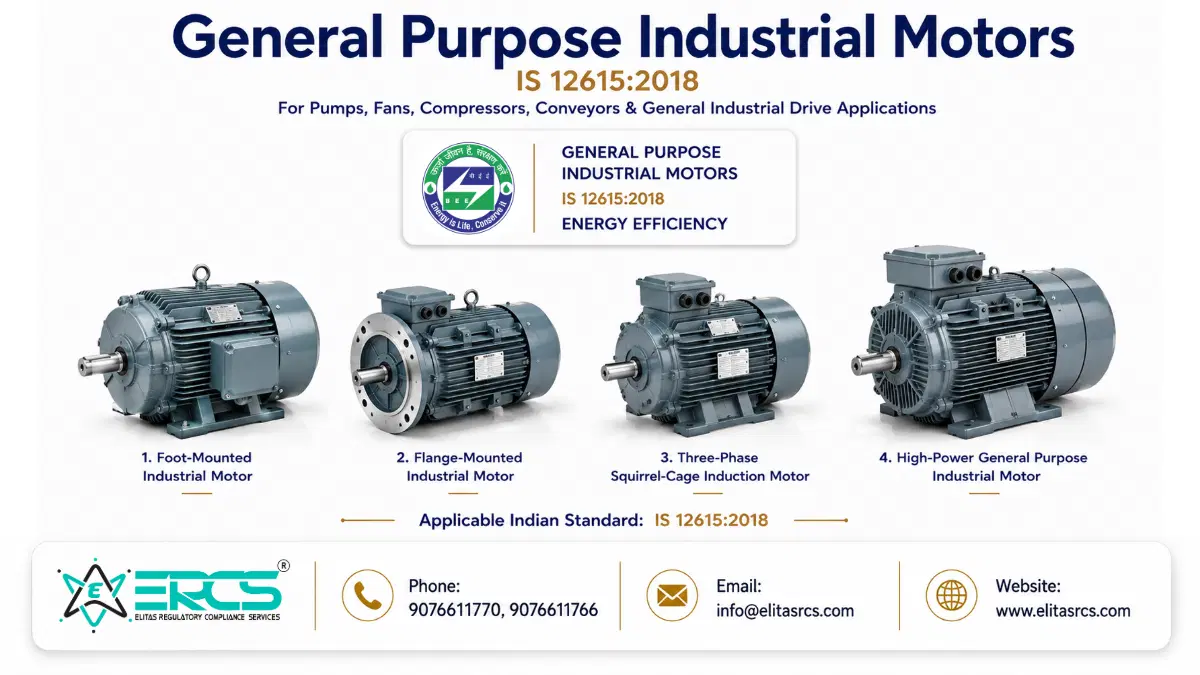
BEE Registration for General Purpose Industrial Motors is an energy-efficiency labelling scheme regulated by the Bureau of Energy Efficiency (BEE), Ministry of Power, Government of India. General Purpose Industrial Motors fall under Schedule 6 - Induction Motors of the BEE Standards & Labelling Scheme. At the moment, BEE has categorised this type of product within its voluntary labelling scheme.
The relevant Indian Standard is IS 12615:2018, Line-Operated Three-Phase A.C. Motors (IE Code)Efficiency Classes and Performance Specification. This standard sets out efficiency classes and performance criteria for covered three-phase AC motors. It includes motors with designated power ratings, number of poles, voltage and frame sizes.
BEE registration allows manufacturers/suppliers to indicate the energy-efficiency performance of industrial motors using the voluntary star-label system. High motor efficiency is especially crucial in industrial applications, as motors drive various machines such as pumps, fans, blowers, and compressors, and improved motor efficiency translates to reduced electricity consumption and operational cost savings.
Key Highlights of the IS 12615:2018 for General Purpose Industrial Motor
Understanding BEE registration under IS 12615:2018 for General Purpose Industrial Motors is essential for manufacturers seeking to register their energy-efficient motors in India.
|
Key Particular |
Important Details |
|
Applicable Standard |
IS 12615:2018 – Line Operated Three Phase AC Motors (IE Code): Efficiency Classes and Performance Specification |
|
Product Category |
General Purpose Industrial Motors / Three-Phase AC Induction Motors |
|
Efficiency Classification |
Motors are classified according to IE (International Efficiency) Classes |
|
Motor Type |
Three-phase, line-operated AC motors |
|
Frequency |
50 Hz supply frequency |
|
Power Range |
Applicable to motors within the rated output range covered by the standard of low-voltage three-phase motors |
|
Efficiency Requirement |
Motor efficiency must meet the prescribed efficiency limits for its applicable IE class |
|
Performance Parameters |
Efficiency, power factor, torque characteristics, starting performance and other specified motor performance parameters |
|
Main Objective |
To promote energy-efficient industrial motors and reduce electricity consumption in industrial applications |
Testing Requirements for BEE Certification for General Purpose Industrial Motor
BEE Certification Testing Requirements for General Purpose Industrial Motor under IS 12615
- Stator Winding Resistance Test: Tests the resistance of the motor winding under standard ambient conditions.
- No-Load Test: Measures the motor's current, power consumption, and speed under no-load conditions at rated voltage.
- Load Test: Tests the motor's performance under load.
- Efficiency Test: Finds out the efficiency of the motor in converting electrical to mechanical energy, mainly at 75% and 100% load.
- Efficiency Class Test: Tests whether the motor complies with the IE2, IE3, and IE4 efficiency classes as specified in IS 12615:2018.
- Temperature Rise Test: Tests whether the temperature rise of the motor stays within the permissible limits under load operation.
Step-by-Step BEE Star Rating Process for General Purpose Industrial Motor
Both manufacturers and importers must complete the same registration procedure to obtain the BEE Star Rating for industrial motors:
- Product Verification: Ensure your product is eligible for Compulsory or Voluntary BEE Certification.
- Product Sampling: Send samples of your product to NABL-accredited laboratories.
- Product Testing: Your product shall be tested in the laboratory for performance (star rating) and safety (BIS).
- Document Collection: Collect all required documents, including the factory license, user manual, BIS license, and the manufacturing unit address.
- Brand/Company Registration: Your company/brand gets registered on the BEE website, and payment is made.
- Application Filing: The application would be filed online and offline, along with signatures on the documents.
- Document Evaluation: BEE officials will evaluate your application to ensure all submitted documents are in order.
- BEE Certification: Once all the requirements in the documents and application are fulfilled, BEE officials give you a BEE certificate.
Documents for a BEE Certificate for a General Purpose Industrial Motor
The following are documents which have to be prepared before filling in the application form:
Documents to be provided by the Company/Business
- Filled-in BEE Application Form
- Proof of Factory/Mfg. Plant address
- Manufacturer/Import Identification
- Registration Certificate of Firm
- Signature Authority details
- Trademark & ISO Certification (wherever applicable)
- Fees Payment Acknowledgement
Documents to be provided by Product & Technical
- Filled-in Product Specification Sheet
- Technical specifications
- Usage and safety instruction manual
- NABL Test report as per IS 12615
For Foreign Manufacturers
- Letter of appointment of Authorised Indian Representative (AIR)
- Brand authorisation letter (if any)
BEE Registration Timeline, Validity & Renewal for General Purpose Industrial Motor
Normally, it takes 30 to 60 days to register for the BEE (6-8 weeks in total, including lab tests). Foreign manufacturers are advised to submit their applications through the Authorised Indian Representatives (AIR) or an Indian importer. The validity period of the certificate is 3 years or the validity period of the product notification, whichever is less.
Procedure for BEE Registration Renewal
- Advance Notice: BEE provides an advance notice or renewal window a few months prior to the expiry date.
- Re-testing: Products need to be retested if any changes were made to the efficiency parameters in a certified lab accredited by NABL or approved by BEE.
- Online Application Submission: Access the BEE Portal for the renewal application submission.
- Documentation and Fees: Provide updated technical documentation, production details, a new sample label design, and pay the appropriate government fees for processing fees.
- Renewal: Upon verification, BEE reissues the certificate and grants permission to continue using the label.
Why Choose ERCS Private Limited as a BEE Registration Consultant?
ERCS Private Limited provides complete assistance with BEE Registration for general-purpose industrial motors, offering easy, hassle-free service for the manufacture and import of industrial motors.
- Expertise in BEE Compliance: In-depth knowledge about BEE guidelines and standards related to industrial motors
- Complete Assistance: Assistance through Testing Coordination till Approval
- Technical Assistance: Access to highly skilled compliance professionals
- Certificate and Form Filing: Preparation of all necessary certificates and forms
- Process Efficiency: Efficient process management to avoid any mistakes and delays
FAQs
1. Is BEE Registration Mandatory for Motors in India?
Ans: Yes, General Purpose Industrial Motors currently fall under BEE's voluntary Standards & Labelling Scheme (Schedule 6 - Induction Motors). While registration isn't mandatory today, manufacturers should monitor BEE notifications, as several product categories have moved from voluntary to mandatory labelling over time
2. Which is the standard used for general-purpose industrial motors?
Ans: The standard for general-purpose industrial motors is IS 12615:2018 - Line Operated Three Phase AC Motors (IE Code): Efficiency Classes and Performance Specification.
3. What are the efficiency classes as per IS 12615:2018?
Ans: IE efficiency classes, such as IE2, IE3, and IE4, have been prescribed in accordance with the standard.
4. Which tests are conducted during BEE Registration of Industrial Motors?
Ans: The tests conducted include stator winding resistance, no-load, load, efficiency, efficiency class, and temperature rise tests.
5. At which load percentage is motor efficiency measured?
Ans: Motor efficiency is measured at 75% and 100% load, respectively, as applicable to the prescribed testing and efficiency assessment requirements.