BEE Registration for
EV Charger
Schedule 41
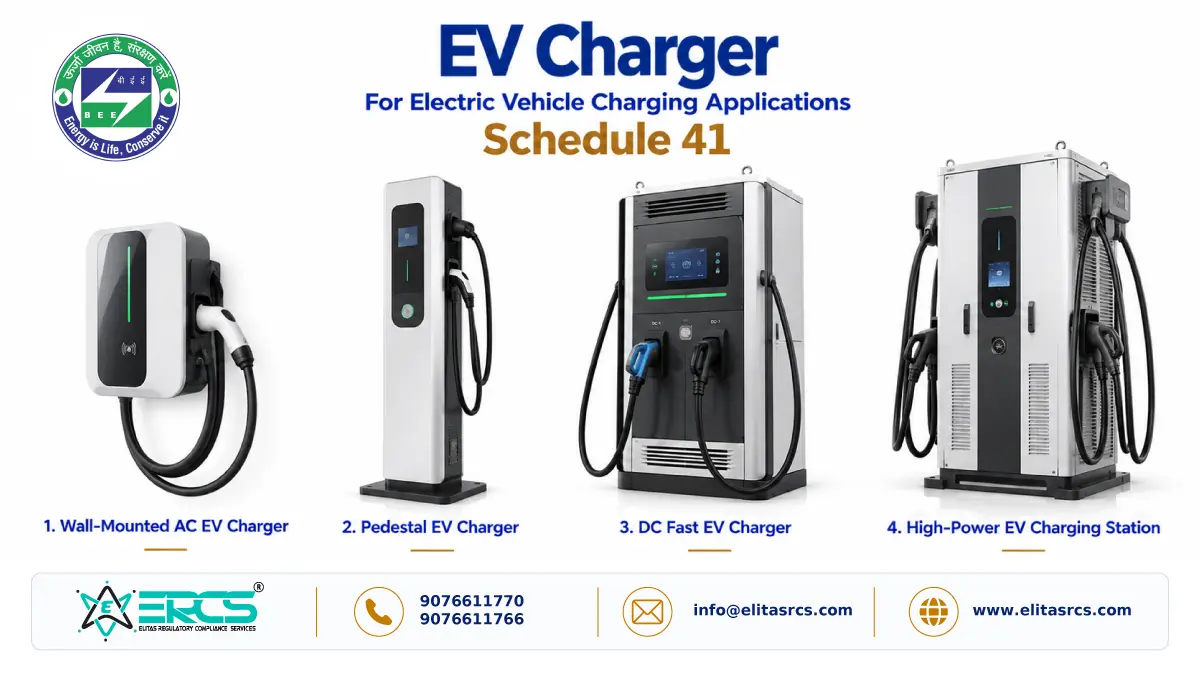
BEE Registration for EV Chargers is a compliance process that enables manufacturers and suppliers to showcase the energy-efficiency performance of qualified EV charging equipment. EV Chargers are devices that facilitate the safe transfer of energy from the supply to the electric vehicle; hence, energy-efficiency performance is vital to minimise energy losses.
For the BEE program and this product category, registration includes applicability determination, product testing, technical documentation, application approval, and filing. Manufacturers should ensure that their EV charger models meet energy-efficiency and technical requirements.
Key Highlights of BEE Registration for EV Charger
The EV Charger under Schedule 41 implies:
|
Key Highlight |
Description |
|
Energy Efficiency |
Helps demonstrate the energy-efficiency performance of EV charging equipment, measured as weighted-average energy efficiency across multiple load points (e.g., a certified 60kW/120kW DC charger recently achieved 97% weighted efficiency, earning a 5-star rating). |
|
Product Testing |
Applicable performance and efficiency testing may be required as per the relevant requirements. |
|
Technical Compliance |
Ensures the EV charger meets applicable technical and energy-performance requirements. |
|
BEE Registration |
It provides an opportunity for eligible EV charger models to be registered under the applicable BEE programme. |
|
Consumer Awareness |
Helps users understand the energy-performance characteristics of charging equipment. |
|
Market Credibility |
BEE recognition can support product credibility and strengthen market acceptance. |
|
Energy Savings |
Efficient charging equipment can help reduce energy losses during charging. |
|
Documentation Support |
Requires appropriate technical, product and testing documents for the registration process. |
EV Charger Testing Requirements for BEE Registration
The test should be conducted according to the relevant part of the IS 17017 series, depending on the type of charger being used: IS 17017 Part 23 for DC EVSE (50-200 kW), and the relevant AC parts (including Part 1, General requirements) for AC chargers. This is done in NABL-accredited laboratories.
- Efficiency of Weighted Average: It is calculated based on several pre-specified load or power output settings (e.g., 10%, 20%, 50%, 75%, 100% load outputs, as per test standards guidelines).
- Test Ambient Conditions: Testing shall be conducted in a controlled environment at a constant ambient temperature of 27±2°C and a relative humidity of 10% to 90%.
- Power Measurement: This test requires the multi-channel power analyser, which must be connected to both the AC power input and the DC output loads to measure power efficiency.
- Standard References: The testing procedure must adhere to the guidelines in IS 17017-23 and be conducted in NABL-accredited laboratories.
Documents Required to Obtain BEE Certification for EV Charger
The list of documents required to get Bureau of Energy Efficiency (BEE) registration for an EV Charger:
- Address and a copy of the Factory License of the manufacturer, mentioning the concerned product range
- Letter in the prescribed format
- Application Form for Brand Registration (Online submission, Printout)
- Certificate of Trademark/Brand Registration or Authorisation Letter from the trademark holder in case of separate holders
- MSME Certificate (Only for Indian OEMs, if any)
- ISO 9001 Quality Management Certificate of the manufacturing plant
- Authorised Signatory letter
- Copy of BIS License with Validity Period (If applicable for the concerned product line)
For Model Registration (for each model):
- Letter in the prescribed format
- Receipt of the payment made for Model Registration
- Print out the online application form and its Annexure(s)
- Test Report from the NABL-accredited / ILAC MRA-accredited laboratory
- BEE Label specimen for the model
Step-by-Step BEE Registration Process for EV Charger
The BEE Registration process involves:
- Verify Applicability of the Product: The manufacturer/applicant shall confirm that the product is applicable under BEE Schedule 41.
- List relevant standards: Test and energy performance evaluations shall be conducted in accordance with the applicable part of IS 17017 for the charger type.
- Product Testing: The model shall be tested to determine its weighted average energy efficiency and other parameters specified under IS 17017
- Get the Test Report: Upon successful completion of the testing process, the applicant will receive the test report from an NABL-certified lab or another authorised lab, as required.
- Preparation of the Application and Relevant Documents: The application document and other relevant documents related to BEE S&L will be prepared by the applicant.
- BEE Application Process: The BEE application shall be submitted through the respective BEE Standards & Labelling registration process, along with other relevant documents and applicable charges.
- Scrutiny and Verification by BEE: The BEE shall undertake scrutiny and verification of the application along with other relevant test documents. Any discrepancies must be resolved before approval.
- BEE Approval and Star Rating: Upon acceptance of the application, BEE shall grant the product approval/registration and assign an energy-efficiency rating. The BEE S&L program rates the products on a 1-to-5-star scale; the higher the star rating, the higher the energy efficiency.
Validity, Renewal & Timeline of BEE Registration for EV Charger
The validity period of Bureau of Energy Efficiency (BEE) registration for an EV Charger, as per Schedule 41, is 3 years, provided the star rating remains unchanged during this period. To obtain BEE registration for an EV Charger, the complete procedure generally takes 30 to 45 working days.
The Bureau of Energy Efficiency (BEE) initiates the renewal process through its BEE Portal before the registration period expires.
- Response Period: The manufacturer/importer should respond and submit an initial expression of interest within 3 months of receiving the notice.
- Application: Log in to the website portal and enter the required company information and the total production/import quantity.
- Document Uploading: Upload the application documents with updated information demonstrating compliance with current energy efficiency norms.
- Payment of Fee: Pay the relevant renewal fee online.
How ERCS Private Limited Helps with BEE Registration for EV Charger
As a BEE Consultant, ERCS offers comprehensive guidance to manufacturers and organisations on obtaining BEE Registration for EV Chargers.
- Applicability Analysis: We analyse the EV Charger and determine the BEE requirements applicable to it.
- Document Support: Help in compiling the required technical and supporting documents.
- Testing Support: Help in testing the product at the appropriate laboratory.
- Application Support: Help in compiling and filing the BEE Registration Application.
- Technical Guidance: Assistance with applicable energy efficiency requirements.
- Application Monitoring: Help monitor your application's status and responding to any queries raised by the regulatory authority.
- End-to-End Support: Help from applicability analysis through registration.