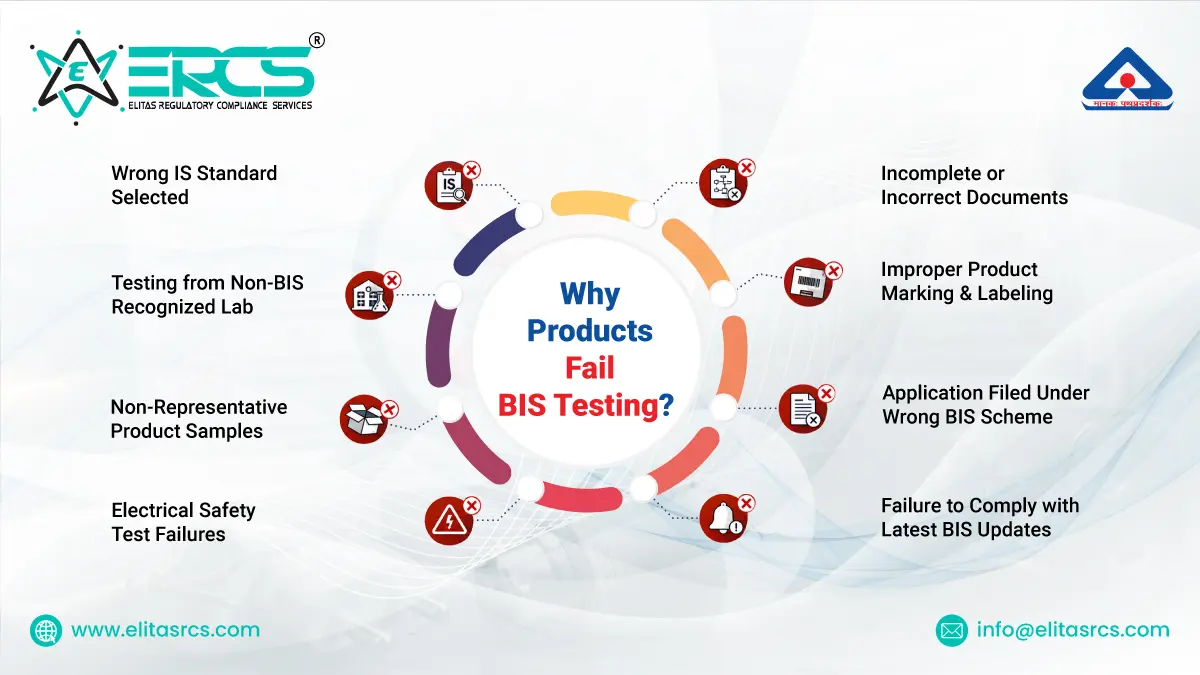
Products fail BIS Certification Testing for many reasons, such as poor documentation, incorrect selection of Indian Standard (IS) codes, mismatched labelling, or non-conformity in physical samples. To fix this, manufacturers and importers must cross-verify all forms using BIS-recognised laboratories for preliminary testing and ensure their products meet the technical requirements specified in the IS.
Product Testing is an important requirement for quality assurance. It assures that goods reaching the Indian market are safe, reliable, and in line with defined standards. The lack of testing poses the risk of defective or unsafe products reaching end-users, which may lead to product seizures, fines for manufacturers, and the destruction of brand identity. In this blog, we are going to discuss the reasons why products fail at testing and how you can fix them.
What is BIS Certification Testing?
ISI Mark Certification Testing is an important method to verify that a product meets the relevant Indian Standards (IS) established by the Bureau of Indian Standards (BIS) for safety, quality, and performance. This is an important part of the legal process for manufacturers who want to manufacture, import and sell products in India. Once the product has passed testing, the manufacturer can legally affix a certification to it, indicating that it has completed testing and verification. Foreign manufacturers under the FMCS Scheme and Domestic manufacturers face different problems throughout the testing. This is why hiring a consultant for your certification journey becomes important.
Common Reasons Why Products Fail BIS Testing
Lack of preparation or small errors frequently lead to product testing failures for many importers and manufacturers. Understanding common reasons for rejection helps businesses improve their chances of obtaining BIS certification.
Here are the most common reasons for BIS Testing product failures and exactly how to fix each one:
1. The Incorrect Indian Standard (IS) Code is Chosen
Using the incorrect IS code will result in your test failing or being rejected. Be sure you are using the appropriate standard for your product category.
2. Testing performed by a non-recognised laboratory
BIS only accepts reports issued by BIS-approved laboratories. If you conduct your tests in an unapproved laboratory, your report will be invalid.
3. Product sample is not from final production
If your product samples are prototypes rather than final production units, they may be rejected upon verification.
4. Electrical safety testing failure
Products can fail during BIS Electrical Certification testing due to overheating, leakage current, insufficient insulation, or poor wiring quality.
5. Incomplete or incorrect documentation
Failure to provide complete or accurately filled-in documentation can cause delays in your certification process and ultimately result in rejection of your application.
6. Incorrect product labelling or markings
Improper labelling of your product, incorrect ratings, or missing manufacturer information can result in your product failing to comply with BIS Certification requirements in India.
7. Applying under the wrong BIS scheme
Applying under an incorrect BIS Certification Scheme can delay your application, result in rejection, or require you to reapply.
8. Failure to keep up with regulatory changes
Failing to keep up with changes to BIS regulations and other regulations can limit your product's ability to comply with appropriate manufacturing standards.
How to Fix BIS Testing Failures?
If your product fails BIS testing, follow these steps to identify the cause, make corrections, and reapply successfully.
Here are the key solutions to correct product failure and get BIS approval:
- Identify the reason for failure: Take the time to read and understand the test reports, and determine which parameter or safety requirement did not meet the BIS standards.
- Make improvements to design or component quality: Use higher-quality raw materials and upgrade internal components, such as wiring and insulation, to meet the standard and pass BIS testing.
- Ensure correct product labelling and marking: It is correctly rated and includes the manufacturer's name.
- Ensure correct product labelling and marking: confirm it is correctly rated, includes the manufacturer's name, carries required warnings, and displays BIS-required markings, has the required warnings, and has the BIS-required markings.
- Update missing documents: Provide the BIS with an accurate, complete set of documents, including technical and factory information and all application forms.
- Have the product re-tested: After you have redesigned the product with improvements and have acceptable-quality-level parts, send the updated sample to a BIS-recognised testing laboratory for retesting.
- Obtain expert BIS consultation support: Working with a professional BIS consultant can help prevent you from repeating mistakes and can expedite your approval.
Best Practices to Avoid BIS Certification Rejection
Several techniques will help you to avoid BIS Certification Rejection:
- Deciding which IS Standard is Appropriate - Make sure you have selected the correct IS code for your product category before applying.
- Use a BIS-approved laboratory - Always conduct all of your product testing with the help of a laboratory accredited as BIS-recognised.
- Send Final Production Samples - Always send samples of the product you plan to produce from an actual production batch, rather than trial production samples.
- Ensure the Quality and Safety of your Products - Always use high-quality components and conduct your own internal safety assessments before submitting the product for official testing.
- Complete Documentation Accurately - Always thoroughly review your complete set of documents, including application forms, technical documentation, manufacturing plant information and all supporting documents.
Conclusion
To ensure product quality, safety, and legal compliance in the Indian market, manufacturers and importers need to have their products tested and certified in accordance with BIS standards. Delays or rejections occur when issues arise due to inadequate documentation, incorrect standards (as indicated by the product's component materials), labelling errors, or product safety concerns.
If you are experiencing difficulty, would like assistance with BIS testing, or want your certification application approved more efficiently, ERCS Private Limited can guide the process. Speak to our BIS experts; experienced consultants can assist with preparing the necessary documentation needed for testing and certification, coordinating testing at laboratories, submitting your completed application to the BIS and managing all aspects of your compliance with BIS requirements.