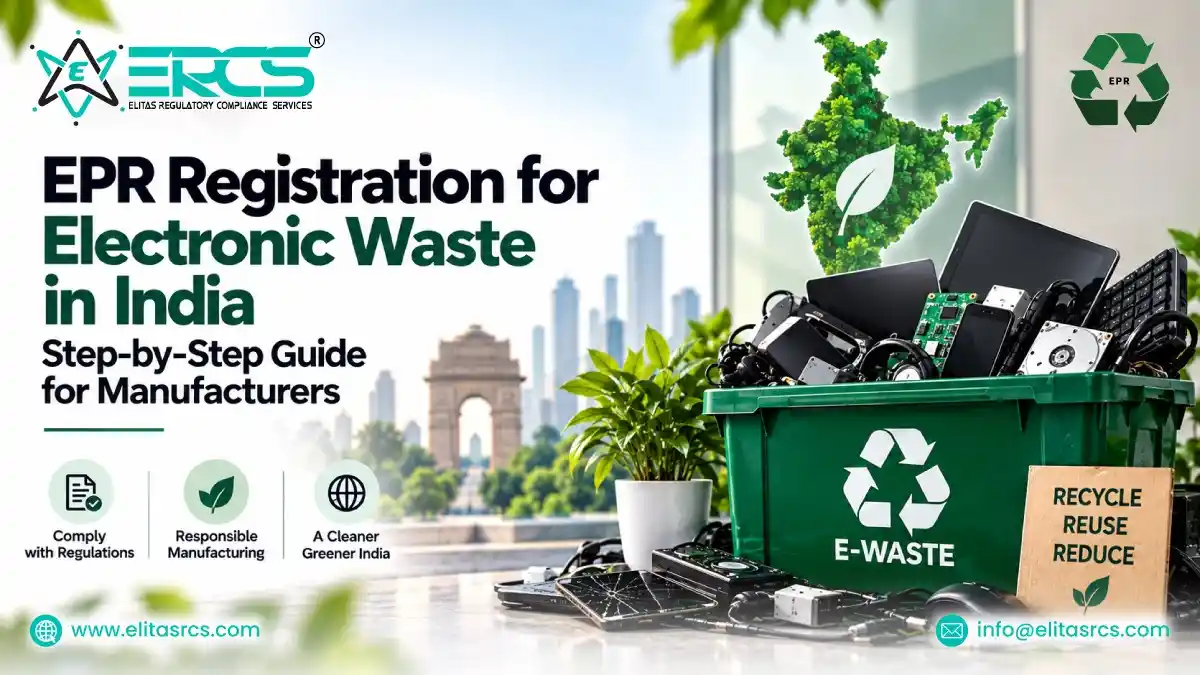
India produces more than 1.75 million tons of e-waste annually, and this number continues to rise at an alarming rate as products become obsolete much earlier than before. To address this burgeoning issue, the Ministry of Environment, Forests & Climate Change has introduced the E-Waste (Management) Rules, which require all producers, manufacturers, importers, and refurbishers of Electrical & Electronic Equipment (EEE) listed in Schedule I to register under EPR.
If you handle any type of electronic equipment, including mobile phones, laptops, home appliances, and IT hardware, your company must register on the CPCB’s centralised E-Waste Portal; failure to do so may result in penalties, including fines and other restrictions.
In this guide, ERCS Private Limited provides an overview of the entire EPR registration process for e-waste in easily understandable language. Whether you are registering for the first time or renewing your registration, you will be informed about everything related to EPR registration.
What is EPR Registration for E-Waste?
EPR (Extended Producer Responsibility) registration for e-waste is a statutory authorisation issued by the Central Pollution Control Board of India, under which businesses are held accountable for the life cycle of their electronic products. The process is regulated by the E-Waste Management Rules in India 2026, under which businesses ensure the proper collection, channelling, and recycling of their electronic products at end-of-life, rather than polluting the environment.
Step-by-Step EPR Registration Process (CPCB Portal)
Go through the following steps to know the steps to get EPR Registration for Electronic Waste in India
- Portal Access: File all applications through the eprewastecpcb. on the website only.in website only.
- Identification of Entity Category: The entity category can be Producer, Recycler, Refurbisher, or Manufacturer, as documents and validity vary by category.
- Submission of Part A & Part B: Part A contains company details, while Part B contains EEE product details.
- Submission of Company Details: Provide your company's corporate office address (the address from which sales across India are conducted), matching the enclosures.
- Upload EEE Details (Enclosure A): Upload details of EEE items for sale, along with the incorporation certificate and PAN. The quantities should be in Metric Tonnes.
- Signing of Compliance Declaration: It states that all the information provided is true and accurate. It also states that all EEE items comply with Schedule I of the Rules.
- Payment of Processing Fees: Pay the fee as per the CPCB fee structure (e.g., ₹10,000 for an amendment or addition of EEE items or a target revision).
- Evaluation of Application by CPCB & Queries Resolution: CPCB will evaluate your application in 25 working days; you need to respond to any queries within
Documents Required for EPR Registration for E-Waste
Below we have mentioned the list of mandatory documents required for EPR Registration in India for E-Waste:
- Proof documents of the Manufacturer/Importer.
- GST Certificate having the address of the manufacturing unit.
- Copy of the documents/certificate of the Company Registrar or the Directorate of Companies, or Import Export Code Letter.
- Copies of agreement documents with dealers, collection centres, dismantlers, recyclers, and treatment, storage, and disposal facilities (TSDFs).
- Self-declaration for RoHS compliance in the prescribed format.
- Technical Documents (Supplier declaration, Description of Product, Material/part/sub-assembly document and Analytical Test Result).
- Copies of the permissions/licenses from the relevant ministry/department for marketing various products or doing business as mentioned below:
- TIN details
- PAN details
- Incorporation certificate
- Copy of IEC in case of importers
- Copy of authorisation issued by the SPCBs/PCCs
- Documents about the EPR plan.
- Details of the proposed awareness programme and allied initiatives.
- Estimated budget allocated for Extended Producer Responsibility (EPR).
Common Mistakes to Avoid During Registration
Manufacturers and importers can keep a few important points in mind to avoid delays and rejections:
- Address Mismatch: GST, PAN, and incorporation documents should match the addresses on the portal.
- Wrong Entity Category: Mismatching producer/manufacturer/recycler/refurbisher causes selection of incorrect targets and registration.
- Incorrect Mapping in Enclosure A: Codes of EEE items must match the exact codes from Schedule I.
- Incorrect declarations of sales/import: Underestimating these figures lowers EPR targets and may invite a penalty.
- CA Certificate not available: Sales/import figures must be certified and accurately declared.
- RoHS declaration incomplete: The self-declaration generated automatically should be signed and submitted.
- Lack of recycler/PRO tie-ups: The incomplete, non-specific EPR action plan lacks evidence of such tie-ups.
- Delayed responses to CPCB queries: Clarifications must be provided within 7 working days.
Also know about the future scope of EPR Registration for Electronic Waste
How Long Does It Take to Get EPR Registration for Electronic Waste in India?
CPCB is required to take action regarding the producer's application within 25 working days from the date of receipt of the application through the portal. In case any question/clarification is asked by CPCB, the applicant is required to provide information/reply within 7 working days, following which the application is evaluated once again; an application not having complete details and consistent information can increase the period far beyond 25 working days.
According to most available sources, the process takes 30 to 60 working days from submission to issuance of the certificate, assuming all documents are complete and correct on the first attempt.
Conclusion
In India, EPR registration for electronic waste is no longer optional; it is mandatory for all manufacturers, producers, importers, and refurbishers of electrical and electronic equipment listed in Schedule I. Though the process is purely online and done via the CPCB EPR Portal, it requires detailed documentation, accurate product classification, and timely submissions. Even a minor mistake, such as a mismatch in address details or an incomplete Enclosure A submission, can cause delays in getting the registration approved or lead to outright rejection.
Having difficulties getting your EPR Registration for E-Waste done? Then ERCS Private Limited takes care of your EPR Registration process from beginning to end!