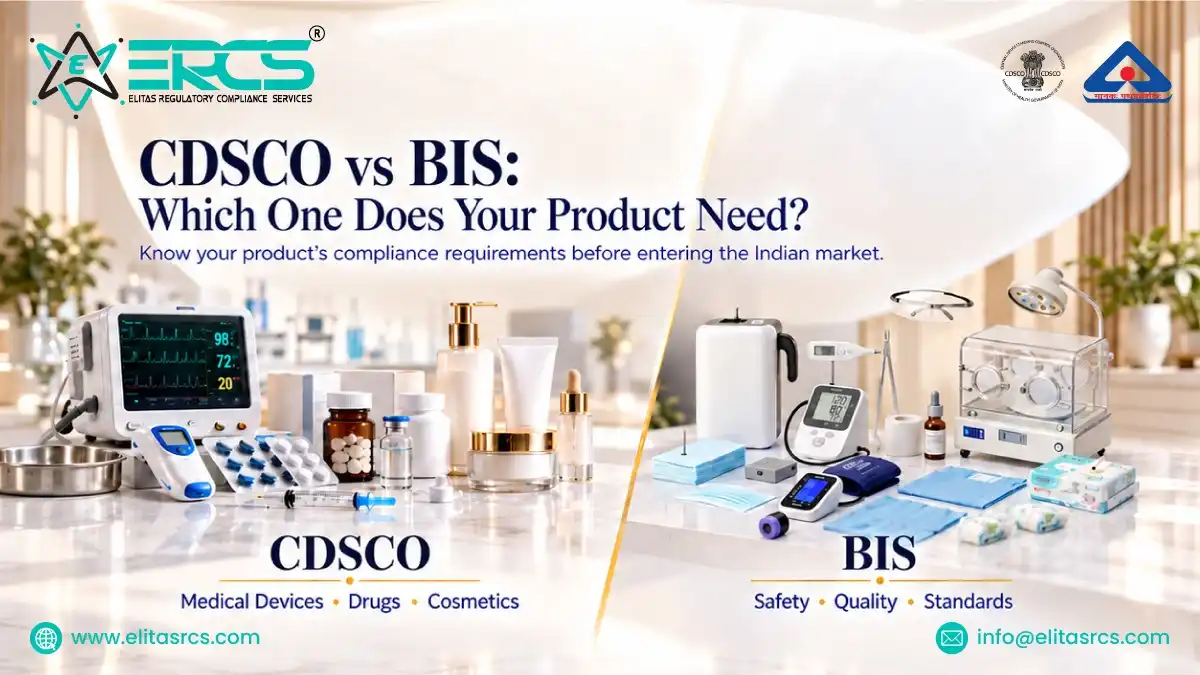
CDSCO registration and BIS approvals for your product would depend heavily on its primary use, as CDSCO serves as India’s official market gateway for healthcare, pharmaceuticals, and cosmetics, whereas BIS sets technical standards for general electronics, machinery, and consumer products. More importantly, some health-related products are dual-regulated and legally required to obtain both approvals before being sold or imported.
Choosing the wrong route is expensive. Shipments get held at customs, applications are rejected, penalties follow, and launch dates slip by months. In this Blog, ERCS Private Limited explains the difference between CDSCO certification and BIS certification.
What Are CDSCO and BIS Certifications?
CDSCO and BIS are separate approval processes. CDSCO certification ensures public safety by regulating healthcare products. BIS ensures consumer safety by ensuring that notified products conform to Indian Standards.
What is CDSCO?
CDSCO stands for the Central Drugs Standard Control Organisation, the government agency responsible for regulating the medicine, medical device, and cosmetics industries in India under the Ministry of Health & Family Welfare, Government of India.
- Regulated products: medical devices, diagnostic kits, drugs, and imported cosmetics.
- Criteria for evaluation: safety, quality and performance of the product.
- Regulatory framework: Medical Devices Rules, 2017; Drugs and Cosmetics Act, 1940.
- Approval process: License or Registration for manufacturing/importing, based on product/device classification.
What is BIS Certification?
Bureau of Indian Standards (BIS) is the National Standards Body in India. It is an autonomous body constituted under the BIS Act, 2016. BIS Certification India guarantees that the product conforms to the Indian Standard (IS) for quality & safety.
The product belongs to Quality Control Orders (QCOs) or the Compulsory Registration Scheme, including electronics, batteries, chargers, LED light bulbs, helmets, toys, footwear, etc. Some of the significant schemes are the ISI marking scheme (product certification), the CRS Registration scheme for Electronics/IT products & Hallmarking scheme (Precious metals). Compliance with Indian Standards (IS through testing in a BIS-recognized laboratory and/or Factory Inspection for some schemes.
CDSCO vs BIS: Key Differences at a Glance
|
Parameter |
CDSCO registration |
BIS |
|
Governing body |
Ministry of Health and Family Welfare |
Ministry of Consumer Affairs, Food and Public Distribution |
|
Legal framework |
Medical Devices Rules, 2017; Drugs and Cosmetics Act, 1940 |
BIS Act, 2016; QCOs and CRS |
|
Products covered |
Medical devices, IVD kits, drugs, imported cosmetics |
Electronics, batteries, chargers, LED lights, helmets, toys, footwear |
|
Main focus |
Safety and efficacy of health products |
Conformity to Indian Standards |
|
Type of approval |
Licence or registration |
ISI Mark Certification or CRS registration |
|
Testing |
Test reports; clinical data for higher-risk devices |
BIS-recognized lab testing |
|
Who applies |
Manufacturer, importer or authorised agent |
Manufacturer or authorised Indian representative |
|
Typical timeline |
About 2 to 6 months or more (varies by risk class) |
About 1 to 3 months (ISI can take longer) |
Which Products Need CDSCO Approval or BIS Certification?
The approval you need depends on what your product is and what it does. Health products go to CDSCO. Notified standard-based products go to BIS. Always confirm against the current notifications for your exact product. Products That Need a CDSCO Certificate.
CDSCO regulates products used for diagnosis, treatment, or affecting health.
- Medical Devices: syringes, BP monitors, glucometers, implants (Class A-D according to risk)
- IVD Kits: Glucose strips, pregnancy tests, diagnostic kits
- Medicines: manufacture, importation and sale of drugs
- Cosmetics: Import Registration for imported cosmetic products.
Products That Need BIS Certification
The items listed in BIS are those notified under QCOs and CRS.
- Electronics and IT Products: Smartphones, laptops, chargers, smartwatches, LED lighting
- Electrical Appliances: Cables, switches, fans, batteries
- Consumer Safety Products: Helmets, toys, footwear
- Industrial Products: Steel, cement, packaged drinking water
Can a Product Need Both CDSCO and BIS?
Yes, there are some products that definitely require approval from both CDSCO and BIS for legal sale or import into India. Such dual approval is generally required for products such as medical devices and cosmetics. CDSCO is responsible for regulatory and legal market gatekeeping for the manufacture/import/sale of the product, and BIS is responsible for ensuring the product meets quality, safety, and performance standards.
How to Decide: A Simple Checklist
Answer the following five questions to determine the certification required for your product.
- Is your product a drug, cosmetic or medical device?
Look up CDSCO. They govern healthcare products for safety and efficacy.
- Is your product listed in a BIS QCO or CRS list?
Look up BIS. The notified product must comply with the relevant Indian Standard.
- Is it electronic and serves a medical purpose?
Both could be applicable. CDSCO would govern its medical purpose, while BIS would govern its battery, charger, or adapter.
- Does it use wireless technology, or is it a packaged good?
Look up WPC (Wireless Planning & Coordination) for ETA approval for Bluetooth and Wi-Fi technology, and LMPC (Legal Metrology) for packaged goods (Packaged Commodities). For packaged food, add FSSAI.
- Can’t figure out which is relevant?
Get product classification done by a consultant before applying.
Need assistance with product classification? Take a free consultation with the ERCS team. → Get Free Consultation.
Common Mistakes to Avoid & How ERCS Private Limited Can Help
Most compliance delays come from avoidable errors. Here are the mistakes we see most often, and how ERCS Private Limited helps you avoid them.
Mistakes That Should Be Avoided
- BIS does not substitute CDSCO, and CDSCO does not substitute BIS.
- Incorrect risk classification leads to application rejections and rework.
- Only reports from BIS-approved labs will be accepted by BIS.
- Neglecting renewals and labelling requirements can result in halted sales and penalties.
- Using old notifications: QCO, CRS and device notifications keep changing frequently.
How can ERCS Private Limited assist you?
- Classification of products and regulatory mapping
- CDSCO registration and licensing assistance
- BIS approval and CRS registration
- Documentation & Testing assistance
- Coordination with authorities
- Renewals and regulatory updates