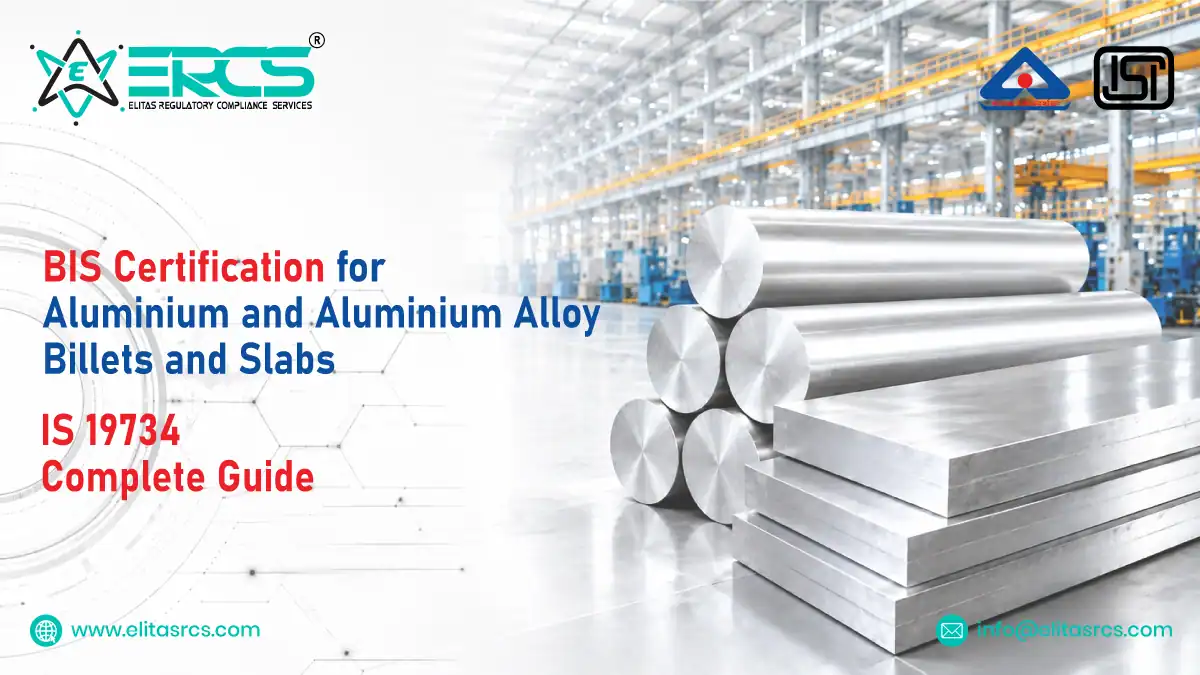
The Bureau of Indian Standards (BIS) has issued IS 19734, which shows specific requirements for aluminium and aluminium alloy billets and slabs. The purpose of this standard is to help manufacturers produce goods that consistently meet the quality and safety benchmarks established by the government and recognised nationwide as acceptable.
The Indian aluminium industry plays a vital role in the development of basic infrastructure and manufacturing industries in India. As a result, manufacturers can (directly or indirectly) manufacture aluminium and aluminium alloy billets, providing a wide variety of products for numerous industries. In addition, these billets and slabs can be used to manufacture a variety of other products, including automotive, aerospace, consumer, and industrial products. Maintaining appropriate quality and technical standards is crucial because billets and slabs are used in a wide variety of applications.
Scope of IS 19734 for Aluminium and Aluminium Alloy Billets and Slabs
IS 19734 provides guidelines for the requirements of Aluminium and Aluminium Alloy Billets and Slabs intended for further processing to create various aluminium products. Including manufacturing process, chemical composition, mechanical properties, dimensions, tolerances, quality, testing, inspection, sampling, and marking of aluminium and aluminium alloy billets and slabs.
The main objective of IS 19734 is to improve quality assurance through standardisation and the production of Aluminium and Aluminium Alloy Billets and Slabs used as raw materials in downstream manufacturing processes such as extrusion, rolling, forging, and fabrication, while meeting the increasing demand for high-quality aluminium products across different industrial sectors.
The standard applies to:
- Aluminium Billets
- Aluminium Alloy Billets
- Aluminium Slabs
- Aluminium Alloy Slabs
Why IS 19734 important for the Aluminium Industry?
IS 19734 is important for the Aluminium industry, as it helps build trust among manufacturers, suppliers, and customers by ensuring that materials meet consistent quality standards and can be used reliably across industries. IS 19734 sets clear requirements for factors such as chemical composition, dimensions, and quality, thereby making purchasing easier and helping maintain a smooth and reliable supply chain.
Many industries use aluminium billets and slabs as raw materials to manufacture finished products. The IS 19734 helps to ensure that these materials are suitable for processes such as extrusion, rolling, forging, and machining.
What is a Billet Under IS 19734?
A billet is a solid piece of aluminium (or metal) that is cast into a round (cylindrical) or rectangular shape. It serves as the raw material for making other products through processes such as rolling, forging, or extrusion.
- Solid Billet: A billet that is completely solid from the inside and has no holes or hollow sections.
- Hollow Billet: A billet that is manufactured with a hole running through its centre from one end to the other, which helps produce hollow products such as tubes and pipes more efficiently.
- Bored Billet: A solid billet in which a central hole is created by machining or drilling after the casting process.
What is a Slab?
A large, thick, rectangular block of aluminium or metal produced during casting that is processed into flat products such as plates, sheets, strips, and foils.
What is Homogenising Treatment?
Homogenising treatment involves heating aluminium billets and slabs for an extended period to ensure that alloying elements are uniformly distributed throughout the material, thereby improving quality and performance.
Dimensional Tolerances for Aluminium Billets and Slabs Under IS 19734
Manufacturing requirements for aluminium billets and slab dimensional tolerance as per IS 19734 are mentioned below:
|
Product Parameter |
Dimension Range / Measurement Requirement |
Permissible Tolerance / Specification |
|
General Size Requirement |
Billets and slabs |
Sizes shall be as agreed between the purchaser and manufacturer |
|
Round Billet Diameter |
≤ 200 mm |
± 1 mm |
|
> 200 mm |
± 0.5% of nominal diameter |
|
|
Diameter Measurement Method |
Measurement location |
At both sawn ends of the billet |
|
Measurement procedure |
Two diameter measurements taken 90° apart |
|
|
Billet Length |
≤ 1200 mm |
± 5 mm |
|
> 1200 mm to ≤ 2500 mm |
± 10 mm |
|
|
> 2500 mm |
± 15 mm |
|
|
Length Measurement Method |
Length determination |
Measured overall after sawing |
|
Slab Width |
≤ 800 mm |
+7 mm / -4 mm |
|
> 800 mm to ≤ 1300 mm |
+10 mm / -5 mm |
|
|
> 1300 mm |
+15 mm / -10 mm |
|
|
Slab Thickness |
≤ 200 mm |
± 2 mm |
|
> 200 mm to ≤ 450 mm |
± 3 mm |
|
|
> 450 mm |
± 5 mm |
|
|
Purchaser-Specific Requirements |
Billets and slabs |
Alternative tolerances may be specified by mutual agreement between the purchaser and the manufacturer. |
Chemical Composition Requirements Under IS 19734
To ensure the consistency and quality of aluminium and aluminium alloy billets and slabs, IS 19734 specifies requirements for chemical composition and testing, which involves:
- Aluminium and aluminium alloy billets must comply with the chemical composition requirements specified in IS 733 or IS 5082.
- Aluminium and aluminium alloy slabs must comply with the chemical composition requirements specified in IS 737.
|
Heavy Metal |
Maximum Permissible Content |
|
Mercury (Hg) |
0.1% |
|
Lead (Pb) |
0.1% |
|
Hexavalent Chromium (Cr⁶⁺) |
0.1% |
|
Cadmium (Cd) |
0.05% |
To verify compliance, the composition of materials must be tested in accordance with IS 504 (Parts 1–16) or IS 11035, or any other established chemical method. In the event of any disputes regarding test results, the procedures specified in IS 504 will serve as the reference. If no testing method is provided in IS 504, the manufacturer and purchaser may agree on an appropriate referee method.
Retesting, Packaging, Marking, Labelling, and BIS Certification Requirements for Aluminium Billets and Slabs
Before aluminium billets and slabs are sold in the Indian market, they must comply with BIS Certification requirements to ensure product quality and compliance.
- Retest: First, the samples are tested for chemical composition; if the results do not meet the required specification, two more samples will be tested. If either of them fails in testing, then they are rejected to maintain quality and standards.
- Packaging Requirements: The material must be packed according to IS 10259.
- Product Marking: All billets and slabs must be marked clearly with the Cast Number/Heat Number and Alloy Grade
- Labelling Requirements: All billets and slabs should carry a label including the Manufacturer Name, Alloy Grade, Billet/Slab Size, Number of Pieces, Net Weight, and Gross Weight
Key Benefits of Compliance with IS 19734
Manufacturers can get a variety of advantages when they acquire ISI Certification India for their aluminium alloy billets and slabs:
- The quality of all aluminium billets and slabs will remain consistent over time through proper quality control.
- Customers will have more trust in the manufacturer by fulfilling the applicable quality requirements and complying with the applicable Indian Standards for their products.
- Defects and rejection rates during production processes will be significantly reduced.
- Material waste will be greatly reduced, and the total cost of aluminium production will decrease due to lower production levels.
- Product performance, safety, and durability in end-use applications will improve substantially.
- The aluminium sector will strengthen its market position and enhance its credibility.
- Manufacturers will have an advantage over other aluminium manufacturers.
Final Thoughts
The Aluminium industry relies on IS 19734 to establish a common grade standard, helping build confidence among raw material suppliers by ensuring consistent quality for materials used in many manufacturing and engineering processes. Businesses that manufacture or supply aluminium billets or slabs need to be aware of the requirements of IS 19734 and obtain BIS Certification to maintain a competitive advantage and ensure long-term market expansion for their aluminium production and/or supply operations. If you need assistance with obtaining BIS Certification for aluminium alloy billets and slabs.