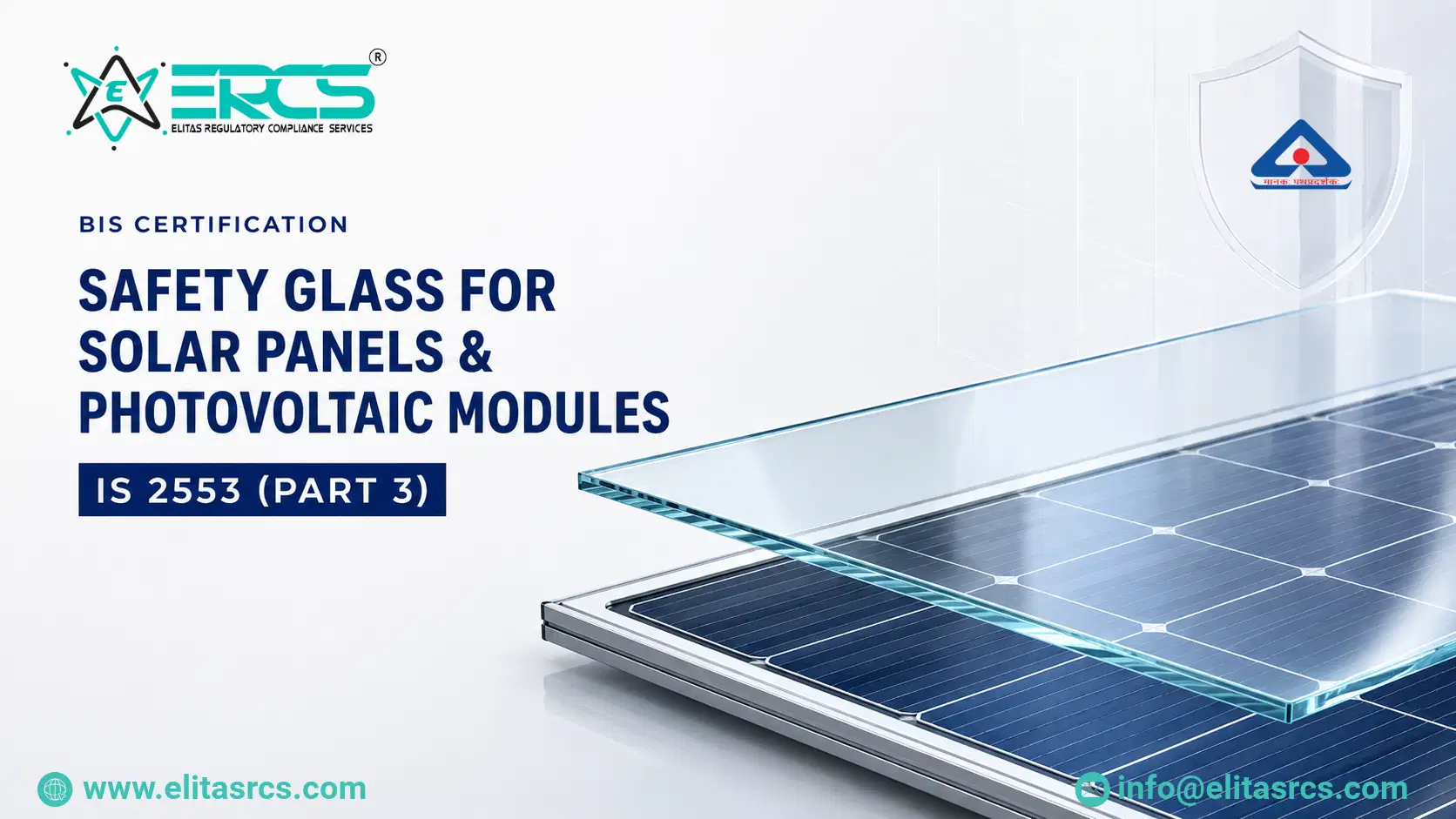
The BIS Certification of Safety Glass Specification for Solar Panels and Photovoltaic Modules is mandatory in the Indian Market. With growing renewable energy capacity in India and the nation's increasing solar energy goals, authorities have become stricter about the quality of products used across the PV value chain. Using solar safety glass without the ISI Mark puts the business at risk of penalties, shipment detention, and disqualification from government tendering and subsidised solar projects.
Safety glass is a key material used in the manufacture of solar panels and photovoltaic (PV) modules. Safety glass is the front protective surface in a PV module and protects the solar cells from various external forces while ensuring maximum light transmission to the solar cells. The IS 2553 (Part 3): 2019 Safety Glass Specification, Part 3: Solar Applications, was formulated by the Bureau of Indian Standards (BIS). The standard was first formulated in 2019 and reaffirmed in February 2026 by BIS as part of the mandatory standards review process.
Key Highlights of IS 2553 (Part 3): 2026
The performance and quality requirements for safety glass intended for solar panels and photovoltaic modules in India are detailed in IS 2553 (Part 3): 2026 – Safety Glass Specification for Solar Panels and Photovoltaic Modules. It covers the technical details, performance criteria, testing procedures, and quality criteria that manufacturers should follow to ensure that safety glass for solar panels meets high standards of quality and reliability.
|
Parameter |
Key Highlights of IS 2553 (Part 3): 2026 |
|
Standard Name |
Safety Glass – Specification for Solar Panels and Photovoltaic Modules |
|
Indian Standard |
IS 2553 (Part 3): 2026 |
|
Product Covered |
Safety glass intended for use in solar panels and photovoltaic (PV) modules. |
|
Objective |
To establish uniform quality, safety, optical, and performance requirements for solar safety glass. |
|
Glass Type |
Covers processed safety glass such as toughened/tempered glass suitable for solar applications. |
|
Primary Function |
Protects photovoltaic cells while allowing maximum transmission of solar radiation. |
|
Mechanical Performance |
Requires adequate mechanical strength to withstand external loads, impact, and handling conditions. |
Latest BIS Updates on IS 2553 (Part 3): 2026
Revisions to IS 2553 (Part 3): 2026 relate to the initial revision of the standard for safety glass for use in solar energy applications, covering testing methods, strength properties, and the quality of solar panels.
- IS 2553 (Part 3): 2026 is the latest revision of the Indian standard for safety glass for solar panels and PV modules.
- The revision offers technical specifications to make sure that the safety glass is high-quality, durable, and safe.
- The standard covers safety glass for solar panels, photovoltaic modules, and solar flat plate collectors.
- The standard is developed by the Glass, Glassware and Laboratoryware Sectional Committee (CHD 10).
- The standard contains test specifications relating to dimensional tolerance, flatness, fragmentation, impact resistance, and mechanical strength properties.
Technical Requirements under IS 2553 (Part 3): 2026
The technical requirements mentioned under IS 2553 (Part 3): 2026 are as follows:
- Strength: Ability to withstand impact due to extreme weather conditions, hailstones, and mechanical stress.
- Durability: Resistance to UV radiation, thermal variations, and humid environments in the long run.
- Transparency: High level of light transmission to guarantee optimal energy efficiency.
- Tests: Sample products should undergo strict mechanical and optical tests in BIS-accredited laboratories.
- Factory Tests: Manufacturers should have passed initial and periodic factory tests conducted by BIS.
- Certification: Approved products should be authorised to use the ISI mark.
BIS Certification Process for Safety Glass under IS 2553 (Part 3): 2026
The process for receiving a BIS Certification Scheme-1 has 5 basic steps:
1. Application Submission: The manufacturer will submit their application through the BIS Online Portal. You must also send a signed copy of your application for verification.
2. Document Preparation: The documents requested in the application must be prepared in accordance with IS 302 Part 1 (IEC 60335-1).
3. Inspection: BIS will perform an inspection of the manufacturer's facility to determine whether the production is acceptable, and the BIS officer will seal the product sample.
4. Testing Products: Sealed samples of the product shall be sent for testing to BIS Laboratories.
6. ISI Mark Granting: Once both testing and inspection are completed, the manufacturer will receive their certificate and a copy of their ISI mark from the BIS.
Indian and foreign manufacturers need to complete the following steps to receive their BIS certification:
- BIS Certification Process for Indian Manufacturer
- BIS Certification Process for Foreign Manufacturer
Documents Required for ISI Certification of Safety Glass for Solar Panels and Photovoltaic Modules
The documents required for BIS certification of safety glass for solar applications (under IS 2553 Part 3) or photovoltaic modules include:
- Company Incorporation Certificate / Business Registration Certificate
- GST Registration Certificate (for Indian manufacturers)
- Factory/Manufacturing Licence
- Complete Factory Address Proof
- Trademark Registration Certificate (if applicable)
- Authorisation Letter for the Authorised Signatory
- Manufacturing Process Flow Chart
- Factory Layout Plan
- List of Manufacturing Machinery
- List of In-house Testing Equipment
- Calibration Certificates of Testing Instruments
- Product Technical Specification Sheet
Benefits of ISI Mark Certification for Safety Glass Manufacturers
The key advantages of obtaining ISI Mark Certification for Safety glass specifications for solar panels and photovoltaic modules are as follows:
- Legal Authorisation: Allows you to legally manufacture, sell, and distribute safety glass in India under government quality orders.
- ISI Mark Usage: Grants the right to stamp products with the ISI mark, proving adherence to national safety codes.
- Avoid Penalties: Prevents heavy fines, stock seizures, and legal actions from regulatory authorities
- Tender Eligibility: Qualifies your glass products for major government, architectural, and automotive tenders that require certified materials.
- Consumer Trust: Boosts buyer confidence by proving your glass withstands strict impact, thermal stress, and fragmentation tests.
- Reduced Defects: Forces high manufacturing benchmarks that lower product failure rates over time.
Challenges Faced by Manufacturers During BIS Certification of Safety Glass
Some of the common difficulties experienced during the certification include:
- Manufacturers have to ensure that the products comply with IS 2553 (Part 3): 2026. Failure to do so leads to test failures and delays in the certification process.
- Safety glasses should undergo mandatory BIS performance and safety tests. Products failing the tests must be improved and retested.
- Inaccurate and incomplete documentation might delay the process of BIS applications and approvals.
- Consistency in manufacturing quality is important to comply with BIS standards for each batch produced.
- Manufacturing plants and quality control processes need to be ready for BIS inspection.
Conclusion
BIS Certification under IS 2553 (Part 3): 2026 is critical for the safety and quality of safety glass used in solar panels and photovoltaic modules. This will help manufacturers and importers meet BIS requirements and improve product credibility in the Indian market. ERCS Private Limited can provide full assistance in the process.
Please contact our professionals now to obtain certification without any hassles.