The demand for certified safety glass in India is rising rapidly with the growth of the infrastructure, real estate, and automotive sectors. The Bureau of Indian Standards (BIS) has made it mandatory for all safety glass products used in India to comply with IS 2553 Part 1. This includes products imported from countries like Italy, which is known for its high-quality architectural glass manufacturing.
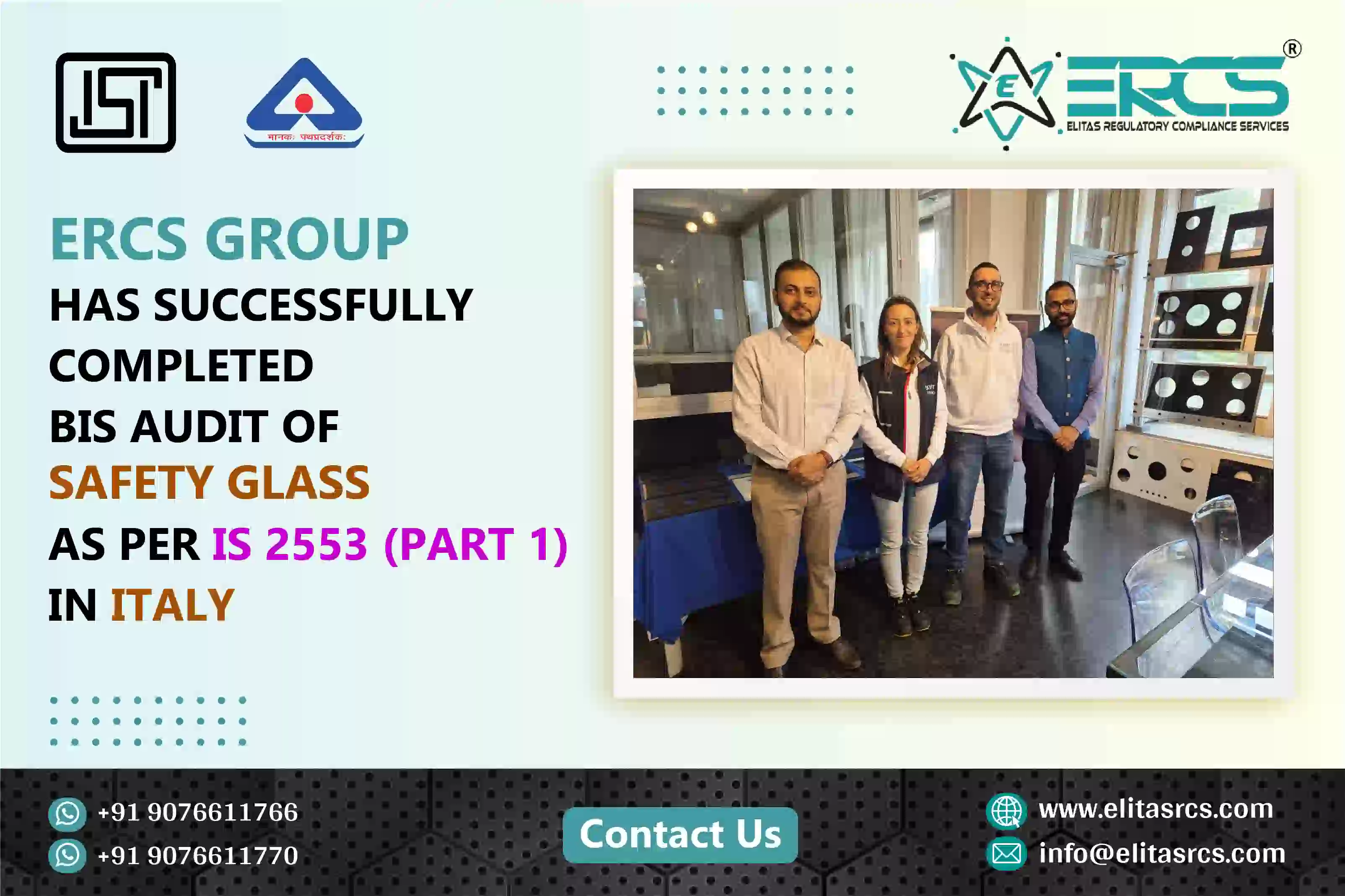
At ERCS Pvt. Ltd., we take pride in facilitating global compliance for manufacturers entering the Indian market. One of our recent engagements involved the successful coordination of a BIS Audit for safety glass manufacturers in Italy, ensuring compliance with the Indian Standard IS 2553 Part 1. This certification is critical for any foreign manufacturer wishing to export safety glass to India.
What is a BIS Audit?
BIS Audit is a systematic evaluation conducted by BIS or its representatives to ensure:
Compliance with IS 2553 Part 1.
- Existence of quality management systems.
- Adherence to labeling, testing, and traceability protocols.
- Factory capability to consistently produce standard-compliant products.
BIS Audit Process for Safety Glass Certification under BIS:
- Application Submission (for foreign manufacturers via Authorized Indian Representative).
- Document Review (test records, quality checks, production flow).
- Factory Inspection (either in India or in Italy for importers).
- Sample Testing (at BIS-recognized labs).
- License Granting (for using the ISI mark after successful compliance).
Role of ERCS Pvt. Ltd.
As a technical consulting firm, ERCS Pvt. Ltd. specialises in managing end-to-end BIS certification projects, especially for international clients. In this case, we managed the BIS audit for an Italian safety glass manufacturer exporting to India.
Our Support Included:
- Appointing an Authorized Indian Representative (AIR).
- Coordinating all documentation and submissions.
- Training the client on Indian regulatory requirements.
- Arranging for pre-audit quality control checks.
- Liaising with BIS officials throughout the audit process.
- Ensuring that all product and packaging requirements meet IS 2553 Part 1 standards.
Italy and Its Link to BIS Certification:
Italy is a global hub for advanced glass manufacturing technologies. With companies specialising in architectural, laminated, and tempered glass, Italian products are highly regarded for quality and innovation.
Why Italian Glass Needs BIS Certification?
Mandatory for Indian Imports: No glass product under IS 2553 Part 1 can be imported without BIS certification.
Different Standards: While Europe follows EN 12150 and EN 14449, these do not automatically satisfy Indian regulatory requirements.
Expanding Indian Market: India’s booming construction and infrastructure sectors offer new opportunities for certified glass suppliers.
How Italian Manufacturers Get BIS Certified:
- Appoint an Authorized Indian Representative (AIR).
- Undergo the BIS Foreign Manufacturers Certification Scheme (FMCS License India).
- Demonstrate equivalence or superior compliance with Indian standards (even if already certified under European EN standards).
Challenges Faced:
- Different standards: IS 12150 vs IS 2553.
- Translation and documentation for Indian authorities.
- Factory audits across borders (language and logistical issues).
Strategic Considerations:
- Joint Ventures: Indian-Italian glass manufacturing partnerships could localise production and reduce dependency on imports.
- Dedicated Compliance Teams: Investing in dedicated BIS compliance staff can help global companies speed up certifications.
- Awareness Campaigns: ERCS proposes organising workshops in Europe to educate manufacturers about BIS processes and opportunities in India.
- Export Potential for Italian Glass: India’s growing real estate market = increasing demand for high-end safety glass.
- Knowledge Transfer: Italian firms could collaborate with Indian manufacturers for local production to Italian standards.
- Policy Support from Indian Govt: Incentivising European companies through simplified BIS procedures for faster market access.
Conclusion:
With our experience and expertise at ERCS Private Limited, we ensured that the Italian manufacturer successfully passed the BIS Audit under IS 2553 Part 1. This certification opens the door to one of the world’s fastest-growing construction markets. For international glass producers, aligning with Indian safety and quality standards is not only mandatory but also a smart move toward global market expansion. At ERCS, we continue to act as the trusted partner for foreign manufacturers seeking smooth, efficient, and result-oriented BIS certification.